[?] Subscribe To This Site

XML RSS
Add to Google
Add to My Yahoo!
Add to My MSN
Subscribe with Bloglines


Home
Cat Breeds A-Z Photos of Breeds A-H
Photos of Breeds J-P
Photos of Breeds R-T
More Cats & Facts Fringe Cat Breeds
Wild Cats
Feral Cats
Cat Facts
Breeds Categorized
Rare Cat Breeds
Domestic Cat Size
Cats and Law
Cat History
Cat Health
Cat Appearance
Choose cat breed
Cat News
Cat Food
Declawing Cats
Cat Anatomy
Fun and Cats Cat Videos
Cartoon Cats
Pictures of Cats
Warrior Cats
Top 5 Breeds Maine Coon
Traditional Siamese
Modern Siamese
Bengal Cats
Abyssinian
Persian start here
PoC Admin + POC Updates
PoC Admin
Helmi Flick Photo
PoC Site Map

Chinese Mountain Cat

Chinese-Mountain Cat

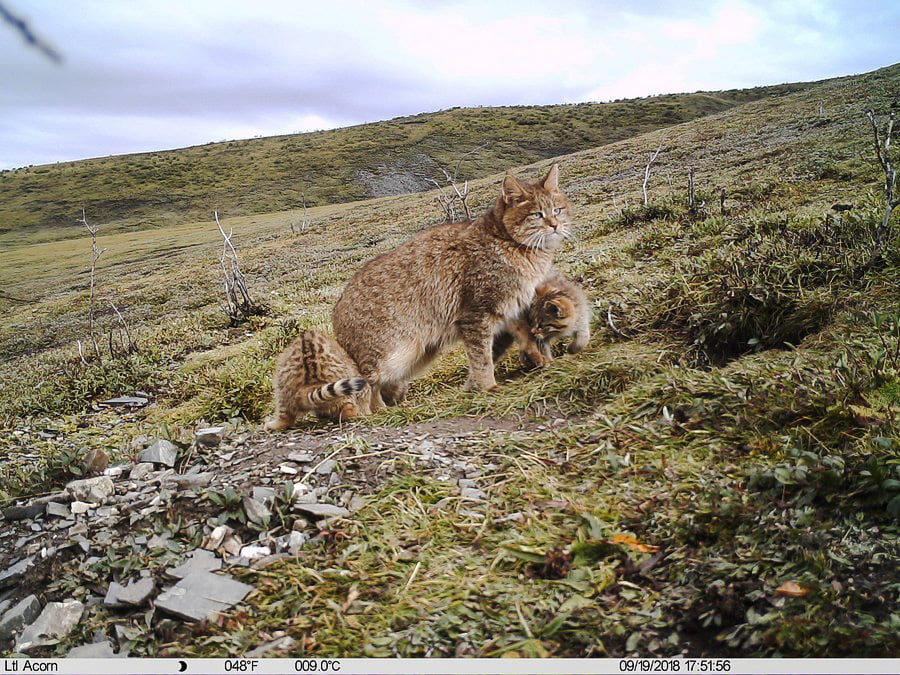
Chinese Mountain Cat – photograph copyright Jim Sanderson Ph.D – please respect copyright. Jim Sanderson is a cat specialist and he and Tibetan assistants obtained this rare picture of this wild cat species from a set the camera trap near the remote village of Rongrah. They chose the spot for the camera having heard stories of a sighting by villagers. The pictures are shown here with the permission of Jim Sanderson. Jim works with the Wildlife Conservation Network and he led the team of people who organised the capturing of this rare photograph.

In recognition of Jim’s generosity and commitment in helping to research this rare wildcat I have donated $50 to the Wildlife Conservation Network (see Pictures of Cats org Donations), with the suggestion that it be used to further support research into this cat.

Chinese-Mountain Cat

This is a captive Chinese Mountain cat (believed photo copyright Jim Sanderson). The picture shows that this cat is somewhat similar to the domestic cat except of course for the wild appearance. Its appearance is also like the Scottish Wildcat or European wildcat except for the fur, which is a threat to its existence (it is hunted for its fur).

This cat is also known as the Chinese desert cat and its scientific name is Felis bieti. This cat is between 27 and 33 inches in length (excluding tail) plus a tail of between about 11 and 16 inches. As to weight, this ranges between 10 and 20 lbs (4.5 to 9 kgs), which puts it in the same size range as the large domestic cats (see Largest Domestic Cat Breed) but it is said to be about twice the size of a domestic cat by the Sunquists (Wild Cat Of The World).

The cat’s fur is sand coloured as can be seen in the picture. This is a brown tabby cat (the best form of camouflage). The tail is very thick with distinctive stripes.

This cat species first came to our attention in 1889, apparently, when members of a scientific expedition discovered it. The discovery, though, was not of a live cat but skins on sale. Plus ca change. It is felt that the Chinese mountain cat is related to the better known jungle cat, sand cat and eurasian wildcat.

IUCN Assessment

Jim Sanderson say that, "Pandas…are very well protected by Chinese law, but there is virtually no protection for this cat….There's no interest in its conservation because it's poorly known, but now perhaps this will change." (src: National Geographic News)

Apparently, the Chinese Mountain Cat is protected in China but is poisoned by people either through reckless use of poison to kill its prey the pika (see below), which also endangers survival through loss of prey.

pika

Pika, the prey of the Chinese Desert Cat. The Pika is also called a 'rock rabbit' and is the smallest member of the rabbit family. Photo by DavidQuick

The IUCN Red List for Threatened Species™ do not list this cat. I presume because there is insufficient data on it. This is a shame as it was “first described in 1892” (src: Wikipedia). We have had over 100 years to research and conserve. Isn’t it time now to list it in the light of Jim’s research? I find it odd that this is the only wildcat not listed by the Red List (or have I got that wrong?).

This cat’s fur is prized, which makes it vulnerable.

chinese-mountain-cat-10

Camera trapped Chinese Mountain Cat.

Habitat

All we can say is that the picture heading this page was taken in Sichuan Province, China at about 12,300 feet above sea level (3,750 meters) on the edge of the Tibetan Plateau.

This province is marked by the blue flag on the map below


Map Channels: free mapping tools

The map above comes from a Google My Map that I created from the assessment of the Sunquists. It probably needs refinement and if you would like to try, please go to the original map here: Chinese Desert Cat Range (new window).

The cat’s thick fur indicates that this cat lives on high ground. Here is a map of the area where the photograph was taken:

Sichuan Province

Sichuan Province is in the west of China near Tibet. I suspect the terrain to be quite harsh. The rock rabbits (its prey mentioned above) will tell us a bit about the habitat of the Chinese Desert Cat. The Pika lives in cold climates. “Most [Pika]..live on rocky mountain sides, where there are numerous crevices to shelter in, although some also construct crude burrows” (src: Wikipedia). The fact that this cat’s name is also Chinese Desert Cat also gives clues as to the barren terrain.

Perhaps the height at which this cat lives is an indication as to intrusive human activity, but that is speculation on my part.

From Chinese Mountain Cat to Wild Cat Species

Sources:

  • National Geographic News
  • IUCN Red List for Threatened Species™
  • Wikipedia®

Photo of Pika: published under a Attribution-NonCommercial-NoDerivs creative commons License -- this site is for charitable purposes in funding cat rescue.


footer for Chinese Mountain Cat page