
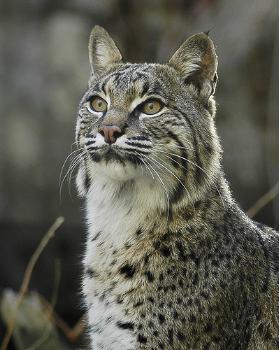
American Bobcat copyright ucumari
Overview
The name is the “bobcat” because of the bobbed (shortened) tail. “American bobcat” is commonly used. This is the most common wild cat species of North America which with Mexico and Canada is its geographic range. This wild cat is one of four of the Genus: lynx. The others are Canada lynx, Eurasian lynx and Iberian lynx. The bobcat is a relative of the Canada lynx.
It is about the size of a cocker spaniel. Its fur is thick and soft, which has made it desirable as a commercial product. The bobcat is similar to the Canada lynx in appearance. The bobcat is adaptable and is found, therefore, in a wide range of habitats including forests, swamps, sagebush grassland, brushland and agricultural forest. The bobcat shares habitat with the puma and coyote. Pumas occasionally kill bobcats. The bobcat mainly feeds on hare and rabbit but also preys on deer and beaver depending on the region.
Taxonomy
| Kingdom | Phylum | Class | Order | Family |
| ANIMALIA | CHORDATA | MAMMALIA | CARNIVORA | FELIDAE |
Scientific Name: Lynx rufus (Schreber, 1777)
Other non-scientific names are: bay lynx, lynx cat, red lynx, chat sauvage.
Description
I have a page on the description of the bobcat. This is a wildcat with a tanned coat and spots. Larger males weigh up to 29 lbs (13.2 kg). Females can be quite small at 13 lbs, the weight of a domestic cat.
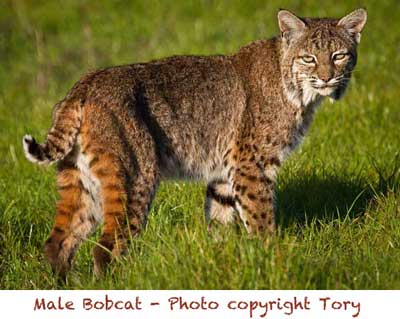
Habitat – Ecology
There is a range map below. The American bobcat is found from southern Canada to central Mexico and is most common in the western states of the USA. It lives in a wide range of habitats: forests, mountains, semi-deserts and subtropical swamps.
Bobcats live in dens that are in rocks, hollow trees and bushes etc.
The wide range of habitats leads to a similar range of prey items. The American bobcat feeds on: rabbits (60-65%), rodents (20-25%), reptiles and insects (2%). Prey includes: deer, beaver, prairie dogs, bats, snakes, bettles, grasshoppers, porcupines, birds, domestic cats, dogs, sheep, poultry, goats and fruit such as apples and pears.
