
Overview: The distinguishing feature of this cat breed is the ears which curl backwards due to a genetic mutation. Other than that, this is a breed that is moderate in all areas. This cat can be either long or shorthaired and is seen in all color categories, all divisions and all colors. The breed started in 1981 in the USA. This cat loves human companionship and is smart and curious.

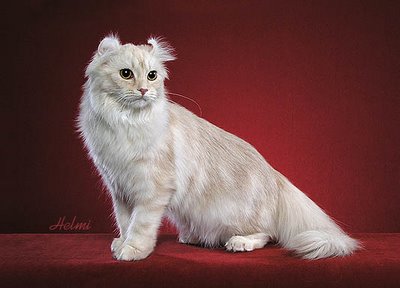
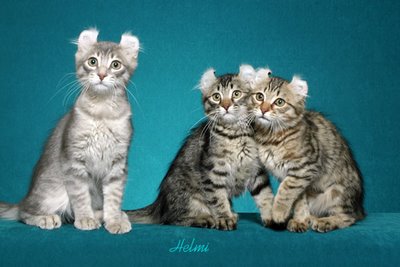
The photos below of purebred American Curls are copyright Helmi Flick.
Introduction
The thing to talk about is…..well yes, you guessed, the ears. Like many other breeds (including, for example, the dwarf cat) the difference in the ears is due to a genetic mutation that happened naturally. The mutated gene is dominant, so in mating with, for example, a domestic cat that has normal ears, at least half the litter will have curled ears.

But they won’t have curled ears on birth. It takes about 2-10 days after birth for the ears to curl back. They curl and uncurl until they firmly settle into the curled position at about 4 months of age. So far, it seems that no harmful defects have been associated with this gene. In other words this gene has no other effect on the formation of the cat after conception that is detrimental to the cat. This is not always the case. See for example the Manx cat health.
This cat breed may be long or short haired. The body what is called semi-foreign in conformation (cat body types). This is a sweet-tempered cat2. The American Curl is recognized by TICA, CFA, AACE and AFCA (see breed standards).
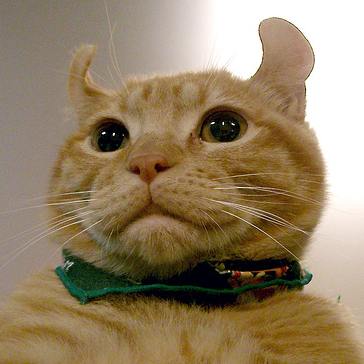
Above: This is probably a pet quality Curl. Below: another American Curl of unknown origin but the cat has the gene which curls the ears backwards.
Origin
The founding cat of the American Curl was called Shulamith. She was a long haired black cat with, of course, curled ears. Both she and another (who was called Panda) walked into the life of Joe and Grace Ruga in Lakewood, California (see map below) in the summer of 1981.
Panda disappeared while Shulamith stayed and half of her first litter of kittens had curl eared, confirming the dominant gene. The gene is also autosomal. Selective breeding began in 1983 and the breed was first registered with the C.F.A. in 1983. See Cat History for lots more on all the cats.
History
- 1981 – American Curl “discovered” in USA
- 1983 – Selective breeding began
- 1983 – Shown at a cat show for the first time
- 1986 – First registered with CFA
- 1987 – TICA grant full championship status to the American Curl
- 1989 – Robinson of “Robinson’s Genetics for cat Breeders and Veterinarians”, declares that there are no defects with this genetic mutation that causes the curled ears
- 1993 – First breed to be admitted into long and shorthair classes by CFA
- 1993 – CFA grant championship status to this breed (provisional status granted in 1991)
This breed is found across the world in the United States, Spain, France, Japan, Russia, and many other countries. Waffle in Catscratch an American animated television series, is one of the cat characters and an American Curl.
Appearance and Character
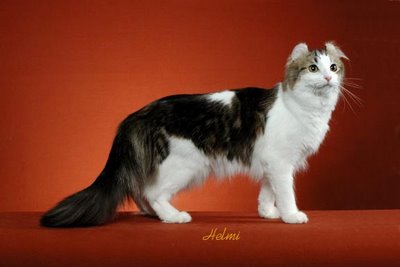
This is a medium sized, intermediate shaped cat of moderate proportions weighing about 3 to 5 kgs (7 to 11 lbs – see cat breed weights). There are no extremes1 (except for the ears). This cat should not be “massive or heavy”1. The head is a “modified wedge”. This means wedge shaped (as is to be expected) but modified by the general contours of the head and not entirely symmetrical. The nose is straight in profile. From people who have kept this cat he or she has proved to be a medium energy cat and good “all rounder”; in short a nicely balanced and even tempered cat. In addition to the curled ears the semi-longhaired cats of this breed have great long haired, full, plumed, tails (see above).
The coat is not a double coat (“little undercoat”1) so it is silky and easier to maintain. It lies flat to the body. By out-crossing to domestic cats matching the breed standard the gene pool has been kept wide and healthy. This also means that there are a wide variety of coat types (long and short hair) and colors. Indeed the American Curl can be seen in any color and pattern. The breed is also mated with other cats of the same breed resulting in all the litter having curled ears. Being a dominant gene, when bred to a cat of a different breed at least half the litter has curled ears. Through careful breeding and the benign nature of the mutated gene causing the curled ears this breed has no inherent propensities to certain illnesses and her temperament is good.
Any colour that TICA recognizes is acceptable for the American Curl. These will include: Self and tortie, smoke, shaded and tipped, tabbies (all types), silver tabbies (classic and mackerel), bi-colours (classic and Van), tabby bi-colours, self and tortie points, lynx (tabby) points2. As to character this is an intelligent, curious cat that “craves human contact”. The are neither vocal like the Siamese nor quiet like the Pixie-bob– just nicely in between. They are adaptable cats. Dr Bruce Fogle describes them as “quietly affable”.
The Ears
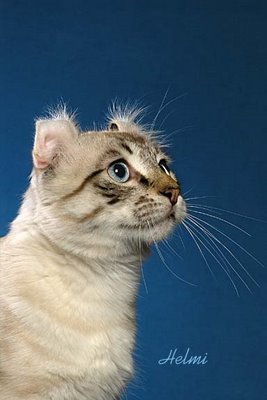
As it takes about 16 weeks for the ears to form their permanent position a breeder can only tell if the cat will be show quality after this period. The amount of ear curl varies a lot from nearly straight to the full show cat curl. If the ears are straight the cat is naturally not going to win competitions and indeed would fall foul of the breed standard. The ears are therefore very important to the American Curl breeder. Nicely curled ears should be handled with care. There are three “grades” of ear curl:
- First degree: Ears that are just turned back – these become pets;
- Second degree: more curl – used for breeding;
- Third degree – half crescent curl – show cats.
The ears and eyes are quite large. Perhaps a critical look at the ears will prove useful as they are the feature that sets this cat apart from all others. The American Curl Breed Group says (and I paraphrase) that the ears should be pleasant to look at (of course:). If there are depressions in the ears the cat would be penalized in competition. The ears should curl at least 90% (I’m not sure how you measure this accurately). But if the ear curls too much and touches the back of the head the cat will be disqualified in competition.
This is just an example to show you how technical and scientific the subject of ears can be for this show cat. It is essential that the curve should be smooth (to be aesthetically pleasing). Ear hair (“furnishings”) are a bonus (my words). You can see a large format slide show with more on the CFA breed standard and some more photographs on this page.
Breeders
At early 2008, there are no free standing cattery websites listed by Google in the first 3 pages for the American Curl. If you’d like to be listed here please contact me.
Update July 2010: CFA breeder search – click on this link and then the continue button and select American Curl.
Procurl Harem – NY, USA.
Samoa Gem’s American Curl Cats (link busted June 2015) – Rudi and Eurica Teichmann from Moorreesburg 100 km north of Cape Town. Nice to see this. It is unusual to see an individual breeders site listed well on a Google.com search.
Notes:
1. Legacy of the Cat by Gloria Stephens
General Sources:
- Wikipedia
- Breeder sites
- Breedlist
- American Curl Breed Group
- Cat Fanciers
- CFA
- Me

Thanks Dawn.
good homes only They are use to dogs but not children.
PS I have no kittens so if that is what you are looking for please do not contact me. For whatever reason these cats have never had kittens.
I live in Dixie Co, Florida. I have a number of these cats that have been dropped at my house. All of the cats are white and have a curl to there ears. they are friendly cats and to date have not had kittens. however it seems that more continue to arrive here.
some are small, yet full grown as they have been here for over a year. If anyone is interested please contact me at 3525421479 I will only allow them to go to a good home. Plus they are outside cats. Dawn