logo for pictures-of-cats.org
XML RSS
What is this?
Add to My Yahoo!
Add to My MSN
Add to Google

Home
Photos of Breeds A-H
Photos of Breeds J-P
Photos of Breeds R-T
Breeds Categorized
Rare Cat Breeds
Cat Health Issues
Largest Cat Breed
POC Updates
33 fine cat photos
22 Dog+Cat Photos
Discussing Cats
Cat Facts
Dwarf Cats
Helmi Flick Photo
Warrior Cats
Photo Album
Videos
Persians Start Here
Persian Cats
Persian Care
Bengal Cats
Bengal Breeders
Himalayan Cats
Maine Coon
Maine Coon 2
Traditional Siamese
Modern Siamese
Photos kittens cats
Cats with guns
Cats Musical Fanart
Painted Cats
Sources & Contact me
Partners and Links
General Link Xchange
UK - Shop
Have a Say
LEFT for pictures-of-cats.org


Birman Cat

birman cat
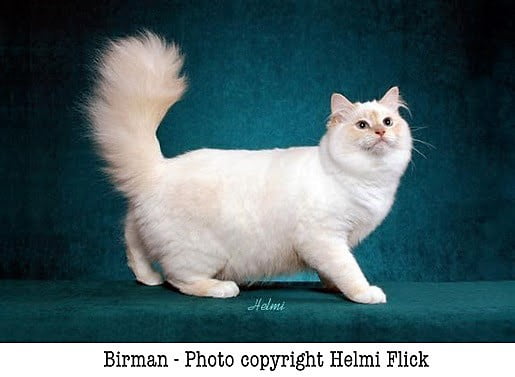
Birman Cat photo of Happy: © Helmi Flick


Introduction

The Name of the cat in the picture above is a suitable one for this breed (but see below about names). An outstanding feature is the Birman's personality, which is balanced and good hearted.

By all accounts this breed has a fine and balanced temperament. In both the picture above of Happy and of Hidden below, the playful and inquisitive nature of this cat is well captured by Helmi.

The origin of this breed, in the Western World, is from the importation of a female Birman Cat from Burma into France (see below). She had kittens, the only survivor of which was a female, who was outcrossed with Siamese, Colourpoints (Himalayans) and White Longhairs. The development of the breed in the West had then begun.

Some, though, argue that the breed has been created after the war through selective breeding of Siamese and black and white longhaired cats (denying the importation story). You make your choice smiley The origin and history of the cat breeds is frequently hazy and sometimes lacks credibility.


Birman cat
Photo of Hidden: © Helmi Flick


The Birman Cat is shrouded in legend going back to pre 653 BC (the birth of Buddha). In outline, the legend is that the coat of a white cat, the companion of a temple priest, turned into the Birman markings we now see, on her master's murder and when she faced the goddess of the temple, Tsun-Kyan-Kse.  These are quasi-religious stories, enjoyable but no more than that and certainly no help in establishing the exact origins of this breed.

white temple cat
copyright and by wildoceans
However, temple cats are very much a part of life in Asia. They are either feral or adopted by priests or I presume people associated with the temple.

The picture opposite evokes, to a certain extent, the image created by the legend of the beginnings of this breed. It is a picture of a white temple cat in Burma and perhaps a young priest studying.

Appearance and Character

This cat has the standard colourpoint pattern and in addition white feet. This is very similar to the Snowshoe Cat in terms of coat colour and pattern. It would be useful to have a look at the Snowshoe cat on this website, as the same genetics are at work.

The Piebald gene (white spotting gene) produces the white (gloved) feet, which should ideally have a nice clean edge and be symmetrical. The coat is not as long as the Persian's (it has been bred long in the Persian - too long in some cases, I believe) and is therefore easier to maintain.
Apparently the texture is such that it doesn't mat so easily.

Helmi's great photographs show you the texture and color of the coat. The color points are pure seal, chocolate, blue, red, lilac or cream. You might like to look at the Traditional Siamese page for some pictures of these point colors.

The Birman Cat has round, blue eyes and a cobby (stocky) and large body. It is her character that some might find the most appealing feature of this cat; intelligent, companionable, playful and pleasant.

My research indicates no particular health related issues with this breed.


Birman cat
GC Kakatz Kaliedoscope Angel Photo: © Helmi Flick


History


Date Event
Before
563 BC
Legend that the Birman's color and markings are a result of the death of a temple priest who was murdered and who's soul was carried to heaven by the cat, when (s)he died.
c.1919 Female and Male Birmans imported into France from Burma by or with the help of  a certain Mr Vanderbilt and/or MmeThadde Hadisch.  Female survives and is pregnant thereby establishing the Birman in the West.
1925 Birman recognized by the French Cat Registry as "Sacre de Birmanie".
1927 Birman referred to in the Paris Cat Show run by the Cat Club of France. The judge's description of the cat is still applicable.
WWII Decimated Birman population - 2 left in Europe.
Post War Birman outcrossed with long hair breeds to rebuild breed.
1955 Birman recognised as a pure breed again.
1960 Birmans imported into UK from France.
1965 Recognized by GCCF (UK).
1966 or 1967 CFA recognize the Birman Cat.

Names

There is a convention that can be adopted for naming the Birman Cat. There is also a naming convention for another cat that originates in France, the Chartreux. The Chartreux truly does originate in France, while the Birman's presence in the Western World started in France.

If the convention is followed, the first letter of the name, in the USA, should begin with "A" for cats born in 2003 (it was "Z" for 2002). For each subsequent year the first letter advances through the alphabet.

This doesn't seem to be the case for Happy and Hidden however (I am waiting for someone to tell me different smiley). Although for Boss below this tells us that he was born in 2004.


Birman Cat
Photo of Boss: © Helmi Flick

Breeders

There are of course many more breeders of this cat than listed here, but these are the only cat breeder sites, as non-directory sites, in the first 30 Google listings.
Taron Birmans
Located Pittsboro, North Carolina, USA. Nice website with a good Google PageRank.

Felonie Birmans
Located near Salisbury, England, Breeding for about 20 years (at 2008).

Russpurrz
Located in Central/Southern Illinois, USA. Breeding since 1991.


From Birman Cat to Home Page

footer for pictures of cats page