logo for pictures-of-cats.org
XML RSS
What is this?
Add to My Yahoo!
Add to My MSN
Add to Google

Home
Photos of Breeds A-H
Photos of Breeds J-P
Photos of Breeds R-T
Breeds Categorized
Rare Cat Breeds
Cat Health Issues
Largest Cat Breed
POC Updates
33 fine cat photos
22 Dog+Cat Photos
Discussing Cats
Cat Facts
Dwarf Cats
Helmi Flick Photo
Warrior Cats
Photo Album
Videos
Persians Start Here
Persian Cats
Persian Care
Bengal Cats
Bengal Breeders
Himalayan Cats
Maine Coon
Maine Coon 2
Traditional Siamese
Modern Siamese
Photos kittens cats
Cats with guns
Cats Musical Fanart
Painted Cats
Sources & Contact me
Partners and Links
General Link Xchange
UK - Shop
Have a Say
LEFT for pictures-of-cats.org

Burmese Cat


Burmese Cat
Burmese Cat - Photo of Candido © Helmi Flick

Introduction

It seems that for centuries this cat was found in the Far East, in Siam (now Thailand), Burma and the Malay Peninsula (now Malaysia). A female Burnese cat was imported into the USA in 1930. The imported cat was mated with a Seal Point Siamese and a male offspring from this breeding was bred back to his mother to produce the Sable Burmese
Burmese Cat (European)
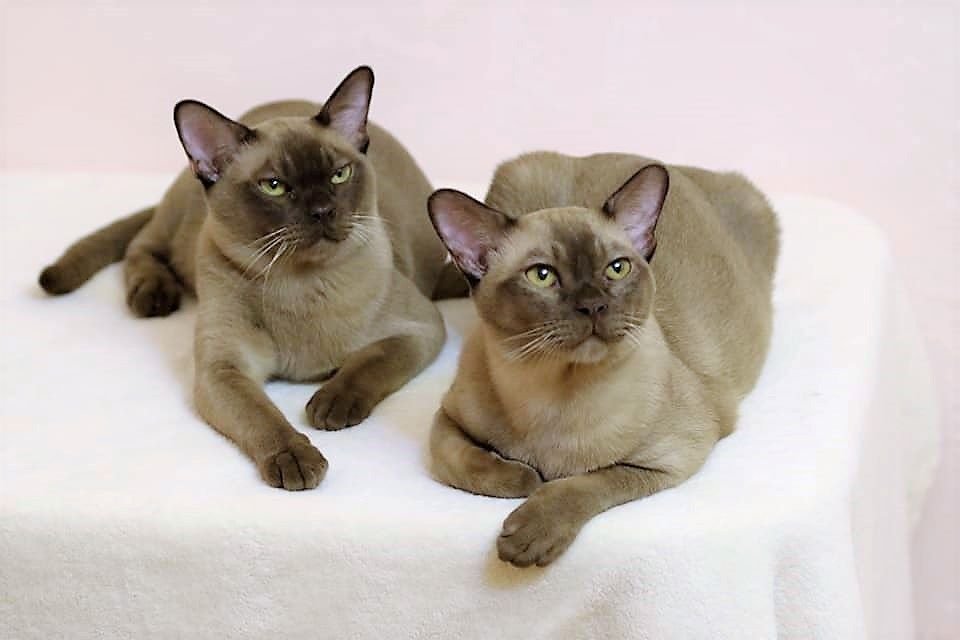
European Burmese - Photo: © danklar
Cat¹. Unfortunately, the development of this breed in the West has taken divergent paths.

This is because of a fundamental disagreement between the UK and US cat fancy as to what the Burmese cat should look like. It is a shame that the US and UK differ in respect of their standard for this breed. The differences between the GCCF (UK) and CFA (US) makes it more difficult for non-cat fanciers to appreciate this cat breed. It also means that other countries and associations have to decide how to treat the divergent Burmese subgroups. Most apparently treat them as the same cat, while some differentiate and call the UK cat the European Burmese.

Most of the cats illustrated on this page are the American Burmese. In the US she is considered a foreign shorthair cat.

Burmese Cat
Photo of Candido © Helmi Flick

History

Date Event
c.1700s? to
present
Burmese Cat living in Burma, Thailand (Siam) and Malaya.
late 1800s This breed found in the UK as Chocolate Siamese.
1930 Female Burmese Cat first imported into USA (San Francisco). Thought by some to be a dark Siamese. She was breed with a Sealpoint Siamese. One of the litter, a male, was bred with his mother and this litter resulted in the 1st Burmese.
1936 CFA recognise breed (USA)
1947 CFA withdrew recognition because of poor breeding practice by some breeders resulting in hybrid Burmese (USA).
1949 Two Burmese Cats imported into UK from France
1951 Third Burmese imported into UK from USA
1952 GCCF recognise Burmese but not on basis of USA pedigrees (UK)
1953 or 1954 CFA restore recognition of Burmese(USA).
1955 First Blue Burmese born in UK.
late
1950s
Champagne Burmese in litters (USA).
1958 Breed Standard drafted in USA.
1965 Champagne and Platinum Burmese bred formally.
1969 Gene pool widened in UK by importation of Burmese from Canada
1972 Chocolate and Lilac colors established in the UK.
1984 Champagne, blue and platinum accepted for registration by CFA in US.
Current The CFA does not register Traditional (European) Burmese and the GCCF does not register the American (contemporary) Burmese.

Burmese Cat Burmese Cat
Candido American Burmese © Helmi Flick - these are large thumbnails

Appearance and Character

If one where to summarise the CFA description it would be that the Burmese Cat is a pleasant, sweet natured and people orientated cat with all the usual attractive domestic cat attributes.

Surprisingly the CFA says that the Burmese Cat has almost no sense of survival and should be kept in as a result. This brings to mind the Ragdoll cat as
Burmese Cat (European)
Photo of European Brown Burmese: © danklar
some people have said similar things about that cat breed. This is manifestly incorrect. It must be almost impossible to breed out the 'hard-wired' survival instinct, the most fundamental off all instincts. And if cat breeders did breed out this instinct, it would be negligent and improper of them, in any event.

The original Burmese was sable (dark brown) in color. Since then, through careful breeding, a wide range of colors have been developed. This has been a further source of controversy. The CFA accepts, sable, champagne, blue and platinum.

The GCCF accept these colors: brown (similar to sable), blue, chocolate, lilac, red, brown tortie, cream, blue tortie, chocolate tortie and lilac tortie.

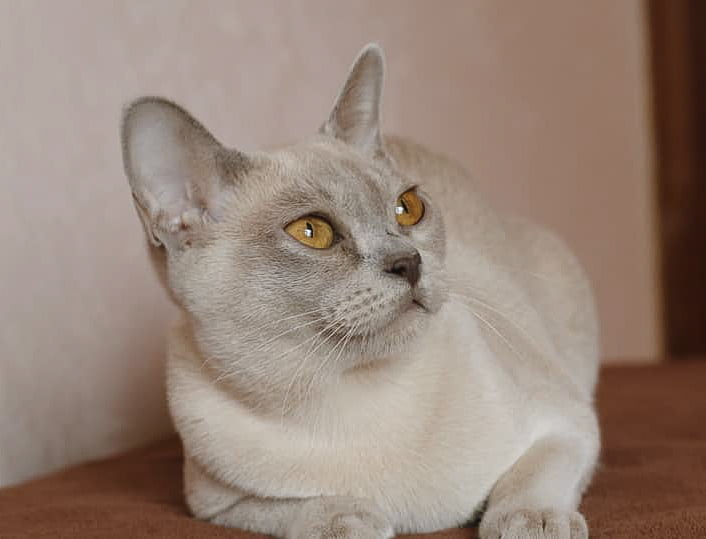
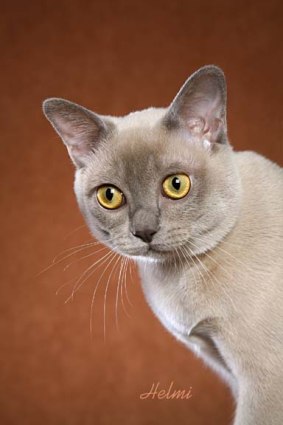
Candido the cat featured on this page is (I believe) a platinum colored cat ("pale silvery grey with pale fawn undertones" - CFA)

Because of the different approaches to the breeding of this cat, there is a range of head and body types. As can be seen from the American cats on this page the face is round.


Burmese Cat
Photo of Cappy (Sable American Burmese) © Helmi Flick

Breed Standard - head and body for GCCF (UK) and CFA (USA)

The USA breeders prefer the "contemporary Burmese" while the Brits go for the "Traditional Burmese". A brief and limited comparison of breed standards helps to understand the difference.

UK - the head should be a "short wedge", wide at the cheeks and tapering to a blunt nose. There is no reference to roundness as in the US standard
Burmese Cat
Photo: © Helmi Flick
below. The body should be of "medium length and size".

USA - the head should be "rounded" with a sweet expression. The body should be medium in size and compact.

This comparison tells us a lot about the difference between the UK and US. The European Burmese (UK type) is nearer a normal or standard cat shape (moggie shape). Although some call it more Oriental. While the US Burmese has a slightly exagerated roundness (supporting the desired sweet look) to her pug-like conformation.

Similar terms are used for the American Shorthair and Persian with respect to a round appearance). Americans, it would seem, demand something a little more ourstanding and tend therefore to breed more extreme cats, either very cobby and round (Ultra Persian) or long and delicate (Modern Siamese).

Health

The breeding lines of the American cat has a defective gene that can make itself manifest by the birth of kittens with a deformed head. Kittens that are born alive are euthanized. This does not effect the UK Burmese. This major health problem has been hard to eradicate. The idea is that it will gradually fade out through wise breeding.


Burmese Cat
Burmese cat photo: © Helmi Flick

Breeders

These are catteries with their won websites found by Google and listed on the first 2 pages in the order listed.
Casa Del Gatos
Located in Dallas, Texas Metroplex, USA.

Chamsey
Located in Illinois, USA. Breed European Burmese. Founded in 1985.

Hexpride
Located in Salisbury, North Carolina, USA. Also breed Bombau Cats and are listed on that page too.

Okeydokey Cattery
Located Sallisaw, Oklahoma, USA. Breeding Burmese since 1980


1. Philosophical point. Why do we find breeding closely related cats acceptable and desirable (to produce the desired "type") when as humans we forbid such mating on health grounds?

Burmese cat Lorenzo
Burmese cat - Lorenzo - photo © Helmi Flick

Sources:

From Burmese Cat to Home Page

footer for pictures of cats page