
by Michael
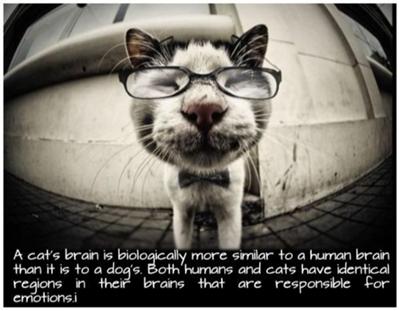
Being a mammal the cat’s brain is similar to ours and all other mammals. For the sake of clarity a mammal is a warm blooded vertebrate covered by skin/hair. All vertebrates have similar brains too. The brain of a mammal is larger in relation to body size that other vertebrates.
The picture above is probably slightly misleading in my opinion. My research indicates that emotions are not controlled by a single or certain specific areas of the brain. As cats and humans have similar brains, logically it could said that we have similar areas of the brain that are involved in emotions. I don’t agree that they are identical, though.
That does not mean that we have the same emotions. However, by simple first hand experience of living with a cat for a long period and knowing a cat well, we can deduce that cats do have emotions and they are likely to be similar to ours. I would have thought that emotions across all mammals follow a template but each species experiences different levels of emotion.
This may be in part because of eons of experience has changed the physiology of the animal. What I mean is the domestic cat is a domesticated African wildcat. The African wildcat has evolved over about million years living a harsh life. This must make the cat more tolerant of discomfort etc. This results in dampened emotions and emotion more directly related to survival. The domestic cat is known to not show pain and discomfort. We don’t see cats being overtly happy like smiling and laughing!
However, I can tell when my cat is despondent and when content. I can see fear and anxiety etc. There are very clear signs for these emotions in cats. Anyone who thinks that cats don’t have emotions are obviously wrong.
Humans in the West have become noticeably softer over recent times. This results in a less stoic approach to life leading to more expressions of emotion for relatively frivolous things. We may see the same thing happen to the domestic cat over thousands of years. Domestic cats may learn to express their emotions more to us.
You might be able to argue that that is already the case. The Siamese has a long history and is the most vocal of all domestic cats.
We should remind ourselves that the period of domestication of the wildcat – the last 9,500 years – is a tiny fraction of the time the wildcat has been on the planet; about 2 million years (domestic cat history). In fact it represents about half of one percent of the overall time. The domestic cat should evolve in domesticity which will probably change the cat.
I don’t think you will find any scientific evaluations of cat emotions and brain function. We don’t enough about our own emotions and brains to make a comparison with a cat.
Michael
Comments for | ||
|

Michael:
Thank you for this great article to certify/clarify that cats INDEED have emotions just like humans,
interested that you bring out the fact that our brains are very similar.
Sincerely
keenpetite,
a human that has loved cats for over 45 yrs & being loved by cats.
