
Note: the article is huge and has been split into many sections for technical reasons with links at the base of each section to the next.
Cat health problems is a very large subject. Use Use Ctrl+F to search for text on this page. It saves time searching. Depress the keys together. A search box appears bottom left or top right of screen. Type in the word and it will be highlighted.
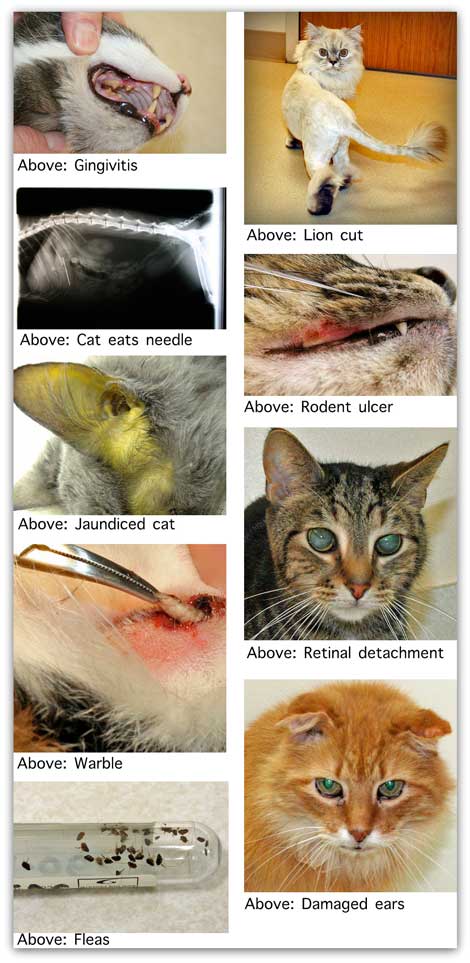
Above: This photo (montage) has been used with permission for teaching/educational purposes at PoC and the pictures were provided by Cuyahoga Falls Veterinary Clinic (new window).
 See a vet to check. How do I know if my cat has a respiratory infection? Click here. How do I know if my cat has FeLV? Click here. How do I know if my cat has a urinary tract infection? Click here See a vet to check. How do I know if my cat has a respiratory infection? Click here. How do I know if my cat has FeLV? Click here. How do I know if my cat has a urinary tract infection? Click here |
Contents – Cat Health Problems
Feline Viruses — An overview page setting them out with links to more. |

Cancer
- Cat Skin Cancer (link opens a new window)
- Cat Health Cancer – A brief overview on this subject.
- Cats Cancer and Passive Smoking – We can get cancer by passive smoking, so can cats, of course.
- Feline Brain Tumor – rare
- Feline Fibrosarcoma – A cancer of the skin that is made notable by its association with cat vaccinations resulting in cat vaccination recommendations.
- Feline Leukemia Symptoms – This really means the symptoms of the feline leukemia virus (FeLV).
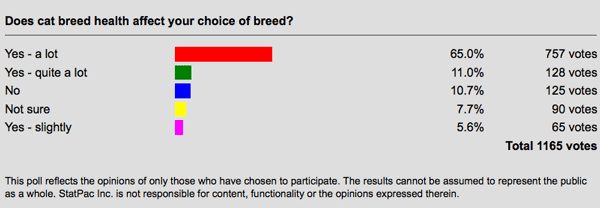
People believe that cat health is an important factor in choosing a cat breed. Some breeds are inherently more healthy than others.
Things we do or are involved In
- Checking cat’s pulse – a useful check on general health and a diagnostic tool
- Adoptable FeLV Cats. Visitors can advertise cats on this linked page.
- After Hours Emergency Cat Care
- Aggressive cat behavior – this is largely to do with us.
- Buying from a Maine Coon breeder – caveat emptor is the rule.
- Cat Aggression – a lot of this is to do with us.
- Cat Antibiotics – can cause an allergic reaction.
- Cat Biting Tail – are we in part to blame?
- Cat Boredom – we should try and alieviate this as it will promote better health.
- Cat Declawing – overview
- Declawing Cats– a most important subject – this is an umbrella page with lots of links to more articles and thoughts – more to come though….
- Complications of declawing – please read this if nothing else
- Declawed all four paws and no teeth
- American Veterinarians are Unethical Towards the Cat – the same as the above but slightly different angle. The same form available as above.
- Declawing: A Physical Therapist Assistant’s Perspective***This is a very informative article indeed and it covers areas that are rarely dicussed by the vets who declaw.
- Cat Eating Grass – we should ensure our cat can do it.
- Cat Losing Teeth – we need to check and clean!
- Cat Pregnancy – Not a health problem normally but health related, hence listed (opens a new page)
- Cat Cloning
- Cat Cremation Urns
- Cat Diabetes Treatment – first hand experiences.
- Cat Drinking Beer – jokey yes, health issues? Yes possibly.
- Cat First Aid Kit
- Cat Flea Treatment
- Cat Games to Play – cat games are important for the health of indoor cats.
- Cat Giving Birth – we should leave alone!
- Cat Health Book – my recommendation. If you are considering getting one book on cat health get this one. It is well written and well indixed.
- Cat Hoarding – an illness or cat love combined with low standards.
- Cat Illness Diagnosis – we can do some but we need to know our limits and we need good reference books.
- Cat Litter Crytals – highly effective + cost effective?
- Cat Obesity
- Cat Poison – this is about car engine antifreeze. Some people use it deliberately. This page has developed poorly – see the comments. See also: Plants poisonous to cats.
- Cat Scratch Disease – This is a human condition rarely caused by a cat but is listed here nonetheless. Also Cat Scratch fever symptoms and Cat Bites Signs of Infection.
- Cat Seizure – a concise list of causes. A vet must see the cat.
- Cat Temperature – what is it and how to take it.
- Cat Vaccinations – these are sometimes over prescribed and can be dangerous.
- Cat Water Bowls – concerns health indirectly.
- Cat Weight Chart
- Cat Whisperer – this is about us more than the cat!
- Cat Years to Human Years
- Changes in Older Cats
- Clogged Tear Duct of a Cat – this is not automatically our fault but often is. That is why it is under this heading.
- Over the Counter Pet Drugs – care needed obviously. These are drugs for people.
- Dental Gel for Cats – We should try and clean our cat’s teeth, but can we?
- Deworming Your Cat
- Dog Eating Cat Litter – what!? About dogs but affects cats.
- Dogs Eating Cat Food
- Donor Cat Adoptions – adopting cats that are blood donors (opens new window).
- Diabetic Cat Food
- Diabetic Cat Food
- Dry Cat Shampoo – not sure about these.
- Dwarfism in the Dwarf cat
- Fattest Cat in the World – this is cat obesity.
- Feline Acne Treatment
- Feline Lymphoma and Secondhand Cigarette Smoke
- Feline Miliary Dermatitis – most often caused by flea bites.
- Feline Pain Relief
 – Rarely if ever should we administer it without a vet’s advice.
 - Flea Treatments Can Kill – yes, true and a major reason is because we failed to read the instructions on the box.
- Giving a Cat a Pill – authorised and non-authorised ways!
- Herbs for a Cat – cats like herbs other than catnip plus they can be therapeutic.
- Humans Transmitting Disease to Cats – concerns H1N1 virus.
- Hip Dysplasia in Cats – breeders can reduce it in purebred cats.
- How to Calm a Cat? – all about environment.
- House Plants Safe For Cats – five popular ones chosen + pics.
- Indicators of a Healthy Cat
- Kitten Development
- Kitten Growth Chart
- Lazy Cat – are cats really lazy or are we making them inactive?
- Milk Thistle for Cats – claimed liver disease natural treatment.
- Microchipping for pets – Are there health problems associated with this procedure?
- Neutering cats – I’m pleased with this page. It covers the terms, the operation and some religion…..
- Melamine in Cat Food – cat poisoning – There was a huge pet food recall in the USA in 2007. It was put down to melamine in cat food (and dog food). Read more about this.
- Outdoor Cat Problems – there is a divide. The cat keepers sometimes upset the cat haters. The cat is in between.
- Removing Ticks from Pets
- Toxoplasmosis and its Prevention in Cats and People
- Toxic to Cats – a lot of what we do can be toxic to cats.
- Tenectomy or tendonectomy on cats
 – more unethical behaviour by the illustrious American veterinary surgeon.
 - Testing Cats for Deafness
- The Cat Flea: biology, ecology and control
- The Signs of a Healthy Cat – quick check.
- Top poisonings in cats
- Urinary Tract Infections | Natural Cure
- Vitamin Supplement for the Senior Cat
- Whiskas Cat Milk
 – Rarely if ever should we administer it without a vet’s advice.
 – more unethical behaviour by the illustrious American veterinary surgeon.
Skin – Hair – Parasites – Allergies – more cat health problems
- Symptoms exhibited by a cat with a food allergy – it is useful to know this because allergy symptoms are vague
- Bobcat Fever – this is a tick transmitted blood borne parasite that has a 95% fatality rate but which can be cured throuh committed treatment.
- Cat Asthma – another version on this subject (opens new window).
- Cat Body Odor
- Cat Dry Skin – another look at this cat health problem. Don’t presume that a cat scratching himself indicates dry skin. It is more likely to be fleas or some other skin condition.
- Cat Saliva – does more than we think.
- Cat Hair Loss – Causes discussed in some detail.
- Feline diseases causing hair loss – a list
- Cat Hairballs – I say this is a domestic cat problem. Lists all the remedies.
- Cat Heartworm – What is it?
- Cat Mites– ghastly, highly irritating, microscopic, spider-like things.
- Cat Ear Mites – Dark gungy wax is the evidence plus irritation.
- Cat Ear Mites
- Cat Skin Rashes – Possible causes discussed.
- Cat Parasites – An overview page pulling the various posts together.
- Cat Deworming – treatments for internal parasites.
- Cat Parasite – the revolting tick.
- Cat Skin Problems – wide ranging list of possible causes.
- Feline Acne or allergic to the plastic bowl?
- Feline Dandruff – A bit like human dandruff, I say, with some differences.
- Feline Dry Skin
- Feline Mange – A relatively rare condition.
- Hypoallergenic Cat Food – probably best to make your own.
- Feline Allergies – Allergies from food, fleas and inhaled allergens are discussed and more.
- Feline Asthma – This may be caused by a range of allergens including food and is usually manageable.
- Hair loss – a simple cat health tip
- Itchy kittens and excessive grooming – written by Jo Singer
- Lungworm in Cats – When it’s wet and warm there are more infections, the life cycle is fascinating…..
- Tapeworms in Felines – These horrible things clamp onto the inside wall of the small intestine – fleas play a role sometimes.
- Removing Ticks from Pets
Head – Brain – Upper Respiratory – Heart – more cat health problems
- Arginine is Critically Important For Cats
- Brain Trauma in a kitten causing stunted growth, perhaps.
- Buspar for Cats
- Cat Cough – All but the simplest causes and shortest durations of cat cough should be dealt with by your veterinarian.
- Cat Dementia – On the increase? Maybe it is, as cats like humans are living longer. We should recognize the signs and be gentle.
- Cat Drooling – usual causes discussed.
- Feline Oral Diseases – Common mouth diseases affecting cats
- Cat Gum Disease – A cat’s teeth are a potential weak spot and we should be ever vigilant.
- Cat Heart Murmur Symptoms – a pretty full discussion on this.
- Cat Losing Voice – link opens in new window.
- Cat Pink Eye
- Cat Teeth – from the point of view of anatomy and health.
- Conjunctivitis in a Kitten – a submission from a visitor on a very ill kitten.
- Deaf cat – A cat has great senses and can cope well even when deaf.
- Deafness in Cats – concise and comprehensive inc. a bit about dogs.
- Heart Failure In Cats – concise.
- Feline Blindness – reasons, explanations.
- Feline Conjunctivitis – most common disease.
- Feline Calicivirus – common cause of URIs
- Feline Endocrine Alopecia – This is rare and can be confused with excessive grooming due to behavioral problems.
- Feline Vestibular Disorder – affects balance and poise.
- Feline Stroke – We know about human strokes, the feline version is similar with different symptoms.
- Feline Hyperesthesia – An unusual disease and one that my cat might suffer from in a very mild form.
- Feline sneezing – Sneezing can be unimportant and transient or important and long lasting requiring a visit to the veterinarian.
- Feline Eye Disease – A long, compact list in summary form of eye diseases
- See URIs for more/overview.
- Siamese Cat Health Problems (click on this link) – A discussion relating to this cat breed focusing on the Modern Siamese cat.
- Signs of Cat Mouth Disease – we should pick this up fairly early on.
- Cat trembling – The causes of trembling and something slightly different: tremors.
Body Fluids etc. – more cat health problems
- Hypercalcaemia in cats – treatment of a Ragdoll
- Blood In Cat Stool – five reasons listed.
- Cat Anemia – a visitor askes about their cat and I answer by researching the causes.
- Cat Constipation – Here is a comprehensive look at a quite commonly encountered problem. It covers home treatments. We all need to know the consistency of our cat’s feces….!
- Cat Vomiting Blood (opens a new window)
- Cat Vomiting – A discussion on the various causes of cat vomiting and what we might do. This is pretty comprehensive I think.
- Feline Chronic Dehydration – This condition can be due to prolonged vomiting and/or prolonged diarrhea.
- Feline IBD – caused by horrible modern cat food?
- Feline Mastitis – inflammation of the cat’s breasts
- Treating Cat Diarrhea – We can treat to a certain degree. The limits are spelled out here plus more.
Pancreas – Kidney – Liver – more cat health problems
- Cat drinking a lot of water?
- Feline Fatty Liver Disease – The cause is unknown but the remedy is, but it needs commitment and dedication from the cat keeper.
- Feline Idiopathic Cystitis (FIC) – The information provided is about prevention of cat cystitis.
- Feline Kidney Stones – Kidney stones are rare but crystalline stones in the urinary tract are less so.
- Feline Kidney Disease – Chronic renal disease can be managed but what is the best way and what is the best diet? The conventional and modern is discussed on this page. You might also like to read about the very prevalent (most common..) Feline Polycystic Kidney Disease
- Feline Pancreatitis – A rare condition it can be a killer but the symptoms are indistinct and diagnosis hard.
- Low Magnesium Cat Food
- Symptoms of Feline Diabetes – Just the symptoms.
Other Potential/Actual Cat Health Problems – more cat health problems
- Causes of hearing loss in cats
- Distended Abdomen
- Cat Paws – just a description and picture of paws and claws.
- Cat Rabies Symptoms – Cat rabies is present in most countries (not UK) and in Asia more so due to low levels of vaccination. Eating cat meat can mean getting rabies.
- Cushings Disease in Cats – This is an endocrine disorder — an inbalance of hormones.
- Elderly Cat Health Problems – illness specific to old age plus general issues are discussed.
- Fading Kitten Syndrome – This is similar to is similar to Sudden Infant Death Syndrome (SID).
- Feline Aids
- Feline Anemia – The main reason not enough blood being produced – why?
- Feline Weight Loss – Undereating – why? – undernourished – a different thing.
- FIP in specific cat breeds
- Lockjaw – this is a bacterial infection causing tetanus, a very serious disease which can be fatal.
Injury – more cat health problems
- Cat Abscess – Cat fights are a typical source of injury, infection and cat abscess.
- Cat Wounds – Some stuff on dealing with them.
- Feline Hypothermia Treatment – What do we do when our cat gets very cold?
Miscellaneous Cat Health Problems
- Cat shaking rear legs when walking – full range of possible causes
- Cat Losing Weight – main reasons listed.
- Genetically Linked Diseases opens in new window. This looks at diseases that are inherited with certain cat breeds. (opens in new page). This is quite a comprehensive list. See also: Persian Cat Health Problems [link]. Siamese Cat Health Problems [link].
- Hip Dysplasia in Cats – breeders can reduce it in purebred cats.
- Maine Coon Cat Health
- See cat illness symptoms – a list of symptoms linked to a description of the possible illness.
- See cat illness prevention – some thoughts about minimizing the occurrences of common and expensive cat illnesses.

On another note reading about savannah is that they need a higher protein and calorie counot where as wet food has 80% water…a raw diet seems to be ideal but the risks scare me away from that…would I be better to switch him to another grain free dry food and just leave him a bowl for him to nibble at as usual and just give him a couple spoones of canned food during the day maybe a couple of crickets or something? Also Ive heard that fish foods contain IEBD or something like that from pollution in the water that is thought to be linked with hyperthyroidism In whales and vats. There is also a chemical I heard that is used to seal canned wet food thats used to seal the can that is thought to do the same (more evidence supports the fish theory) upon finding this information again I find myself very confused and in the unknown abit what is best for my cat, and at that after hearing about the blue recalls and sick pets I’m unsure which companis to turn to
I am really leaning towards wet cat food now and becoming increasingly worried about my cat…he’s an f7 savannah and I know he needs a high protein diet..so as you know I switched him to wilderness blue and he’s has since become constipated he’s defaced once or twice since last weekend his stomach feels quite bloated and I have also learned of lots of people’s pets be comming quite sick and surpassing toxicity limits…I have thrown out the food and just about everything is closed today idk what to do I thought I was on the right path with him now I am lost on what to feed my savannah and I’m becoming scared and worried for him
John, I’m very surprised to hear that some of the people that you talked to were against wet cat food. I’m not surprised that a lot of the pet stores are against it because it is easier for a pet store to store dry cat food. I honestly believe that the people who are against wet cat food are incorrect and I say that from many years of thinking and working on the subject. Here are is a post about dry cat food which may help but in any case I wish you the best of luck. A book called “Your Cat” by Elisabeth Hodgkins is interesting and is about the health affects of dry kibble.
https://pictures-of-cats.org/cat-food-recipe.html
This is a link to many articles.