
By Michael
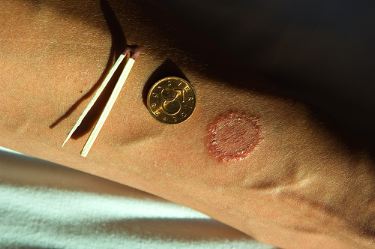
Ringworm photo © topherous
Cat ringworm is exactly the same as human ringworm as it is zoonotic, which means it is a disease or infectious agent that can be transmitted between animals and humans.

The term zoonotic is strange as it presupposes that we are not animals when we clearly are albeit more intelligent than other animals on some levels but not on other levels. The term is a reflection of man’s arrogance.
Back to ringworm. This is a fungal infection of the dead skin. And I just caught it from a stray cat who I am looking after (at March 2020, that sentence was written 9 years ago). I still love him. He came in last night starving as usual and ate a whole can of cat food and slept ’til the early hours and went – bless. It can be seen on a cat by small bare patches of hair loss and bare skin with slightly raised and red areas in a circle. The areas are usually no more than the size of a small coin.
As the picture above makes clear it forms a ring, hence the name. In my case the infection was transmitted to my legs when Timmy (the stray cat) rubbed up against me in the morning before I was dressed. Bingo, rings on both legs.
I knew what they were and didn’t both to see a doctor. I just popped into a local pharmacy and he sold me some “thrush” cream. Thrush is also a fungal infection so it worked OK. Only it took about 3 months to go. It itches until treated – no big deal.
The thing is there is no sign of it on Timmy. This can be the case.
Update
This wasn’t the case as it turned out. I have just very recently, some 6 months after meeting Timmy, seen his cat ringworm. He has it on his right foreleg. He licks the spot as it itches and he has licked off his fur revealing the ringworm. I put some anti-fungal cream on (actually thrush cream for humans) and he was pleased (about a month later there was no sign of it). Cats can pick it up from other cats or from being combed with an infected brush. The way I got it was by coming into contact with Timmy’s infected hairs.
All cats can get it. As I said some cats are symptomless. In others you will see the lesions as above.
Vets can check for this infection by a hair test or a special lamp (filtered ultra violet light). This can see 60% of the strains. If this doesn’t work a hair sample can be taken.

Further Update Dec. 2009
My mother died several weeks ago and I had to take in her three legged cat, Charlie. When I saw him at her house, I immediately saw that he had cat ringworm at the base of his tail and a bit further up at the base of his spine. He is a very thorough groomer so he would lick these areas constantly as they itched. Ringworm is very itchy as I can attest as I have caught it from Timmy. I had acquired some thrush cream from a pharmacy some time ago and it has proved useful for curing cat ringworm.
I gave it to Charlie too (I had previously given it to Timmy – see above) and it worked well. It cleared up in about three weeks. He stopped grooming there and the hair has grown back.
Treatments
Cat Ringworm can go by itself or with treatment. It can several weeks to disappear naturally, as I found out.
The treatment I gave myself was a bit unorthodox. A cat should be given an oral anti-fungal antibiotic or a proper skin cream/ointment. Treatment depends on the extent of the cat ringworm. I will refer to book 1 of Medical References and Methods. Minor cat ringworm problems will probably resolve themselves. If the infection is confined to one spot the hair around the ringworm should be clipped away and the skin cleaned with a Betadine solution (this is a USA product). An antifungal cream is then applied (in the USA: Conofite, Nolvasan, Lotrimin) once a day for several weeks. Infected sores can be treated with an antibacterial cream.
Personally, and through experience, I have found that it can be treated effectively with a simple topical cream and patience. It took about 3 months for mine to disappear, although I am no longer a young person! Here is one that can be bought on Amazon.com:
ANOTHER UPDATE! — THE BEST WAY TO TREAT RINGWORM ON HUMANS IS TO USE A UVB MEDICAL LIGHT SOURCE. UV KILLS RINGWORM AND FAST. THREE 30 SECOND SESSIONS AND IT’S GONE. — I use a medical version bought from Amazon. BUT IT MUST NOT SHINE INTO EYES. LINK TO AN ARTICLE ON THIS.
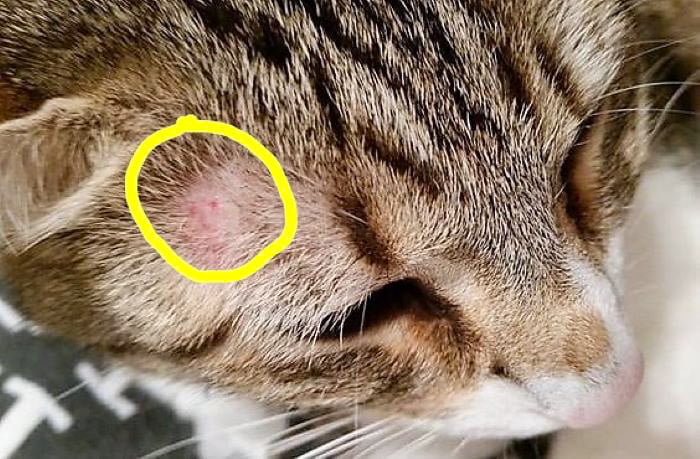
Sept 28, 2021: Ah, yes there had to be another update! Did you wonder about the exact biological process which causes ringworm? No! Well if have you can click on think to read about the cause of a circular inflammation and flaky skin.
If the ringworm is bad (general) a dip in an anti-fungal solution (USA: Nolvasan for example) is needed. Or perhaps more commonly an oral anti-fungal is given (e.g. Fulvicin).
Update Dec 2010: I have found this on Amazon. It gets the thumbs up from two satisfied users and it is cheap:
Any cat showing signs of ringworm cannot be shown in a cat show under GCCF rules (rule D). This obviously applies to the UK. I am sure the same rule applies to other countries.
Lastly and importantly, the environment should be treated as well as the fungal spores may persist for many months. The action required includes:
- disposal of bedding
- disposal of grooming equipment
- vacuuming and disinfecting using a fungal agent (see vet)
Sources:
- Internet (no site, just the SE listing)
- Myself
- Veterinary Notes for Cat Owners

OK.
I think these little perverts just snuggle around my butt when I am sound asleep. It’s soft and warm. LOL!
I am sort of half guessing that it can show up in a place where there is no direct contact. I am not 100% sure but none of the information websites say the infection shows where contact was made. I think the symptoms are more likely to show where contact is made but it is not obligatory. Transmission can also be via objects (items).
See, I didn’t really know that it can show up in places of no contact. I had always thought that direct contact was the key to location. I learn something new every day.
Good. I was groping for an answer as to why my butt was affected. I was guessing that sleeping in the raw was how it happened, that perhaps one of my cat bed partners snuggled there. They can be such perverts! LOL!
Cats, cats, cats. It has taken me 6 months to get a patch of ringworm off my lower right leg using an anti-fungal cream. I think it can come up anywhere. It does not have to have contact at the place where it shows.
This is a first for me.
I have a case of ringworm on my left butt cheek.
I felt a small itch and felt a patch that is very familiar to me.
I tried to get focus in numerous mirrors, ie. full length, compact, etc. but couldn’t actually see it until I climbed atop the bathroom cabinet and looked in that mirror with full lights blazing.
I’ve had multiple cases of ringworm throughout my life on my chest, face, thighs, etc but never on my butt.
I have no explanation as to how this could be.
Any ideas?