
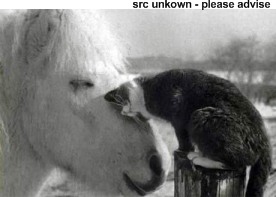
Although it might appear that I have made light of cat separation anxiety disorder, I have not. The photo is just to catch the eye and anyway the website is called pictures of cats 🙂
 Cat separation anxiety is real and I think it is probably on the increase as people find more reasons to be away from home perhaps because of work commitments or because of socialising. I divorced about 13 years ago and we had three cats so the boy cat (Boo Boo, I called him – my ex called him Freddie) went with her and the two girls came with me.
My ex. liked to go out a lot and she worked hard and long hours. Fine qualities, but not so good for your cat. Boo Boo was a large and handsome looking black cat with some Norwegian Forest in him. As a boy he liked to get out and that, in central London (UK), is not a good idea. So, my ex. kept him in while she was out at work and out at play. I remember she said he urinated on her duvet cover one day. Although I can’t be sure it may well have been a case of cat separation anxiety disorder. I reckon I suffered from the same disorder during the time I was married to her! – (that’s a joke, she is a fine person).
Research indicates that cats are social creatures. They form close bonds with other animals and humans. I can vouch for that as I have a very close bond with my remaining cat, Binnie (the other girl was sadly killed on the road in 1994; her name was Missie and I still shed a tear for her as she was my daughter that I never had). When I worked full-time she would wait at the front door for me and greet me beautifully. We have long conversations.
You can see some wonderfully close bonding in the many cat pictures on the Internet. You can see two on this site – one is here (Bengal cat and whippet dog) and the other here (two traditional Persian cats, unrelated).
The signs and symptoms of cat separation anxiety are, it seems, fairly clear. A very close bond say with a human is clearly more likely to result in the disorder. You’ll know when the bond is very close. I guess you won’t be there to hear the symptoms of cat separation anxiety but when you’re gone your cat may cry out. I heard my cat cry out once during the night. It is a voice that clearly says she wants you around and to be with her.
Then there is “inappropriate elimination”, which in this instance might be going to the toilet on your bed or near your personal things. Research indicates that three quarters of the cats who did this only did it on the “owner’s bed”. Seventy percent of cats showed inappropriate urination as a symptom of this disorder and 35% inappropriate defecation. Sometimes it is manifest in destructive behavior. Research in a retrospective study (looking at and analysing data acquired already) by S. Schwartz at Department of Clinical Sciences, School of Veterinary Medicine, Tufts University, North Grafton, MA 01536, USA. indicates that it is the boy cats (13% of the sample) who can be destructive (scratching and chewing) when suffering from cat anxiety disorder.
Cats can also develop obsessive compulsive disorders when stressed due to cat separation anxiety. This can take the form of excessive grooming (“psychogenic grooming” or “barbering”), which can damage the cat’s body by wearing the fur down to the skin. Female cats are more prone to barbering. Or, compulsive tail chewing, digging, destroying furniture, drooling, shaking, panting.
I find it interesting that some articles on this subject ask the question “what causes cat separation disorder”. Well, it’s being separated :-). What they are asking is this. Is there a cat profile which is predisposed to this disorder and the answer is almost certainly “yes”. Through both genetic (nervous disposition) and environmental (bad childhood through ill treatment) influences a cat could be prone to this disorder. For example, being weaned too early may be a factor. Conversely, a well socialized cat will be more robust psychologically.
However, the symptoms of cat separation anxiety as mentioned above may not be due to this disorder so having your cat checked out by a vet is obvious. The cure must also be the obvious to some extent – don’t become separated from your cat. But the classic cure is behavioral and medical. The medicine would be anti-anxiety medicine. Medicine can be administered for a short time until behavioral changes take effect. Your vet may prescribe drugs such as Prozac or Buspar.
Update 27-9-09: Finn Frode Hansen a person with a lot of experience with cats made this sensible comment:
Being home alone for much of the day is of course a given term for many cats, but before resorting to Prozac, I’d much rather get another cat to keep her company.
Our old Norwegian Milly have had a hard time accepting shelter moggie Snehvide, as both were definitely Alpha females. Some hissing and paw punching has occurred, but nevertheless they could eat together from day one and have always been curious about the doings and whereabouts of each other. Then ever since our vacation, when they were left to they own devices for 22 hours a day, things have improved a lot and now they can even sleep within 2 feet of each other.
So I guess the separation actually helped in this case, as they have somehow been forced to accept each others company more.
Thanks Finn.
Cat separation anxiety to home page
