
by Susan
(Ohio, USA)
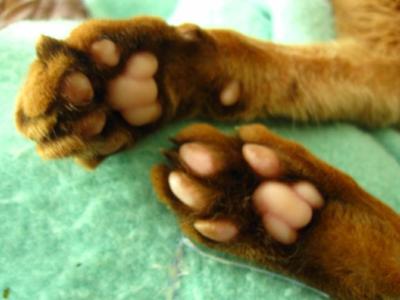
Mushu's front declawed paw pads are hard, dark, irritated, and misshaped.
"A digitigrade is an animal that stands or walks on its digits, or toes...".
Have you noticed that many pro-declawers and veterinarians use the argument that cats walk on their paw pads so they don't need the last digit of their fingers and toes for walking? Not true! Cats are digitigrades whom walk on their "tippy-toes" like ballet dancers.
Imagine walking on the ends of your hands and feet all of your life without the last digits!
You can clearly see in the above photo of Mushu, the declawed shelter cat I live with, how the paw pads in his front declawed paws have broken down after years of being forced to walk on fingers robbed of their last digit. The paw pads in his hind clawed toes are plump, pink, and healthy - the way they should be! The pads in his front declawed paws are dark, hard, irritated, and misshaped.
Pads are for cushioning, not walking! It's not hard to imagine what the physical impact this unnatural walking has on the entire cats skeletal system & balance over the course of a cats life.
These definitions of digitigrade and digitigrade locomotion explain it better than I can!
From wikipedia:
"A digitigrade is an animal that stands or walks on its digits, or toes. Digitigrades include walking birds (what many assume to be bird knees are actually ankles), cats, dogs, and most other mammals, but not humans, bears, and a few others (cf. plantigrade, unguligrade). They are generally quicker and move more quietly than other mammals".
From Statemaster.com
"Digitigrade locomotion:
Digitigrade locomotion is the sort of walking cats, dogs, and most other mammals engage in, excepting humans, bears, and a few others. While humans usually walk with the soles of their feet on the ground (plantigrade locomotion), digitigrade animals walk on the tips of their toes, or, in more precise terms, their distal phalanges and middle phalanges. Digitigrade locomotion is responsible for the distictive hook shape of dog legs, for there are anatomical differences between a plantigrade and digitigrade limb. Digitigrade animals have relatively long carpals and tarsals, and the bones which would correspond to the human ankle are thus set much higher in the limb than in a human. This effectively lengthens the foot, so much so that a digitigrade animal's "hands" and "feet" are often thought to correspond only to what would be the bones of the human toe or finger. Because so little surface area needs to get off the ground, and also because of the added length of the foot, digitigrade locomotion tends to be swift.
Some furries claim that walking on tip-toe, the human version of digitigrade locomotion, feels more natural to them than resting their whole foot on the ground."
From Maxhouse.com:
"Unlike most mammals who walk on the soles of the paws or feet, cats are digitigrade, which means they walk on their toes. Their back, shoulder, paw and leg joints, muscles, tendons, ligaments and nerves are naturally designed to support and distribute the cat's weight across its toes as it walks, runs and climbs."
Susan
Note: the bottom two quotes are repeated verbatim for accuracy. The site owner argues fair use as this is an educational site and an accurate definition is important. The top quote is also verbatim and it is licensed.
Update 5th Jan 2010: Here are some more photos. The first two show the misshapen front paw pads of a declawed cat and the third one down shows the healthy rear paw pads of a paw with claws:
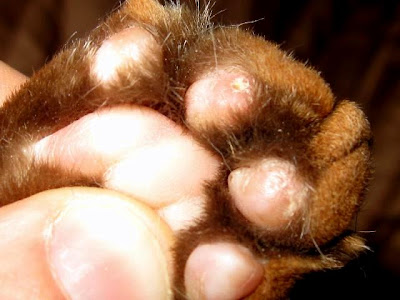
Hard damaged paw pads - photo: Susan Woodhouse
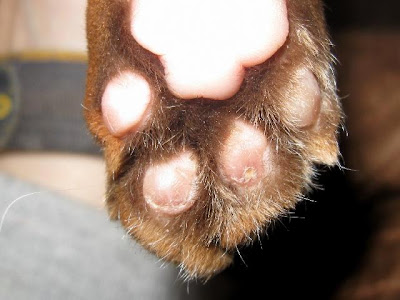
Hard damaged paw pads - photo: Susan Woodhouse
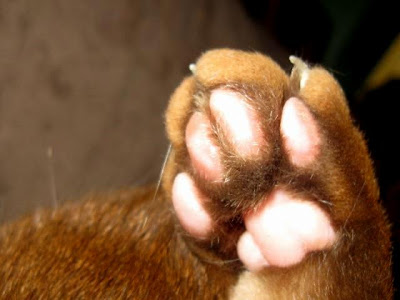
Healthy paw pads of hind feet that were not declawed
- photo: Susan Woodhouse
Cats Are Digitigrades! Stop Declawing Digitigrades! to Declawing Cats


Me too with bells on.This isn’t a site where people come to have grammar lessons,it’s a site where we come to learn or educate about cats and to fight the abuse of them and I think Micheal’s PoC is the best site on the internet for doing all of this.
Get a life Shiggy and do something yourself for animals rather than looking for grammar mistakes by people who are doing their best.
I completely support Ruth’s comment. Grammar is irrelevant provided the message is good and communicated well, which is the case here.
On the scale of this does grammatical perfection really count Shiggity?
I hardly think so when this brilliant article is about a cat who suffered all his life from cruel uneccessary surgery, a cat who Susan rescued and cared for at her own expense and who broke her heart when he died of cancer probably brouught on by the stress of struggling through his short life crippled.
The important thing is that people read it and learn from it and if it stops more cats suffering the same way as Mushu then Susan will be happy.
She is a wonderful lady who devotes her life to rescuing and caring for animals, to me that’s much more important than knowing whether to use who or whom.
Hi Shiggity. I have just seen that grammatical error in Susan’s post some time ago. Thank you for pointing it out. Excellent article don’t you think? It would have been nice if you had found the time to comment on the content rather than an irrelevant grammatical error. Thanks for visiting though.
You mean “who,” not “whom.” “Whom” is used as the object of a sentence, “who” is the subject of a sentence. “Whom” is not the formal version of “who.”