
Click here to see visitors’ submissions
Introduction
I am writing about my favorite cat (probably), the good old moggy (moggie) or non-purebred cat or random bred cat. It is also sometimes described as a “mixed breed” cat. The last description is probably the least accurate as cat breeds are not usually involved. Although a purebred cat “mix” is a moggie and is often one removed from a purebred cat.
A moggie can technically, it seems, be pedigreed. Although all the show cat breeds are also domestic cats, for the vast majority of us the non-purebred is the cat with which we are most familiar. The word “moggie” can also mean a stray cat. The non-pedigreed or non-purebred domestic cat is my favorite because (s)he is the sort of cat that I have always lived with. This “type” of cat is also the most commonly encountered cat worldwide, by far, obviously.
It is interesting to think that the first domestic cat was a tamed wildcat. That domestic cat was a defacto purebred cat in my opinion as its parentage was pure wildcat; African or Eurasian wildcat. This is thought to have happened some 9,000 years ago. When domestic cats spread from Egypt thousands of years ago they were lean, moderate sized cats like the African wildcat. Over thousands of years these cats evolved, through random breeding into domestic shorthair (DSH) and long haired cats (DLH) – moggies.
Then at the end of the 19th century the very same moggies became purebred show cats through selective cat breeding under the auspices of the fledgling cat fancy in England. The domestic cat had gone full circle from a defacto purebred cat at the beginning of domestication, through random breeding and back through selective breeding to become purebred cats. In northern countries the DSHs developed cobby (less lean) bodies.
This cobby moggie became the British Shorthair cat. These random bred shorthaired cats were also the foundation stock for the American Shorthair cat when they were imported with the pilgrims. The imported longhairs, Angoras, became the Maine Coon it is thought. In warmer climates the evolution of the moggie turned towards leaner body shapes allowing for better heat loss. The fur became thinner and the downy undercoat disappeared.
These cats are now called “foreign” in shape. The Abyssinian cat is one such example of a foreign cat body shape. Yet other moggies became rare unusual cat breeds through mutations such as the rex cats (e.g. Devon Rex) and folded eared cats (Scottish Fold). Sometimes a new breed of cat was created from the starting point of two different types of non-purebred domestic cat. An example is the Ragdoll cat. There is still little difference in appearance between the Scottish wildcat and the tabby domestic cat. Might this be due to cross breeding, wildcat to domestic cat producing wildcat hybrids?
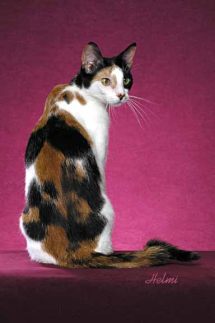
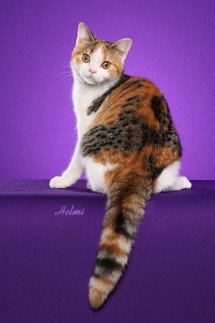
Kallie and Twist are both tortoiseshell & white or calico cats.
The non-pedigreed domestic cat has, it is said, the most chance of being the healthiest as the “gene pool” from which (s)he stems is extremely wide (as wide as it is possible to be)1.
A purebred cat needs to be bred with a cat of the same breed or breeds (and sometimes moggies) that are allowed by the registries or cat associations. This results in a purebred cat but a narrower gene pool. However, in some feral colonies there may be inbreeding so it is not always the case that non-purebred cats are more healthy.
This potential conflict (purity of breed -v- health) is very much in the minds of breeders and associations and (effectively?) dealt with though a balanced approach to breeding including some widening of the gene pool (out crossing) when required at an early stage in development of the breed. This would make the cat non-purebred for a while but still a pedigree cat, however (see below).
The word “moggie” apparently derives from the word “maggie” to describe old farmyard cows. This term came to be used in the cities to describe mangy, feral cats and then domestic cats generally. To an outsider there is a profusion of technical terms and some confusion about the meaning of the terms. There is an overlap in the use of the terms sometimes too.
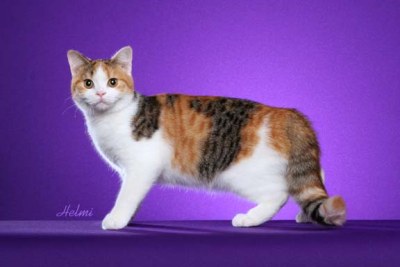
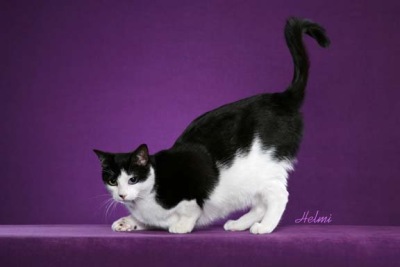
This is a short video of some great looking mixed-breed cats. All the photographs are by and copyright, Helmi Flick.
Terminology
Purebred and Pedigree Cat from Michael Broad on Vimeo.
Purebred cat: a cat whose parents and grandparents are all of the same breed. There are then 3 generations in total of cats of the same breed. A purebred cat has to have the characteristics of a recognized breed. Pedigree cat: 3 generations of this cat must be registered with a recognized cat registry such as the Cat Fanciers Association – CFA (USA) or the GCCF (UK). The parents or grandparents need not necessarily be cats of the same breed.
The difference between these 2 terms is all about registration of the cat. Registries have different views on what is a breed.
Moggy: Technically, a non-purebred cat or moggy can be a pedigree cat on the above definition. The word pedigree meaning a recorded and registered history. In contrast, the ordinary domestic cat that we know has parents of, usually, unknown or mixed breed and there is usually no record. This cat is therefore neither purebred nor pedigree. In practice we think of purebred cats as pedigree cat as this will most often be the case (i.e. purebred cats are often registered). Likewise we think of non-purebred cats as non-pedigree cats, which is almost all the time, the case.
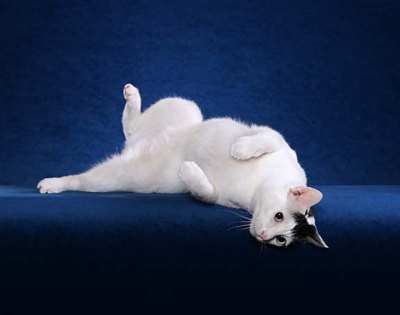
A bicolor cat carrying the white spotting gene
The Moggy and Purebred – characteristics
The purebred cats have well defined appearances. One purebred domestic cat has to be distinguishable from another. The moggy is a domestic cat that has mixed parentage and so hasn’t got this attribute. This cat is usually a short haired (dominant gene) cat of various coat colors and has a standard body conformation. These are called DSH – domestic short hair cats. Although some purebred cats are allowed by the cat associations to have a very wide range of coat types and colours – an almost infinite number.
The purebred cat, particularly the top show cat, as illustrated by Helmi Flick on this website has an eye catching and highly attractive appearance. Not all pedigree or purebred cats are as amazing as some of the cats on this website though. The major variation in appearance of the random bred domestic cat comes from the variation in coat color and pattern, the most common, of which, is the tabby coated cat (and tabby and white). Another frequently encountered coat is the tuxedo (black with a white spot on the chest).
The white spotting gene affects very many cat breeds none more so than the mixed breed cat. A discussion on the solid and white cat coat and many other coats can be seen on a blogger subdomain to this site, POC Blog (please use the labels or the search facility). The following link will take you to a long list of posts on varioius cat coats (link opens in a new window). As mentioned there is a greater prospect (minimized with careful and considerate breeding) for ill health with purebred cats due to inherited health problems and narrow gene pool.
The non-purebred domestic cat has hybrid vigor. In short the purebred cat is more cosmetically attractive but the moggy more durable, in general. Here is a comment from a visitor about her moggies:
To all the cats I loved before… Pinkie, Hansje, William, Bruintje, Witje, Poes Paul, Lodevicus, Bibi, Tim-Tim, Tigri, Micky, Didibri, Bageera, Beauty, Oberon, Hopper, Simon ‘Bollie’ Bolivar, Snoopy, Timmie, Yaba, Smokkelpoes a.k.a. Smoes, all Moggies that I loved and loved me back. What’s so special about a cat that swims, behaves like a dog, listens to his name, or bonds with humans? All of my Moggies had characteristics that you will find with specific cat breeds. The difference between a Moggie and a purebred cat seems to be their uniqueness in looks and behaviour. None of my moggies looked exactly like any other cat (Moggie or Breed), none of my moggies behaved exactly like any other cat. Maria Clara (Netherlands)
What Other Visitors Have Said
Click below to see contributions from other visitors to this page…
Cat Rescue in Poland
One hot day in June we went to the backyard (where we very seldom go, as it’s quite neglected) and noticed two small kittens, lying in the sun spot. Coming …
Two Little Mates! – Lola and Leandro
I have always loved cats and had a black and white tom called Jack for 17 years. His later years were shared with my mothers cavalier spaniel as we lived …
Lucky Girl – My Rescued Kitten
I was going home from a doctors appointment. I happened upon a red light. I looked out my window and down at the pavement. I saw a kitten on the curb. She …
Our Two Pretty Rescued Cats
Hi there! I am Ana from Mexico. I live in Mexico City. All my memories as a child include pets and I thank my parents for that. Now that am married …
Mia the Shadow Cat
Mia came to us as a stray. My postwoman friend had seen her on her delivery round, and known her from a kitten, then when she was only a few months old …
Audrey Hepburn in Breakfast At Tiffany’s
Audrey Hepburn in Breakfast At Tiffany’s had a cat. Oh yes..He looks like a male cat. He was a very well behaved cat. He was a moggie, mixed breed or …
Taz
Taz was a wonderful cat for 14 1/2 years. She passed away recently. She was a runt in a litter. She was amazing. All I or my wife would have to …
Brave Cat
Bravery does not mean having no fears. A man with no fears does foolish things and endangers others around him. Bravery is when you conquer your fears …
Cassandra (“Cassie”)
May I introduce Cassie? Cassandra (“Cassie”) is a beautiful black and white “tuxedo” medium hair cat. She is small, thin, feminine and shy. She is two …
A Totally Black Cat
One of my two female cats is totally black. Her name is Charcoal, nicknamed Charlie. I believe she is an American Shorthair but I got her from a shelter …
A hunter and a non-hunter, use of peripheral vision
Most cats, especially those that exhibit superior hunting motivations and skills, will prefer to use their peripheral vision most of the time. Others will …
My shelter moggy Snow White’s 2nd anniversary
Today is Snow White’s 2nd anniversary with us. Eight months earlier we had lost our wonderful young Somali Ivanhoe to FIP and as we came to realize he …
Our New Polydactyl Arrival
Last weekend we found a so called stray cat. My neighbor Bill (my fellow animal lover neighbor) kept asking me about a grey cat with white on it.
Dirk: No Dumpsters for this Beautiful Boy
I got Dirk in LA a little over 2 years ago, a little boy had him on a bus, and Dirk was about 4 weeks old. The boy told us he was going to throw the …
Adopted by 3 Boys
Back in 2002/03 I worked at an animal rescue. My job was to care for (feed, water, clean, medicate) the 200 or so cats at this shelter. I had at least …
I always choose mixed breed cats!
I have had many cats in my life—all of them mixed breed, and several of them adopted after being abandoned. These cats have proven to be the healthiest,…
Could you please tell me what breed my cats are?
I have a beautiful multi-color female cat (Bella), that just turned a year old in July. A friend of mine brought her cat (Symba) for a play date. She …
I am the proud caretaker of a sweet little moggy!
I rescued a sweet little kitten from the local shelter. I named her Church after the cat in “Pet Sematary”, but she isn’t a demon cat at all lol. She …
Our Alarm Clock Cat
My mom rescued a kitten from the home depot where she works. It was living outside in the garden section. She brought this kitten home. At first he …
Simon the Boat Cat
Simon was born a scraper, behind the Brockton V.A. Hospital in Brockton, MA. The cooks and security guards took care of the kittens until they could no …
I found a cat and children killed it
I found a cat, almost dying, what you would call a typically stray cat. I took it home and loved it, something no one around here understood at all. The …
New Found Joy
I have never really been a cat person, I always more wanted a dog. I was considering getting my kids a pet, but just hadn’t moved on it yet. The other …
The Cat I Loved
Her name was Tigger. She came to be by coming to me as a gift. A gift I didn’t even know I wanted. I started to reject her before I saw her. A neighbor …
Cat Lover
My little Polywig came to me from a household where the family decided they like dogs more than cats. Their new dogs killed Polywig’s Mom as she watched….
Possible Turkish Van or Turkish Angora cats
Visitors ask questions about their cat and whether they are cat breeds.
Two Gray Cats From Buenos Aires
Cinza and Noria arrived in a box, 2 weeks old and making a noise that sounded more like birds having a serious discussion. We were asked to take care …
Kitten Adopted Us!
About two years ago, a little kitten arrived at out home. He was terrified and hiding under our deck. We finally got him out and determined that he was …
Cat Attacks
There is a story circulating in England that a 19 year geriatric cat who sleeps all the time, gets up to attack postmen and then returns to his bed! Three …
The Loves Of My Life
Hi, all my life I was allergic to cats. I am from Chicago, Il. My husband and I moved to Arizona five years ago. We always had dogs as pets. When our …
A little Jynx and Serenity in my life
I was a first time cat owner. She was a beautiful calico cat. I had her since she was 4 months old. She was my joy in life. She ended up getting pregnant….
High Flying Nala
I have a cat named Nala and I have looked for her breed for two years. The animal hospital told my mother Nala was a special breed of cat but my mom …
I’m the lucky owner of 2 naughty moggie kittens!
I call them kittens because they act like them still but they are both 10 months old now! There’s Charlie, male, who is the mackerel Tabby (I think,…
Toki The Gift From The Other Side
Toki is not a pure-breed as far as I know. (Being more of an expert on dogs). She is a lovely tabby cat with green eyes. The story began around 2005….
Cat Etiquette for Non-Owners
It has come to my attention that people who refuse to fill a void in their life with a sweet and loving cat(or dog) have a different set of standards than …
My Baby Skye
I recently acquired a white longhaired cat when she was 6 months old. She was a stray that hung out at my Mom’s work. She was not friendly at first but …
The Bygone Era of the Outdoor Housecat
Sometimes I miss the by-gone era of the outdoor cat. Until I look at the list above. To my readers they are just names and causes of death. I remember …
Poor Goldie Was An Accident Waiting To Happen
I still remember the day I met Goldie in 1985. He was underneath a shrub in my mother-in-law’s yard. I could tell he was between 5-7 weeks old and the …
Frank Sinatra
Hello POC friends. I didn’t think a website called “Pictures of Cats” would be complete without a picture of Frank. This is my good friend GG’s cat,…
Huggy Bear Had Lived With 126 Other Cats
Huggy Bear was one of the most beautiful cats I’ve had the pleasure of owning. I was visiting my mama and had just walked in the door when she handed …
Carl My Old Girl Cat
Back in the 80s my elder brother had a great red and white tomcat. It’s origins were unclear, but allegedly he had found it abandoned somewhere and then …
My Cat Loves Water
I acquired a kitten one and a half years ago, originally in order not to send him to the Cat Protection League (CPL – a rescue organisation), little did …
Lola’s Story From Lonely Orphan to Indoor Queen
Lola came into our lives in July, 2009. My daughter Laura had spent the previous month “hinting” she wanted a cat. I thought our home was complete with …
Me and my Shadow
I adopted Shadow when she was about 3 weeks old. I say “about” because she was found abandoned up a tree near the local primary school, therefore any guess …
He’ll Love Me No Matter What
About 8 years ago, I found a tiny little runt under our car covered in oil. He looked to be about 5 weeks. I felt so bad that I took him and gave him a …
Ms Coco Chanel or Our Hershey Bar Kitty
Last spring (2009) our friend rescued three kittens. All of them were varying shades of brown. Rich dark brown points with slightly lighter brown bodies….
The Cat That Refuses A Name
Okay, so our cat was an abandoned cat by our neighbor. We first spotted her when she was sitting on the steps of said neighbor’s house. I instantly fell …
Cassiel The Dumpster Cat
It has been about sixteen years since Cassiel came to live with us . It was a day that pretty much started out as any other; off to work and out the …
Bigfoot’s Christmas Present To Me
I can’t remember Bigfoot ever being a homeless cat, wandering the neighborhood. He must have been abandoned by someone who moved, left to fend for himself….
Season’s Greetings from Denmark
A Very Merry Christmas and a Happy New Year to Michael and everybody else, who contribute to make Pictures of Cats such a great site. I learn something …
The Boss Cat
Although there are at present 11 in our “wild Bunch” one of the youngest toms, Caps, rules the roost. He demands that he eat first and on sunny days …
I Saw a Dead Cat Today
I saw a dead cat today on the way to buying a newspaper nearby. Nothing special really. Just sad. A women was checking if the cat was dead. It was obvious …
We Have Ten Cats!
We have ten cats that are all related. It started out as one unspayed female that belonged to my clueless boyfriend and dad. This is a list of our cats …
My Fur Baby Mixed Breed Cats
Every cat I’ve ever had has been a mixed-breed, to the point where I couldn’t tell what the heck they were mixes of. (Until my baby girl Amunet, that is,…
My Final Farewell to My Teacher, Pal and Best Friend
This is a story about my very first cat as an adult. I was always a dog owner till this ball of gray fur entered my life twenty years ago. I named him …
Thomas the Miracle Boy
Thomas came to us 3 years ago when his previous owner who had rescued him as a tiny kitten, passed away. She was a very dear friend of mine, & was only …
Moscow Cat Theatre
Lets remind ourselves what the Moscow Cat Theatre does. Here is a photo and two videos: Here is one on YouTube: OK it’s a …
I don’t Know What Breed Sunny Is
My cat is sort of a faded orange/yellow. I think its an Egyptian Mau because he has sort of a pouch of fat in between his thighs and looks a lot like one….
Mickie the Unknown Moggie
I’m a long-time, self-proclaimed ‘dog guy’ who took in my first stray cat, a very tiny kitten in my backyard mewing like crazy for its mother. It was …
My Mpoukitsa “Tiny Bite”
Abour 2 years ago, a tiny tiny kitten came outside my work place meowing (probably for food). She was the tiniest kitten i have ever seen, and also skinny …
Miss Lucy Queen of the Castle
I adopted Lucy 8 years ago from our local Humane Society when she was about 2 y.o. She had been rescued from a snare trap. When I got her she was very …
Yay for Moggies!
I love mixed breed cats! All of the cats i’ve ever had in my entire life (and now!) have been mixed breed cats! I mean, purebred cats are nice and all….
Boy Cat That Likes To Bark
My cat, Dakota likes to chase dogs, play fetch and even walks me to the bus stop in the morning and comes to meet me from it at night, much to the admiration …
Finnigan Fitzsimmons.
Hi, I adopted a 3-month-old male kitten this past April from a New York City shelter. When I first saw him, he was so cute and tiny and I automatically …
7 Cats
I have 7 moggies. One of which is pregnant and due to give birth any day (16/4/2009. Mum is a mixed tabby and is very temperamental. Although she is generally …
Origin of word Moggy
Moggy or moggie is an old British affectionate term for a domestic cat, but is also used as alternative name for a mongrel or mixed-breed cat whose ancestry …
Dilute Calico Cat
Hi, My name is Jana and we found our cat under a car in a vacant lot. We have been trying to find out what breed she is but with the help of your web site …
Cat Wool Sucking
Cat wool sucking is unnatural and is caused by an interruption to the natural and gradual process of a kitten coming off drinking mother’s milk and …
My Tommy Is So Dear To Me
Well I just wanted to write about my new addition to the family, Tommy! I never imagined that I would be a cat person because I love dogs. Well, my sister …
My Alice
I got Alice from my next door neighbor whose calico had four very different kittens. Alice was the only female and certainly calico by her coloring. She …
My cat Bella!
When Bella gets done using the litter box she will climb out, find the most near article of clothing on the floor bring it all the way back to the litter …
Scruffy our Spoiled Rug of a Cat
About 2 years ago my husband was working and saw some kittens that had got down in a ditch half full of water. They were very wet and hungry. My husband …
This Cat Needs A Vacation
Time for a quick break under the shade. Jun Lim
My Cat Double Trouble
Hello: Got this bundle of fur on his 5 week old birthday and was cute and short hair. As he got older, now he is 13 months old he is all fur that is soft ..
Don’t Forget the Elderly Shelter Cats
All children should at least once during their childhood experience the fun and joy of raising a kitten. That’s probably one of the reasons that the shelter …
TJ The Crackhead
I got my precious Moggie not even a year ago and I like to call him my lil cow since he’s got the spotting of a cow. He ran all over the house at first …
Xolie
I found her as a kitten 13 years ago. She thinks she’s the queen of the house! Her family was all killed in a factory fire, I happened to catch this one …
Honey AKA Honey Buns
I am not sure exactly when she was born because I got her from a local shelter. On her first visit to the vet back in March, he said she was around 6 …
Cat Training Problems
We should ask ourselves if cat training problems are, in fact, human expectation problems. What do we want and expect from our companion cat? I know …
Is My Cat A Moggie?
This is Peaches. He is my baby and I want to know what type of breed he is. My looking at some of the cats he seems to have some of the traits. He looks …
Sylvester Our Happy Cat Not rated yet
He was a rescue cat found to be neglected and ungroomed, dirty, out all hours of the day and night in a built up area of a big city. He was under 12 …
Peeper: A Tame Cat With a Wild Heart Not rated yet
Peeper was one of the smartest cats I had the pleasure of owning. She’s also one of the few I acquired on my own instead of rescuing. The first time I …
My Cat Jumong Not rated yet
Our cat has been with us for 3-4 years already..I’m not quite sure about it. she’s very playful like all of my cats..every time someone would ask what …
Can You Identify A Cat? Not rated yet
This is an email I received from David, a visitor to this website: I was wondering if you could help me identify a cat that my ex-roommate had. He is a …
Barney My Special Cat Companion Not rated yet
Let me tell you a little about Barney my special cat companion. He was born to a feral cat mother on October 24th 2008. An elderly lady found him and …
Best USA Cities for Cats Not rated yet
The ten best USA cities for cats, according to a website called, catalystcouncil.org are: Tampa, Phoenix, San Francisco, Portland (Ore.), Denver, Boston,…
Tabby and White Stray Not rated yet
Well, after my old Black Moggie Raz was killed in a RTA, I said no more cats then five weeks back, about eight years after losing poor Raz, a kitten found …
Mad Cats Not rated yet
People search for mad cats . First a slightly serious point. “Mad cats” can mean one of three things:
a cat that is acting oddly to us, perhaps in …
Registries and Moggies
TICA: Non-pedigrees. Moggies are known as Household Pets in the Cat Fancy. They do not need to be registered by the TICA to be shown at a TICA show.However, if you want to go on and win some rosettes in TICA shows, you should register with them and your Moggy will have to be “altered” (neutered or spayed). TICA say that Household Pets that have been altered are accepted for registration regardless of their appearance and parentage.
GCCF: This registry (the biggest in the UK), call all unregistered cats with one or more parents who are unregistered, Household Pets. This will nearly always mean moggies, but of course could mean the purest of purebred cats that had a complete parentage history but who was simply unregistered.Household Pets can be shown at all shows and without a guiding standard are judged on condition and temperament. They have their own class at the Supreme Show. The Moggies that you see at the Supreme Show are very special looking cats much like the ones you see on this page.
CFA: Thisregistry (the biggest at Jan 2008) has a Household Pet Class. Moggies can be shown without registration and if older than 8 months must be altered. There is no CFA standard (as is the case for all purebred cats) but they are judged on the things that count in the show world, such as disposition, unusual markings and overall uniqueness.Breeders
Of course there are none unless you factor in careless people who fail to neuter their cats.
You can pop down to the nearest rescue center and find the most beautiful moggy you saw and you will fall in love and spend a thousand precious and tender moments together over the long years ahead.
From Domestic Cat to Home page
Domestic cat – Sources:
