
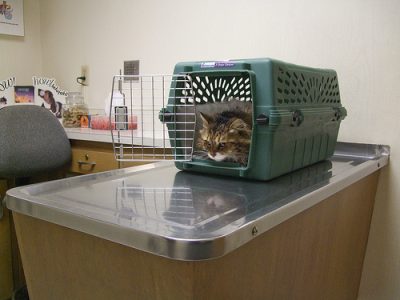
Feline Diabetes? No but this is a nice cat at the vets pic.
Photo by Scott Beale / Laughing Squid – laughingsquid.com.

Introduction
Feline diabetes was and still is something that I am particularly interested in as my cat is susceptible to it, being overweight, and in the past I have been fearful that she may have developed it. For a long time is was thought that if a cat was overweight she was susceptible to contracting diabetes. In fact this, it seems, is still the general view.
About 2.5% of cats taken to the vet are taken for feline diabetes. As there are an estimated 90 million domestic cats in the USA and about 7 million in the UK, there are an estimated 2.25 million diabetic cats in the USA and 175,000 in the UK. These are just examples of course. These are large numbers, almost frightening numbers.
What is causing the increase in percentage of cats that develop feline diabetes?
One veterinarian is convinced that it is linked to the changing diet of domestic cats and it’s our job to do something about it. Her name is Dr. Hodgkins.
Feline diabetes (diabetes mellitus) is a complicated disorder of the pancreas that concerns the metabolism of carbohydrates, fat and protein, which is caused by the inability of the cat with the condition to produce enough insulin (or to utilize it adequately). Insulin is a hormone.
Although it can occur in cats of any age, it is more likely to affect cats over the age of 6. It would seem that there is a greater incidence of this disease in Siamese cats. I am not sure if that cuts across all Siamese cats as there are now at least three types, the Modern (skinny), the Thai (classic Siamese) and the traditional Siamese (the original appearance). In my view the Modern is less healthy than the traditional (go to Siamese cat health problems).
Apparently many diabetic cats are neutered and overweight males (src: Your Cat by Dr. Hodgkins).
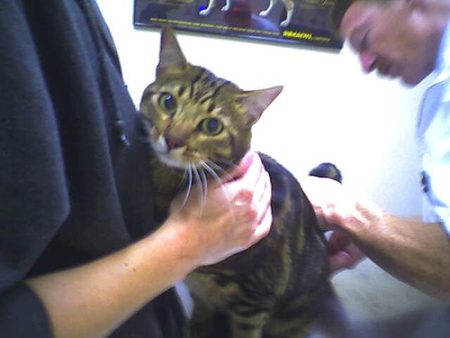
Cat at vets but as far as I am aware not for feline diabetes
Nice photo, nice face – photo by by Chuckumentary
What are the symptoms of feline diabetes?
If the following scenario is in place you might consider having your cat checked by a veterinarian for diabetes. These symptoms are however not exclusive to a diabetic cat. The symptoms are due to the cats inability to store or use glucose. This results in higher levels in the blood and some glucose is excreted in the urine. As glucose needs to be in solution (dissolved in water) water is lost from the cat in the urine. Hence greater thirst and more urine. These are some symptoms
- Your cat’s diet is made up, substantially, of dry cat food (if you subscribe to the Dr. Hodgkins theory as I do).
- Muscle wasting
- Your cat drinks more water than usual. This is noticeable as the water bowl will need topping up more frequently and the litter will have more urine in it.
- Many diabetic cats are overweight neutered males drinking a lot and urinating to excess.
- Your cats coat may be in poor condition (this though may be due to poor grooming due to being overweight).
- more technical indicators are the presence of jaundice and dehydration.
- Some diabetic cats walk with their hocks touching the ground. The hock is the part of the hind leg that extends up from the toes to the first joint (dwarf cats are prone to this due to their dwarfism).
- Sometimes, it is believed, the symptoms of diabetes are not apparent for a long time due to a “compensated state”. The diabetes may become apparent when and if the cat suffers another illness.
- I’ve added a short post on the Blogger site about symptoms of feline diabetes.
- your veterinarian will combine the above signs with a blood sugar level test.
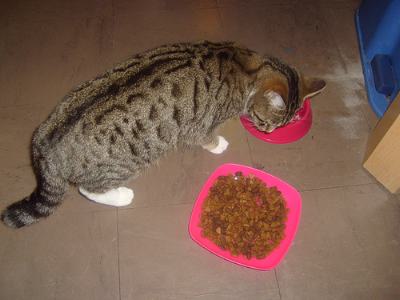
photograph © vovchychko
Cause of Diabetes
It is probably fair to say that there causes of feline diabetes is still work in progress. This explains the differing views on cause and treatments.
There are 2 types of diabetes. In type I (or 1), insulin dependent diabetes, the cat doesn’t produce enough insulin. The lack of production of insulin is due in turn to lack of functional beta cells. It is currently thought that the reason for this is due to genetic predisposition and environmental factors (e.g a viral infection).
In type II (or 2) diabetes the condition develops because the cells of the body do not respond to insulin. This may be due to overeating and being overweight. In overweight or obese cats there is a reduced number of “receptor sites” where insulin acts (src: Veterinary Notes for Cat Owners). Type 2 diabetes is caused by the pancreas not producing enough insulin to deal with large quantities of blood sugar released into the bloodstream (src: Your Cat by Dr. Hodgkins).
Dr. Elizabeth Hodgkins believes that one underlying cause of cats being overweight and diabetic is a diet of dry cat food (i.e. being overweight is not a cause). Although, of course a cat’s genetic make up dictates her susceptibility to such a condition. There has been an increase in dry food diets (highly convenient for supplier, buyer and cat) and a parallel increase in feline diabetes. The two, it seems, may be linked. Please see this example: EVO Cat Food.
Dry food is popular as it is convenient and modern mankind likes convenience as we are too busy for anything less than convenient. Dry cat food is high in sugar. If a cat has a genetic tendency to become diabetic, plus she/he eats dry food and she is an indoor cat, you have a potential recipe for the onset of diabetes, thinks Dr. Hodgkins. In other words the genetic tendency may be realized by the environmental factor of a high sugar content diet in dry cat food and a sedentary indoor lifestyle.
Diabetic cats on a dry food diet can become hypoglycemic (become faint through low blood sugar levels).
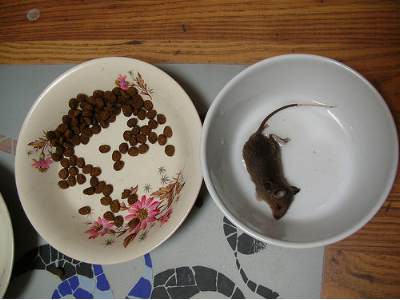
Photo © Mags
The Analysis
If your cat has the symptoms above see a vet. You can also use the human blood sugar level testers (glucometer) available in pharmacies to track blood sugar levels your cat under the direction of a vet.
The Cure
Clearly the starting point is a trip to the vet. Elizabeth Hodgkin’s views will not necessarily be the views of all vets. My vet, some years ago, advised an exclusively dry food diet for my cat (Hills RD or LD) as my cat was overweight. I didn’t want to comply as it sounded horribly boring so I have given her Hills LD and fish plus canned cat food.
However the mainstay of my cat’s diet had been dry food and I am sure that that this is incorrect. Cats are obligate carnivores (see header picture). The photograph above sums it up. The cat instinctively looks for meat. The cat food manufacturers instinctively manufacture food that humans find convenient (e.g. dry food) and the cat finds tasty (high in sugar, flavored and smelling good)
The cure, from Dr. Hodgkins’s point of view, is the immediate stopping of a dry food diet and a return to canned or wet cat food high in proper meat content and low in vegetable and sugar content. This though should be quality cat food low in starches. You can get canned food that is made for diabetic cats too.
In addition to the above your vet may advise regular shots of insulin to control sugar levels until they stabilize, under the new diet. Some cats will remain on insulin shots.
The conventional treatment of Type I (insulin dependent) diabetes is to administer insulin injections. The type of insulin, according to Dr. Hodgkins should be cow or cow+pig insulin which is nearest to cat insulin and therefore more effective.
Injections are daily (or twice daily) doses adjusted to the levels of glucose in the blood. Accidental over administering of insulin will result in a fall in blood sugar levels with accompanying signs of weakness and drowsiness in the cat. This can and must be rectified by giving the cat a sugar solution or some honey for example, which will be fast acting.
Conventional treatments support Dr. Hodgkin’s view in my opinion. A controlled diet is necessary. This diet should have less complex carbohydrates (starch), restricted fat content and more fiber. Less starch and more fiber avoids the temporary higher levels of glucose in the blood that would require more insulin to control. Diet control will also (or should also) have a beneficial effect on weight.
Type II diabetes (non-insulin dependent) can be controlled by combining the above diet with hypoglycemic drugs given by mouth and thereafter all being well by diet alone. This concurs with Dr. Hodgkins (above).
The prognosis
This is good. The cat may return to good health and a correct sugar level within several months, or sooner, under a carefully managed regime of insulin (if the vet advises) and her new diet.
Disclaimer
I don’t believe in non-vets trying to be vets. You can go very wrong. It’s alright taking risks with an inanimate object (like fixing your computer) but when it comes to ourselves and our fellow creatures risk is to be avoided. However, there is nothing wrong in studying a subject. Sometimes laypeople (non-experts) can know more of a certain subject that the experts for various reasons.
I would though advise people to read what Elizabeth Hodgkin’s says about feline diabetes yourself, see a vet and research the matter on line further. This article is meant to be an introduction only to this important and growing problem.
Source:
- My thanks to Elizabeth M Hodgkins DVM and her excellent book “Your Cat”
- Veterinary Notes for Cat Owners by Dr. Trevor Turner and Jean Turner VN
The photographs are reproduced under a creative commons license.
From Feline Diabetes to Cat Facts
