Home
Cat Breeds A-Z Photos of Breeds A-H
Photos of Breeds J-P
Photos of Breeds R-T
More Cats & Facts Fringe Cat Breeds
Wild Cats
Feral Cats
Cat Facts
Breeds Categorized
Rare Cat Breeds
Domestic Cat Size
Cats and Law
Cat History
Cat Health
Cat Appearance
Choose cat breed
Cat News
Cat Food
Declawing Cats
Fun and Cats Cat Videos
Cartoon Cats
Pictures of Cats
Warrior Cats
Top 4 Breeds Maine Coon
Traditional Siamese
Modern Siamese
Bengal Cats
Persian start here
PoC Admin + POC Updates
PoC Admin
Helmi Flick Photo
PoC Site Map

First Abyssinian Cat Zula, Zula

by Michael (PoC Admin)
(London UK)

The so called first Abyssinian cat, Zula Zula is shown below. The picture was created in 1874. I don’t know who created it. The timing of its creation fits quite nicely into the history of the Abyssinian cat. Zula is meant to be the cat that was brought back to England by an officer in the army who was based in Egypt and who might have also been to India.

The picture was first published (it seems) in a book by Dr. William Gordon Stables called Cats, Their Points and Characteristics and Curiosities of Cat Life 1874. Dr. William Stables was Scottish and he wrote a large number of books. He was not it seems a specialist on cats.

The truth is that we really don’t have much of a clue as to the history of the Abyssinian cat although a lot has been written (however see the picture and story in the comment below). I think what is more interesting about this picture is the appearance of the cat.

First abyssinian cat Zula, Zula

early-abyssinian-cat

I have also included the photograph, above, of an Abyssinian cat from 1907, which bears out the more stocky body conformation of this cat breed at this time. The two are very similar.

I have stated this before a number of times but it seems to occur quite a lot. The cat in the picture of Zula is considerably more cobby (less slender) than the current Abyssinian cat which is meant to be slender and athletic; what the cat fancy call “foreign” in body conformation. See Cat Body Shapes.

abyssinian-cat-photo-of-the-week

I think the above photo by Helmi Flick taken this year (2009) of Nobgoblin pretty well sums up the difference in conformation. A number of cat breeds have been transformed in this way.

If I am correct in that the Abyssinian has become more elegant during the 21st century because of breeding then it calls into question the argument that the cats depicted in Egyptian cat art are possibly Abyssinian cats because the cats that are the subject matter of sculptures and drawing etc. from Egypt of that era are considerably more slender than Zula. They are more likely to be Egyptian Maus (still feral cats today in Egypt), I feel.

A point though is that artists in those days were sometimes not that good at getting the proportions accurate and this may be a factor but the photo supports the appearance as being accurate.

I have discussed the history of the Abyssinian cat (Origins) but I am now inclined to believe that the Abyssinian is a cat created to look like a Jungle cat or was a Jungle cat hybrid, originally, in India. The Chausie is just that.

To have a cat called the first Abyssinian cat, Zula Zula is convenient. I am not sure it is possible to say a single cat is the first unless the cat has been deliberately breed, which is not meant to have happened with this breed.

First Abyssinian cat, Zula Zula to Abyssinian cat

Comments for
First Abyssinian Cat Zula, Zula

Average Rating starstarstarstarstar

Click here to add your own comments

Oct 24, 2009
Rating
starstarstarstarstar
Leiden cat
by: Michael

Hi Finn, yes I have heard of this cat. But there appears to be not much on it. What you have said is the best I have seen! I suppose the question is how it got there.

Oct 24, 2009
Rating
starstarstarstarstar
First Abyssinian Cat
by: Finn Frode, Denmark

I agree, Michael - the origian of the various breeds is an interesting subject and your article started chains of thoughts in many different directions with me. ;-)
Did you see the Leiden cat and what do you think of it?

Oct 24, 2009
Rating
starstarstarstarstar
Thanks
by: Michael

Hi Finn, thanks very much for adding to this article to complete the picture. Great stuff. It makes for a very useful article I think on this interesting area.

I think that the origin of the "natural" or "discovered" cat breeds is interesting and often the stories are clouded in some mystery so to try and shed some light on it is fun and I hope the article has some originality. Something hard to achieve on the internet.

Oct 24, 2009
Rating
starstarstarstarstar
The Leiden cat
by: Finn Frode, Denmark

Thank you for another interesting article. I agree that the notion of the Abyssinian cats as being descendants of ancient Egyptian cats does not hold water. But it's a nice romantic dream - and the elegant look of the cats does it's best to support it. Still it seems much more likely that the Indian 'Felis Chaus' jungle cat has played a role in the forming of the breed.

As to the bodyshape of the Abyssinian cat in the early days of cat fancy, I'm always a bit surprised to see those pictures. The "natural" cat breeds originating in warmer regions usually are smaller and less chubby than those from the cold regions - like Siamese versus British. A plausible explanation is that Indian jungle cats hybrids were already mixed with British domestic cats at the time of Zula Zula, but this is of course purely speculative.

When talking about the first Abyssinian cats, the Leiden cat must also be mentioned. It's a ruddy ticked cat purchased around 1833-34 for the National Museum af Natural History in Leiden, Holland. This was 40 years before the picture of Zula Zula!

I have not been able to verify facts from the homepage of the museum , but it's story is reported on a number of Aby pages. At the site of Belgian 'Nanu-Emuishéré' cattery two photos are shown. (Note for Michael: Since the pictures are on other sites as well, they may be public domain).

Alledgedly the founder of the museum bought the specimen from a supplier of small wild cat exhibits and labeled it "Patrie, domestica India". The cat clearly has a ruddy ticked coat and is of athletic build not that different from modern Abyssinian cats. The ears look more like a Felis Chaus (jungle cat) as do the tabby markings on the neck and front legs. It does not however, have the striped tail of the jungle cat, instead it carries the black stripe on top of it's back and tail, which is distinctively Abyssinian.

Since at that time nobody had even thought about the breed, this cat is of course no Abyssinian in the modern sense. More likely it is another hybrid between an Indian domestic cat and a Felis Chaus. The Netherlands were a major seafaring nation, so through the trade routes this cat ended up in Holland - just as other hybrid cats went to London on British ships.

When talking about the sea, let's not forget that until railways were built, the sea was what really connected regions - on land there were mountains, rivers and all kinds of obstacles. The vast Indian Ocean was routinely travelled by Arab, Indian and Chinese merchants for centuries before the first European explorers got there. So although East Africa and India now seems far appart, there once was a flourishing exchange of commodities, culture - and maybe cats. ;-)

Oct 24, 2009
Rating
starstarstarstarstar
A Post Script
by: Michael (PoC Admin)

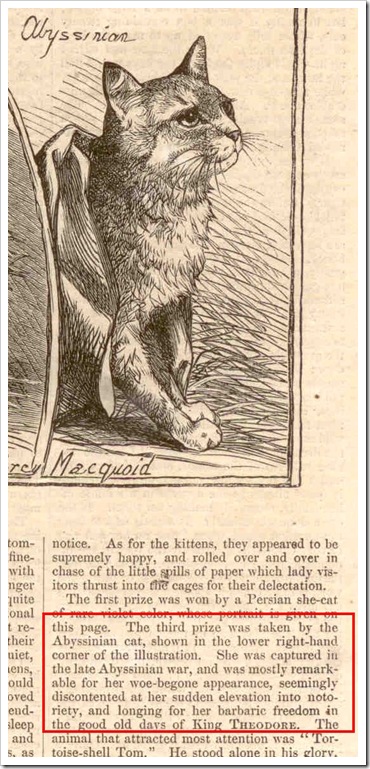
Here is a picture from a newspaper of what I think is Zula Zula. This cat came third at the Crystal Palace show. This may have been the first cat show.

early abyssinian cat at Crystal Palace show

Click here to add your own comments

Join in and write your own page! It's easy to do. How?
Simply click here to return to Abyssinian Cat Submissions


footer for pictures of cats page