

Taxonomy
| Scientific classification | |
| Kingdom | Animalia |
| Phylum | Chordata |
| Class | Mammalia |
| Order | Carnivora |
| Family | Felidae |
| Genus | Prionailurus |
| Species | P. bengalensis |
| Sub-species (ssp) | iriomotensis |
| Scientific name: Prionailurus bengalensis ssp. iriomotensis | |
| Japanese name: Iriomote-Yamaneko | |
Description
The house cat sized Iriomote cat is a subspecies of the leopard cat (sometimes referred to as the Asian Leopard Cat) and with the other subspecies, the Tsushima cat, it is Japan’s only wildcat3. At one time it was thought to be a separate species. Early taxonomy (classification of species) was based on morphology (the form and structure of organisms), but DNA testing has reduced the number of species generally, reclassifying species as subspecies. This is one example. The scientists who reclassified this wildcat are Masuda and Yoshida 1995, Johnson et al. 1999 and Eizirik et al. submitted). The phrase “et al” means “and others”.
Location
A central part of the description of this cat is the place where it lives as it is named after that place. The Japanese island of Iriomote (284 km²) is off the Taiwanese coast. Here is a Google map showing where the island is:
The island was once joined to the mainland (some 200,000 years ago) and this is how the Iriomote cat arrived in this area and eventually became isolated. Here is a nice general view of the island:
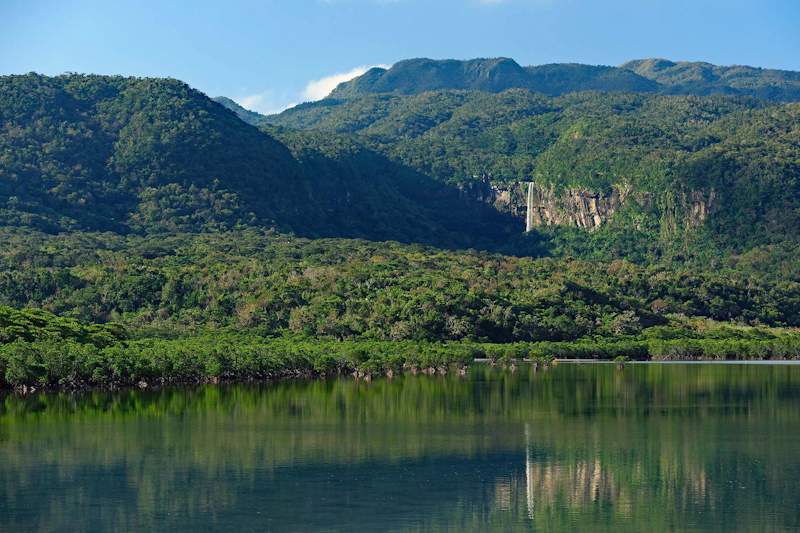
The island’s terrain is mainly low mountains below 460 meters covered with sub-tropical evergreen forest. There are “belts of mangrove along the waterways”2. These wildcat likes to live at lower elevations (nearer sea level) in wetlands and streams. They have home ranges of 1.4-5.8 km². This causes a conflict with people who also prefer to live in these areas.
The Iriomote cat is perhaps the world’s best studied wildcat with 130 cats being radio collared1. Yet despite this the cat remains on the edge of extinction in the wild.
Endangered
Here is a nice picture of this wildcat. Err yes, it’s stuffed, what else do you expect! This is a “Critically Endangered” and extremely rare small wild cat and I think it is appropriate to show this cat stuffed because before long that is probably all you will ever see of it. “Cars, hotel development, and the threat of a deadly frog fungus are pushing one of the world’s rarest wildcats closer to extinction, conservationists warn . . .”1 Its status as critically endangered is because its population is less than 250. In fact, it is probably less than 100. In 1994 its population was estimated (estimates are almost invariably inaccurate and optimistically so) at about 100, but there has been a declined due to loss of lowland habitat at accelerated rates2.

It is listed on CITES Appendix II (as Prionailurus iriomotensis). See CITES in relation to cats and IUCN Red List for cats.

It seems that of all the treats to this rare wild cat, the ubiquitous car accident is the main cause of its demise. There are many warning signs on the roadside but to no avail. The key threats are cars and lowland habitat destruction. Habitat destruction due to human population expansion and increased activity including commercial activity is perhaps the main threat to wildcats generally. Underpasses have been built on the island, which are being reviewed to make them more effective1.

Here is some habitat destruction on the island that I suspect is fairly typical:

2022: Well, the Red List say that the largest threats on 2022 are: road traffic accidents which kill these cats on the road and habitat loss. Also dog attacks and competition with feral cats makes survival harder toether with disease spread from domestic cats. Tourism is also detrimental as it increased road traffic and an enhanced risk of roadkill.

Notes:
1. http://news.nationalgeographic.com
2. IUCN Red List of Threatened Species®
3. Jim Sanderson, PhD.

How about not removing the reply area for about 48 hours?
I love the look of this cat.
I wonder why some are not transported off the island and onto better ground.