
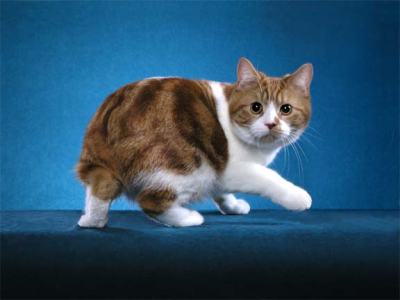
Manx cats – photograph ©copyright Helmi Flick
All the photos and text on this page are protected by copyright © except where indicated. Violations of copyright are reported to Google.com (DMCA).
Contents
- Introduction
- Origin
- History/Myths
- The Mutation
- Appearance
- Health overview
- Spina Bifida
- Atresia ani
- Rectal prolapse
- Pyoderma
- Other points of interest
- Breeders
 |  |  |  |
Note about the photos: The high quality pictures by Helmi Flick are of purebred Manx at cat shows. They are known to be cats of this breed and some will be champions. The photos above are thumbnails – click on them for larger format photos and more on the breed.
Please note: there are a couple of photographs by amateur photographers of cats described as Manx. They are probably not purebred and may simply be cats with a short tail but people do tend to refer to tailless cats as Manx cats. They are here to help illustrate this article.
Manx Cats are a cat breed that developed and evolved initially on a small island off the English Coast – The Isle of Man. The name in Manx (the language of the Isle of Man) is: Kayt Manninagh or Stubbin4. The exact origins of this breed are, in fact, unclear. I discuss the origins below. Despite being relatively rare it is one of the best known breeds outside the cat fancy perhaps because of its striking appearance and long history. It has been around a long time.
The exact genetics of this breed are not fully understood some would argue1. Similar mutations have occurred throughout the world. There are a number of colors that are acceptable by the associations (but some associations limit the spectrum2) and there are two coat lengths. The long haired Manx is called a Cymric in the USA. Although the name Cymric refers to the Welsh language the cat has no connection with Wales, UK.
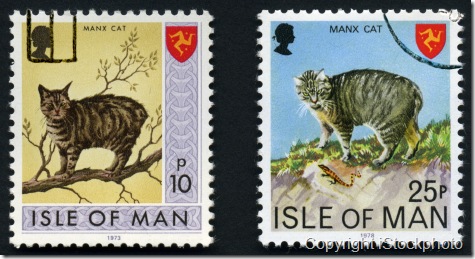
Manx cats are thought to have originated before the 1700s. Although there are some extraordinary myths describing how this came about, the taillessness is caused by a dominant genetic mutation (the genetic symbol for the mutated gene is M). The mutated gene has a high degree of penetration. This accounts for the Founder Effect and the establishment of this breed from a small number of original cats. Several breeds have been created through spontaneous genetic mutation (e.g. American Curl, Dwarf cats and Sphynx, for example), so this is not unusual….
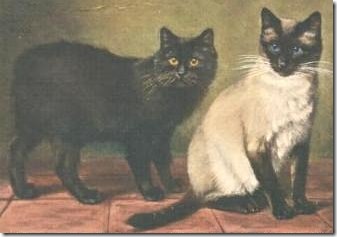
The above picture from 1903 of a Manx (left) and a Siamese (right) is interesting because it can be seen that they have similar body types, whereas today the Manx is considered “the absolute extreme of the cobby body”1 while the Modern Siamese has the most extreme of foreign type bodies. Today, then they are at the opposite ends of the body type spectrum as a result of selective breeding to make the breeds more outstanding in appearance. See cat body types for a description of these terms. The cat below, Manx Silverwing, a champion from a bygone era, also shows how the body shape has evolved in breeding:

…What is perhaps unusual is that the genetic mutation happened several centuries ago. Although this may simply be a question of when the cat demonstrating the mutation was discovered and when people became interested in the cat. The other mutations are fairly recent or at least have been noted/discovered fairly recently.
credit: weretable
The history of the cat is bound up with the Isle of Man (see the embedded map below for the location. The blue flag can be clicked for a photograph of the island). The mutation happened on a small island and the breed has developed on that island with limited interaction with other breeds.
It could be argued that this is a natural cat as they have had limited opportunities to intermingle with any other breed. However, the origins are not altogether clear. Although, the Isle of Man is small (33 miles by 13 miles, population 80,000), it was a center for smuggling and in the late 1700s it was described as a place to store contraband from various countries on Continental Europe (as it is now).
Perhaps then Manx cats were brought in on ships from the Continent? In any event the breed has a long history including recognition by the CFA since the 1920s. It is then a very well established cat breed but I am a little surprised when considering the health implications of this defective gene. Click on the following link to see how Manx cats relate to other cat breed in respect of a cat history time line. A point of interest is that the first pedigree cat club for native shorthaired cats, the Short Haired Cat Society and Manx Club was formed in 1901 and represented this breed. The club was in part set up to champion the British Shorthair cat that was at the time becoming less desirable than the Persians and Siamese cats. These were the early days of the cat fancy.
The maps below show where the Isle of Man is – midway between Northern Ireland and England. If you click on the blue place markers you will some information.
View Manx Cat Place of Origin in a larger map
Here is an interesting snippet from a journal, “The magazine of natural history, and journal of zoology, botany, mineralogy” … – Page 134 and dated 1834

From this it can be seen that Manx cats probably inhabited a small island at the southern extremity of the Isle of Man called “the Calf of Man”.
This is not one of the rare cat breeds but is somewhere in the middle in terms of rarity on my estimation. The same applies with respect to weight and size.
History/Myths
There is documentary evidence of the existence of tailless cats in Cornwall and Dorset in 1837. In 1909 the evidence suggests that this cat was called a Manx cat. Much like the Japanese Bobtail, there are numerous legends surrounding the Manx cat.
| Date | Event |
| ? | Myths about a cat losing its tail in Noah’s Ark door! And importation on ships from Japan (Japanese Bobtail – this is wrong as it carries a different genetic mutation). |
| 1588 | First Rumpy came in off a ship wrecked of Spanish Head at the time of the Spanish Armada. |
| 1730 | Research on the Manx language indicated the mutation occurred around this time. |
| 1750 | The tailless cat called “Stubbin”, an English word. The Manx language was used until 1750 indicating the cat arrived after 1750. |
| 1845 | A writer describes the Manx as a cross between a rabbit and a cat having some of the characteristics of a rabbit. |
| late 1800s? | Belief that amputation of a tail either naturally or purposefully (by docking) can result, in the cat who has had her tail docked, having tailless offspring.
|
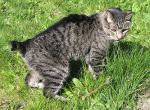
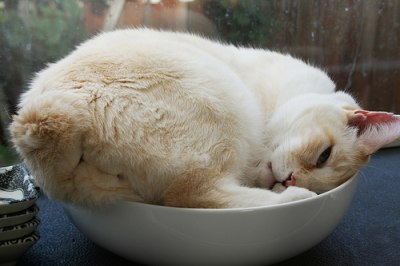
Manx-Flame point Siamese cat cross. That is what I think but I’d like the photographer to tell me. Photo © by ex.libris under a creative commons license.
As the taillessness is caused by a dominant gene mutation (M), if the Manx is out crossed with another breed say a domestic shorthair cat the result will be that at least half the litter carry the tailless gene. However, not all Manx cats are tailless. There is a range from fully tailed to without a tail (show quality). Indeed the some Manx cats have an indention where the tail should be. The range then is from a “negative tail” to a full tail. It is thought that the range of tails is due to the presence of modifying “polygenes” (multiple genes):
| Tail length | Description | Comment |
| Dimple for tail | Dimple rumpy or rumpy | Show quality. This is susceptible to pyoderma |
| No tail | Rumpy | Show quality |
| Lump of cartilage/vertebrae where tail should be | Riser or rumpy riser – can be divided into rumpy high riser and rumpy low riser – you can’t feel the cartilage when the cat is relaxed in the low riser. | Show quality-can be felt when cat is happy (i.e. “tail” is erect) -the lump musn’t stop the hand when stroking cat |
| Short tail | Stumpy – tail is movable although sometimes deformed and kinked. |  Pet quality – the photo above is of Inka who lives (or lived) in Finland3. Wikimedia User: Jonik |
| Normal tail (shorter than average however) | Longy or tailed | Pet qualitynotes |
| No tail – docked | Docked | Cat had a tail and breeder had it docked – see below. |
Manx cats are heterozygous for the gene (M/m). Where the cat is homozygous the gene is fatal (in the womb – “prenatal fatal”2) or if born the kitten has severe abnormalities1. Studies have indicated however that 24% of embryos that were the result of Manx to Manx breeding (homozygous) were reabsorbed in utero2
There are reports that at the age that the kittens start to eat solid food they begin to lose their health1.
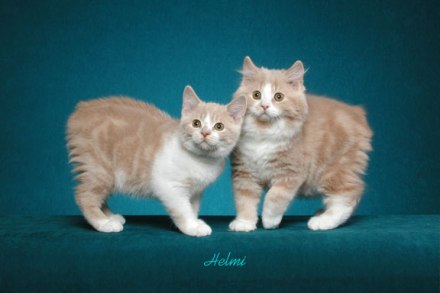
Copyright Helmi Flick
If the cat is born a stumpy or longy the breeder will dock (amputate) the tail. This is ostensibly to prevent the possibility of the tail becoming arthritic and becoming painful later in the cat’s life. My thought (and this is only my thought) is that the tails are also being docked to allow the breeder to sell a cat that the public associate with the Manx, namely a tailless cat.
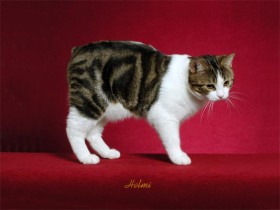
Photograph copyright Helmi Flick
What happens to the tailed Manx cats? They will look like “any other cat” more or less so will be less valuable to the breeder (this is disputed by Kay – see comment). The reason for docking is probably twofold – cosmetic and medical but may be more for cosmetic reasons. Apparently docking is more prevalent in the USA. Manx cats come in every color and pattern and hair length. As mentioned above, the long haired Manx is called the Cymric by some Registries.
The Cat Fanciers Association (CFA) do not accept the pointed or Himalayan pattern. Helmi’s photographs provide the best illustration of appearance. Please click on the thumbnails for more detail on the appearance. Other than the lack of a tail the outstanding feature is the fact that, more so than normal, the back legs are longer than the front. That accounts for the posture in some of the photographs. Manx cats have stocky cobby bodies.
Health – manx cat health problems
Note: Manx cat breeders manage/control these health issues.
A cat’s health is the most important issue and about 60% or more of visitors to this website consider a cat breed’s health to be very important. Mutated genes sometimes don’t just cause a single change in the physical appearance of the cat. Often there are other abnormalities, which are detrimental to the cat’s health (e.g. Dwarf Cats, Bob-tail).
In this instance the mutated gene that leaves the cat without a tail also shortens the spine (this is an extension of losing the tail). This causes secondary health problems that ultimately prove fatal. The answer as usual comes down to wise and sensible breeding with the cat’s wellbeing as the center of interest.
This condition is called Manx Syndrome. It most commonly occurs when rumpy is bred to rumpy. The breeder therefore breeds from tailed Manx Cats to minimize the condition. The client is protected as the breeder will hold onto to the cat up until a time when the condition manifests itself (max 4 months after birth). This also allows Manx Cats to be socialized.
As mentioned, breeding evidence indicates that cats that are homozygous (two copies of the “defective” gene at the same locus [location on the chromosome]) die before birth. In other word the gene is lethal in homozygous form, which is potentially a desirable form as the cat would breed “true” (all offspring would be tailless). The Manx cat will never breed true because of this deficiency. Also the size of Manx litters are small as a quarter of Manx/Manx mating are lost.
The M gene’s presence is not solely demonstrated in the shortened tail. Its effect is present throughout the vertebral column of Manx cats and elsewhere. The M allele disrupts the normal development of the caudal neural tube during the growth of the embryo2. Here is a list conditions caused by this allele:
| Area of body | Defect |
| Upper spine (towards head) | Individual vertebra are slightly shortened |
| Lower part of spine | Decrease in number and fusion of vertebra |
| Sacral Bone | Badly developed |
| Pelvic Bone | badly developed |
| Spinal cord | Some cases of Spina Bifida. This is a congenital defect of the spine due to a defective vertebra |
| Bowel | Occasional “bowel stoppage” due to a narrow anal opening. This is caused by the nerve supply being disrupted by the loss of the sacral cord segment2. |
| Spine | Sometimes terminates too short causing various problems such as hind leg paralysis. |
It would seem that a number of kittens are born with severe disabilities, which the cat breeder will have to euthanize. On this basis the Manx cat as a breed is not in my opinion viable and I am surprised that this cat is registered with the CFA, TICA and FIFe (this is only my view of course).
One last health issue. Manx cats can as a result of spinal developmental deformities suffer from constipation and fecal incontinence -see below.
Manx cats – Updates 18-10-08 – some more detail5: The Manx gene can affect these areas of the body resulting in abnormalities.
Spina Bifida This is a malformation of the vertebrae and the spinal cord because of the nonfusion of the neural tube and vertebrae arches at the sacrococcygeal junction. This could cause the cat to suffer from the following:-
- Fecal incontinence (due to be able to close the anus)
- Urine incontinence may also be present
- Megacolon
- Constipation
- Hind limb weakness
- Hind limb incoordination
- Hopping rather than running
Other spinal cord defects and brain abnormalities have been reported.
Atresia ani. This is a disorder of the anus. It is also called imperferate anus. A membrane covers the anal opening. The sphincter muscle is intact but could be weak and there is a nerve supply. Symptoms are no feces, abdominal extension and bulging perineum and tenesmus. It is resolved through surgery.
Rectal prolapse Straining to pass feces can cause rectal prolapse. This is when the walls of the rectum protrude through the anus and are visible. It can treated and should be treated quickly to minimize the degree of treatment required.
Pyoderma
This is a puss filled skin disease. The dimple for a tail is apparently susceptible to this disease. The dimple should be kept clean. If it develops the hair should be clipped and antibiotic cream and astringent (a chemical that constricts body tissue) applied.
Sometimes Manx cats can suffer from arthritis due to the shortened tail. These cats sometimes (routinely perhaps) have their tails docked (cut off)4.
- Manx cats are very playful.
- Good jumper due to powerful hind quarters and they like high vantage points. The tail is a balancing tool so without one the strong hind legs compensate1.
- Medium sized
- Slow developers
- Hind legs noticeably longer than front legs
- Good hunter (probably used as a mouser in days gone by). They are still used it seems for that purpose4.
- Note: a tailless cat is not automatically a Manx Cat – there is a genetic difference between the Manx and the Domestic Tailless Cat
- There is a local variety of bobtail cats that are like the Manx and which are found in and around Cape Breton, Nova Scotia. This is about 500 miles north east of Maine, USA, the home of the Maine Coon cat. These tailless cats are called the Cape Breton Bobtail. They are less cobby than the Manx.
I have picked these on the basis that they have a good presence on the internet (as at late 2007 – things change, some of these links may become broken in time despite checks). This indicates that they have been around for a reasonable time at least. Please check out “on the ground”. These links open in a new window.
Karello Manx
This breeder located in rural Pennsylvania, USA. Concerned breeder. Google Page Rank for site. No Alexa rank (low traffic relatively) for website. Ranked top of Google for Manx Cat search. Looks good. Good views on docking of tail.
Vagary Mews Manx
Located in North Carolina, USA. Website is Alexa ranked and it is Google Page ranked. First page of Google listing.
Dey Dream Manx
Once again this website came up on page one of Google. Small cattery. Manx specialists. Located in Central New Jersey, Eastampton, NJ 08060.
Briar-Brae Cattery – this cattery’s website no longer exists it seems and therefore perhaps they have closed (at Feb 2016)
Listed page 3 on Google search. No Alexa listing but claim to be in business of breeding Manx cats since 1961. Located in Rio Rancho, New Mexico. Google page ranked.
Titania Cattery – Champion Manx Cats
Located here (plus directions) Take I-80, I-81, or the Pennsylvania Turnpike NE Extension Rte. 476 to Wilkes Barre. Listed page 3 Google. No Alexa rank (low traffic). White Website. Update 16th April 2012. I have received a report from a visitor to this site that this breeder was good but is no longer and that the cats are kept in very poor conditions. The kittens bought by this person were not socialised and they suffered from Manx Syndrome. This cattery is therefore not recommended unless counter reports come to light.
- “Founder Effect” means that the effect of creating (“founding”) a new population from a small number of founding original cats of the breed.

Credit: weretable - The word “penetration” in genetic terms describes the proportion of individuals who demonstrate the physical characteristics of the mutated gene in comparison to the number of individuals who carry the mutated gene. So high penetration means a high proportion of Manx Cats have short or no tail when they have the tailless gene.
- “Pet Quality” is not a lesser quality.
Sources:
- http://www.isleofman.com
- CFA
- http://www.smuggling.co.uk
- Wikipedia – definitions
- http://www.fanciers.com/
- Messybeast
- Robinson’s Genetics for Cat Breeders and Veterinarians
- Medical, Genetic & Behavioral Aspects of Purebred cats Edited by Ross D. CLark DVM.
Sources other than above:
1. Legacy of the Cat – Gloria Stephens and Tetsu
2. Robinson’s Genetics for Cat Breeders and Veterinarians 4th Edition
5. Medical, Genetic & Behavioral Aspects of Purebred Cats Edited by Ross D. Clark DVM

Hi! I think my 1 year old cat is most likely a long-tailed manx. I want to stay aware of any potential issues so I can take good care of her. What indicated to you that she had a UTI? so like what do you recommend I watch out for. Any advice is appreciated!!
I had a Siamese/Manx for 16 years. Her Momma was a black Manx & Dad a Siamese. She never had bathroom issues, but was prone to UTI’s & low thyroid. With the proper medications, she was able to live a long, happy life. I miss her so much! She was a joy to have around! I recommend anyone who wants a playful, intelligent cat to consider a Manx. You won’t regret it!
Thanks Kay. I have added a short amendment.