

Aug. 2009: This page is about a small wild cat species called the Oncilla. It contains a map of the range of the Oncilla but this page, in fact, contains a lot more than the distribution of this smallest of the South American wild cats, weighing between 1.5 to 3 kilograms (2.9 lbs to 6.6 lbs). This weight puts it below the average weight of our domestic cats (see Largest Domestic Cat Breed and Wild Cat Species by Size). The scientific name for this cat is Leopardus tigrinus.
The map below in an embedded one from this original: Oncilla Range 2009, which is a map that I made but it is open to the public and also open to collaboration from anyone willing and able to improve it. It can be changed using Google My Maps and if you are unfamiliar with this program please take a look at the video in this section. The Oncilla is distinguished by being one of the smallest wild cats and one that has as many names as the Puma! The map, by the way is accurately based on the IUCN Red List of Threatened Species™ map (Red List).
| Some differences between oncilla and margay |
|
Oncilla Names
This cat has the following additional names:
- Little Spotted Cat, Little Tiger Cat, Tiger Cat (Red List)
- Little Spotted Cat, Lesser Spotted Cat, Tiger Cat, Ocelot Cat and more..(Sunquist 2002). The margay and ocelot can also be called some of these names indicating a bit of confusion and similarity between these wild cats.
Appearance
As mentioned, the oncilla looks similar to the margay and ocelot and research indicates that they are closely related (Sunquist). In fact there may be an argument for splitting the oncilla into two species as there is thought to be a difference between the oncilla that inhabits Central and South Brazil and the cat in Costa Rica. The difference in these two potentially new oncilla species is similar to the difference between the margay, ocelot and oncilla. Some say the oncilla should be split into three not two species.
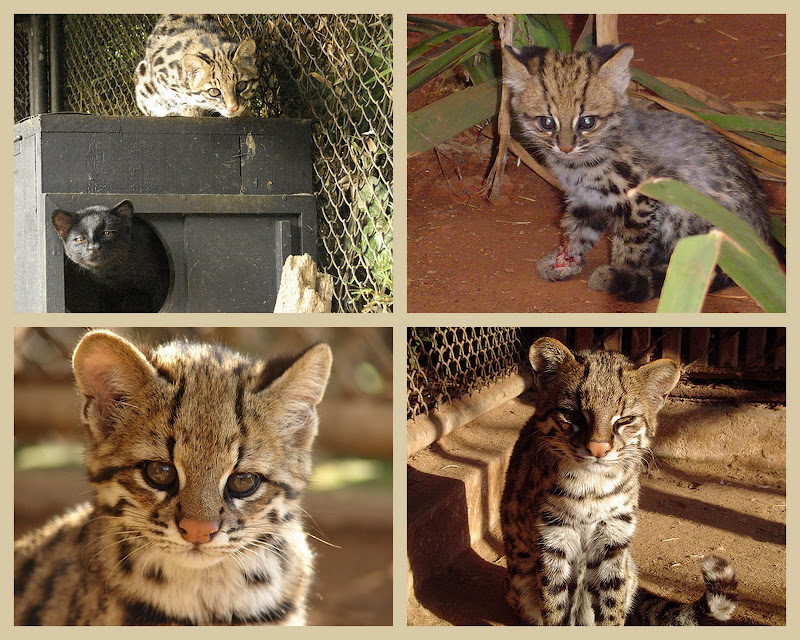
Melanistic oncillas (black) are not uncommon in the rainforests. An example is top left in the collage adjacent.
The oncilla has the following features:
- the fur is thick and soft, light brown to dark ocre. The spots are open (rosettes – holes in the middle ), irregularly shaped and dark brown or black
- the undersides are paler and has dark spots
- the tail has rings
- the backs of the ear flaps are black with bold ocelli (white ear spot)
- the legs have spots tapering to smaller spots near the paws
Distribution – Oncilla Range
Well, the map, of course tells the story as at 2009. Things are constantly changing, usually in a detrimental way for the cat with financial benefits
for people. The range is large but occupancy of the range by the oncilla is localised. This means that the cat is not distributed entirely or evenly over area indicated in the map. Also the quality and size of the habitat is diminishing due to human activity (see Threats and Conservation below).
The countries included in the oncilla range are:
- Argentina
- Bolivia
- Brazil
- Colombia
- Costa Rica
- Ecuador
- French Guiana
- Guyana
- Panama
- Paraguay
- Peru
- Suriname
- Venezuela
Ecology – Behavior
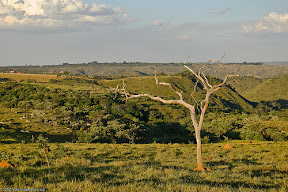
Despite the acrobatic nature of the oncilla’s tree climbing skills (see video) this cat is not (as once thought) confined to forest life in the oncilla range. They inhabit a variety of landscapes including:
- subtropical forest
- savannas (cerrado) in Brazil (see photo right)
- thorny scrub land in Brazil for example
- urban landscape: São Paolo
- from sea level to about 4,000 metres above sea level
At 2002, little was known about this cat in the wild. However sometimes people can discover information about a cat’s eating habits from stomach contents of dead cats. Yes, sounds a bit gruesome but it is effective for secretive cats. Such research shows that the prey of the oncilla includes:
- normally ground living animals (despite the oncillas tree climbing skills) of less than 100 grams such as:
- deer mice
- pocket mice
- shrew
- birds
- rodents generally
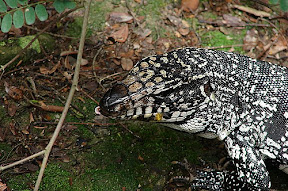
- lizards (Teiidae – see picture right) – preying on lizards encourages the oncilla to be diurnal as these lizards are diurnal (daytime activity). Many wild cats are crepuscular meaning dawn and dusk activity.
- insects (grasshoppers, centipedes, beetles for example)
On reproduction, the little that we know includes the following:
- oncilla is on heat (in estrous) for between 3 – 9 days
- pregnancy (gestation) is about 75 days
- litter size is usually a single kitten weighing 92 – 134 grams (average litter size is 1.12 kittens)
- kitten opens eyes at 8 – 17 days
- kitten eats solid food at between 38 – 56 days of age
- Kitten weaned at about 3 months of age
- adult cat at about 11+ months of age
Threats and ConservationListed as Vulnerable by the Red List.

The reason for this classification is:
- previously widely hunted for its fur. For example in 1983, over 84,000 skins were traded!
- low densities in localized areas within a wide range. It seems that the size of the oncilla range is misleading by giving the impression that there is a high and secure population. However within the oncilla range there would seem to be fragmentation in addition to low densities (as low as 0.01/100 km² in some places). Where there is higher densities of oncillas it is outside the protected areas leaving them vulnerable to habitat loss, habitat “degradation” and conversion of habitat to plantations (is this palm oil? – probably and certainly coffee plantations) through human activity.
- being killed by farmers etc. because the oncilla treats poulty as prey (answer: better protect the poultry and stop destroying the cat’s habitat).
- despite prohibitions on hunting (since 1981) and CITES Appendix I “protection” (1989 – but it is paper protection, I would argue) it is still hunted. CITES Appendix I is intended to prevent trade in animal parts in species thus classified. Unfortunately enforcement is not the most effective.
- road traffic. Yes even wild cats suffer from that hazard.
- hybridization with Geoffroy’s cat
- the ocelot has a negative impact on the oncilla and reduced densities of oncilla are found when the ocelot shares the oncilla range.
- projected heavy decline in population by 30% over next 18 years.
- The EEC has banned all imports of oncilla skins (1986).
Sources: Red List, Sunquists and as stated in text. Great care has been taken to ensure that the information is accurate at 2009. From Oncilla Range to Wild Cat Species.

Well, you can’t be serious in the words of John McEnroe.
I auctally found this more entertaining than James Joyce.