
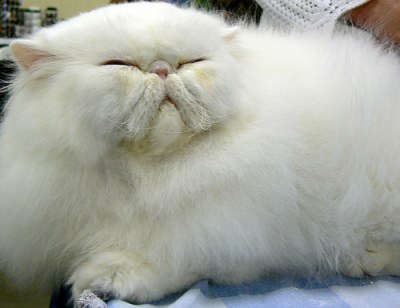
to simply illustrate the page – photo by ~Sage~
Do Persian cats suffer from health problems? Well, yes and no. You can read about them here. But don’t make the presumption that Persian cats are all automatically unhealthy – they are not. It really depends in my opinion on the breeders (if you buy from a breeder) and how they deal with the health issues raised here. And also we should remember that the Himalayan cat breed is simply a pointed Persian, and the Exotic Shorthair is a shorthaired Persian, so what is said here applies to these cat breeds too.
The difference between Ultra Persians and Traditional Persians is the effect breeding has had on their facial appearance and underlying bone structure. They have a “brachycephalic” skull – short and round with a flat face. See: cat head shape for the range of shapes of different breeds. See also a discussion on the change from trad to extreme. So, in answer to the question as to whether the Traditional is more healthy than the Ultra, the answer is “yes” (that doesn’t mean all Traditional Persians are more healthy). As mentioned, this is because of the health issues associated with the “Pekingese” look of the contemporary Persian cat (as the CFA described it in 1969 – the dog equivalent is the Pekingese). These issues are breathing and sinus problems and, as described on this page, tear duct overflow.
Other health problems caused by this unnatural head and face are “abnormal alignment of the teeth, and impaired respiration….compaction of the teeth….overshot lower jaw”1. Although not really a Persian cat health problem, the very thick, dense and long coat requires “a great deal of daily care..”1. If not health problems could ensue. This last point could apply to traditional and extreme cats.
In addition brachycephalic cats such as the Persian and Himalayan are prone to respiratory infections because they have less area for the protective muccociliary blanket. This is a mucous membrane which lines the nasal cavity tapping bacteria and foreign bodies. It is the first line of defence against infection.
Update Sept. 2010: Richard lives with a 3 month old ultra Persian and refers to his problems with Persian cat health problems: My Little Magpie.
| Important: please go to the base of this page to see the sources of this information, which discusses potential Persian cat health problems. I only use quality, authoritative and informative sources. |
Update March 2011: Persian cats have a predisposition to cancerous eye tumors and basal cell carcinomas that are malignant – see Cat Skin Cancer.
Persian cat health problems can take the following form, nostril constriction, cherry eye, tear duct overflow, dental malocclusions, polycystic kidney disease, entropion, and seborrhea oleosa.
An inherited disease exists within the Persian cat breed. The disease is called Progressive retinal atrophy (PRA). It causes blindness. It affects other mammals including humans. It is early onset in Persians. Read about Bengal cats and PRA.
Below, I focus on two health issues, polycystic kidney disease and tear duct overflow as common Persian cat health problems.
PKD1 Quick read reference Persian cat health problems
| PKD1 Polycystic Kidney Disease |
| PKD1 has gone unnoticed for many years and has spread throughout the Persian breed. |
| In Persians, the condition has been shown to be inherited as a single autosomal (any of the chromosomes other than the sex-determining chromosomes) dominant gene |
| It is estimated that over 37% of Persians have PKD1, a breed that accounts for nearly 80% of the cat fancy. |
| PKD1 is most common in the Persians and breeds that are related to Persians or have used them in breeding programs |
| Other breeds may have inherited PKD1 from an accidental use of either a purebred or random bred cat that had the heritable form of PKD1 |
| Generally, 50% of PKD1 positive cats’ offspring will inherit PKD1 |
| It is slowly progressive disease |
| It shows up later in the cat’s life at on average 7 yrs of age – a late onset renal disease |
| The cysts in the kidneys are in existence from birth and become visible early in life |
| It results in kidney enlargement and dysfunction |
| The cysts grow and enlarge the kidney resulting in kidney failure |
| Kidney failure is certain if and when the cysts grow |
| Symptoms are: |
|
| Diagnosis |
| PKD is most easily diagnosed by ultrasound, which can identify the disease very early in its course. |
| When carried out by experienced personnel using proper equipment, ultrasound diagnosis is 98% accurate after approximately 10 months of age. |
| What can be done? |
| Greatly reduce this frequency by using ultrasound screening (and now DNA screening) methods and improved breeding practices (see below). |
| Which cats should be tested? |
| British Shorthair, Persians, Exotics, Scottish Fold, Himalayans and Persian out-crosses only |
| What can owners and breeders do? |
| Testing for Persian PKD1 can be performed as early as 2 weeks of age. |
| Cat owners will be able to collect their own samples, without a veterinarian. |
| Wait 60 minutes if the cat has been eating, drinking or nursing before sampling. |
| The swabs are stable at room temperature indefinitely. They can be shipped to any laboratory offering the test worldwide. Regular post can be used. |
| the contacts page of Veterinary Genetics Laboratory is:- http://www.vgl.ucdavis.edu/contacts.html |
| Breeders should visit Dr Lyons’ Website for advice on dealing with this disease and to take part in a survey: http://faculty.vetmed.ucdavis.edu/faculty/lalyons/Sites/PKDDNAtest.htm Also visit CFA website. |
| Experts conclude that Breeders need to work with scientist to reduce the occurrence of this disease through a breeding programme. I am sure this is happening as this is clearly one of the exotic Persian cat health problems. |
| For Genetic Diseases in Persian Cats generally, please see this page: Persian Cat Inherited Diseases |
 Feline Kidney Care Kit – Cat – $ 89.95 Kidney Care Kit with Drinkwell Pet Fountain and NHV Tripsy: Drinkwell Pet Fountain provides the hydration your cat needs while Tripsy helps control infections, reduce irritation caused by cat kidney stones and acts as a diuretic. |
Tear Duct Overflow
Tear duct overflow can occur in any breed of cat. However, because of the very flat nature of the face of the exotic Persian cat, additional causes for the failure of tears to drain away are presented. Here is a quick read overview of one of the potential Persian cat health problems.
| Tear Duct Overflow |
 The abnormal overflow of tears due to overproduction of tears or poor drainage of tears. The tears overflow onto the face. What causes the overproduction? Several causes:
What obstructs drainage? Several possible causes, the ones listed specifically relate to the peeked Persian and Himalayan breeds:
What are the symptoms?
|
Go to Siamese Cat Health Problems
Persian cat health problems – Updates 7th May 2009:
I have mentioned genetic diseases in purebred cats above. It is common knowledge that the Persian as a purebred cat has a higher incidence of health issues associated with genetic inheritance. PKD is one. Here are some more. These are labelled as “recognized medical problems” associated with this breed by Ross D. Clark DVM in his book, “Medical, Genetic & Behavioral Aspects of Purebred Cats”:
- Chediak-Higashi syndrome (oculocutaneous albinism). Dr Clark says that this is a “well-recognized” problem with Persian cats. It is an automsomal recessive trait. It caused lighter than normal hair color. The symptoms in addition to the one mentioned are: photophobia, a tendency to bleed and perhaps a heightened susceptibility to infection. Treatment is symptomatic.
- Congenital ankyloblepharon (in Blue Persians). This condition results in the joining of the upper and lower eyelids by a membrane.
- Entropion. This is the inversion of the eyelid margin. The eyelashes rub and irritate the cornea of the eye. This leads to excessive tearing, squinting, corneal vascularization and ulceration. Treatment: surgery.
- Congenital epiphora. This is the medical term for tear duct overflow referred to above.
- Primary glaucoma. This is a elevation in the pressure in the eye whereby the eye becomes unhealthy. It is caused because the rate of production of aqueous humor (the liquid in the eye) is higher than the drainage of the liquid from the eye. The eyes can bulge.
- Skin fold dermatitis. Concerns the facial folds of the face. Wetting of the face due to tear duct overflow contributes to the problem. The area should be kept clean and dry. This is another of the Persian cat health problems.
- Mannosidosis. This medical condition concerns a component of cell membrane and body fluids. Some cats are stillborn. Some have ataxia and central neuropathy, slow righting and flexor reflexes, intention tremor and strabismus from 3-7 months of age. Growth is retarded.
- Urinary tract stones. Persian cats suffer a higher than average occurrence of urinary calculi (small stones in the urinary system -the bladder). If small the stones are often passed in the urine. If large they may have to be removed surgically. The problem is worse for males. A plug can form. Medical treatment will be urgently required if the urinary tract is blocked. Low magnesium cat food (new window) is part of the treatment. Cats suffering from urinary calculi are very often overweight (80%).
- Seborrhea oleosa. A chronic skin disease causing scaly and greasy hair. Yellowish clumps stick to the hair. The coat smells rancid. It can be caused by providing homemade cat food that is poorly supplemented.
- True idiopathic seborrhea. A chronic disease that can be controlled. The skin becomes scaly and crusty. Regular medical shampooing helps control the condition. Shampooing with coal tars and salicylic acid must be avoided. Supplementing a cat’s diet with fatty acids, linoleic and arachidonic acids will help.
- Studtail. Frequently occurring in sexually active males this is a seborheic skin disorder on the tail. It is thought to be caused by hyperactivity of modified glands of the tail.
- Polycystic renal disease. This is mentioned above.
- Perinephric pseudocysyts. This is an accumulation of fluid around the kidneys. Treatment is drainage of the cyst.
- Neonatal erythrolysis. This is the destruction of red blood cells in newborn kittens. It occurs when a queen has blood type B and the kittens have the more common blood type A. It is one of the Persian cat health problems.
- Patellar luxation. This disease can be found in conjunction with hip dysplasia. The knee cap slides about to the sides. It can cause lameness and a reluctance to jump.
- Hip dysplasia. The hip joint pops out of the socket. Causes intermittent walking abnormalities, lameness and a reluctance to jump.
Persian cat health problems – Sources other than as stated above:
Information about Persian cat health problems has been carefully researched from the following sources.
- Cornell University College of Veterinary Medicine
- Free Animal Health Resources Web Sites.
- http://www.vgl.ucdavis.edu/service/cat/PKD.html
- http://www.vgl.ucdavis.edu/
- Veterinary Genetics Laboratory
- Genetics Home Reference
- http://ghr.nlm.nih.gov/ghr/glossary/autosomal
- Lyons Den (Leslie Lyons PhD)
- http://faculty.vetmed.ucdavis.edu/faculty/lalyons/Sites/PKDDNAtest.htm
- Tally’s Cat Care, Behavior, Health & Illness
http://www.geocities.com/Heartland/Pointe/9352/alphalinks3-a.html– link broken 2012- Cat-World (this resource is not on the Cornell University list of referred sites)
- http://www.cat-world.com.au/TearStainingInCats.htm
- 1. The Cat, Its Behavior, Nutrition and Health by Linda P Case page 25 pubished by Blackwell Pubishing ISBN 978-0-8138-0331-9 — Note: Linda says that cat associations have rejected the perpetuation of the extreme Persian. As far as I can see this is not an accurate assessment.
Return from Persian cat health problems to the Home page

Your Persian cat is probably fine. This page lists all the diseases this cat might have. Thanks for visiting and commenting.