
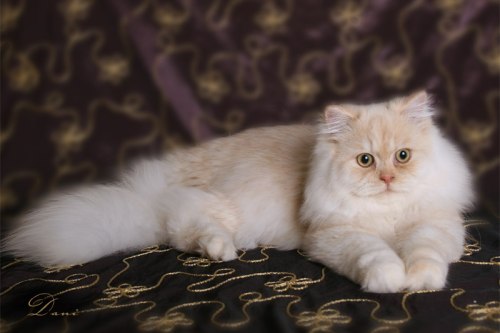
Persian cats – Photo of Cristalline a Traditional Persian © D. Rozeboom
Contents:
This page covers a wide range of topics and focuses on the development of the contemporary Persian cat appearance. Here are some links to sections of this page and to other pages:
- Persian cat facts – succinct page, handy
- See visitors’ submissions
- Poll on peoples’ preference for Traditional or Ultra Persians
- Link to see a page in Memory of Yeri a superb Traditional Persian
- Link which takes you to more on the appearance of this breed
- Link which takes you to superb photographs of Ultra Persians
- Links which take you health, maintenance, rescue and breeders
- See some more Contemporary Persians and links***
- Basic information for schools in slide show
- Illustrated CFA Breed Standard
Before discussing the gradual transformation of the Persian cat (below) I mention here some general information about this popular cat breed.
Introduction
After the Siamese the Persian is probably the best known cat breed and these two breeds are at opposite ends of the spectrum in terms of body conformation (type – see cat body types).
The Persian is defined by “roundness” whereas the Siamese is elegant and slender. The most noticeable feature is the round brachycephalic (broad headed) head with the flat face. This is the extreme look I refer to below.
It is one of the oldest cat breeds and its name comes from its place of origin, now called Iran. It is one of the first cats to be discussed in cat show records and news stories in the late 1800s in England (Crystal Palace shows in London). At that time they were considered “exotic”. Now the word “exotic” refers essentially to wild cat hybrids such as the Savannah cat.

At the outset, Persian cats were developed by British people. They were referred to initially as Angoras. The Americans developed the flat face and more extreme rounded body shape and features and then it seems exported that back to the UK judging by the pictures on the GCCF (the premier cat association in the UK) website.
The development of the more extreme Persian cats (see Persian cat breeding for more on this!) resulted in two types of Persian cat with a range in between. Traditional Persians are like the original Persians and you can find links to both on this page. It is known that the development also resulted in specific health issues directly related to the unnaturally flat face one of which is poor tear drainage due to a deformed nasolacrimal drainage system (this takes you off site).

The Wikipedia authors say that in England the Persian is called the Persian longhair or Longhair. The GCCF website refers to them as Persians, however. A question I asked myself was whether the breed standards of the various cat associations had made it impossible for the traditional Persians to be show cats: Traditional Doll Face Persian cats (contains another slide show of trad Persians in large format).
Persian cats are characterized by their placid nature. This may in part be due to perceived lower than average intelligence (the brain case of an extreme or ultra typed Persian will be smaller – ref) amongst the purebred cats (see – cat intelligence – the Sphynx is the most intelligent supposedly). This makes Persian cats suitable for full-time indoor living including apartment living. The Persian is more popular in the USA where far more cats are full-time indoor cats. Although the real test of successful full-time indoor living is whether we can create as near as possible a natural environment through the stimulation of our cat’s natural behavior.
There are a number of associated purebred cat breeds: the pointed Persian commonly called the Himalayan in the USA (a Persian/Siamese cross), the Exotic Shorthair (a short haired Persian) and the teacup cats and miniature cats are almost always Persian cats.
The Himalayan was a separate breed until 1984 but is now the same breed but demarcated by a different registration system (src:CFA)
Persian Cats – History
The early history (before the cat fancy started to develop the breed) is suitably vague. I use some “facts” and some speculation about the history of this breed on this page: Persian Cat History.
The first breed standard was that of Harrison Weir in the early stages of the cat fancy in England. It served as the guidelines for the early development of Persian cats. Later development is set out on this page below. By the early 1900s the breed was recognised by all registries. It is one of the founding cat breeds of the cat fancy.
Associated page: Angora Cat
Popularity
On this website’s breed popularity poll (2623 votes 9-2-2010) the Persian is 6th most popular. The CFA rate this cat breed the most popular. This site’s poll is based on votes from the public, while the CFA ranking of 1st is based on registrations for 2008.
The pictures below are thumbnails. Click on them for larger versions.


A discussion on the changing appearance of Persian Cats
The appearance of Persian cats has changed over the last 100+ yearsand particularly over last 30-40 years it seems. This is an interesting and well discussed subject, polarizing opinion. There are no absolute right and wrong conclusions. All the cats in the slide show below are traditional “doll face” Persian cats – aren’t they beautiful? By clicking on the link, you can see a spectacular traditional orange Persian cat.
| Persian Cat Rescue A list of rescue groups and notes on the subject. A carefully prepared list designed to simplify the search for a rescued Persian cat in the USA & World and in the UK |
Please go the visitor’s input form and tell us all why the breeders are breeding a type of Persian that is less popular than the original traditional appearance. Please read this page as it explains how this came about. Carol Trevelyan-Knox (UK) has written a very useful article on this subject. See it here.
If you have any questions on the development of the Persian or any other cat topic that interests you please raise it in comments etc. and I or a visitor to this website will answer it quickly.
It seems to me that when it comes to what we do in relation to cats we should always strike a balance between the interests of the cat and our interests. It is this fine line between competing interests which is the interesting thing. Or, are the interests competing? You would have that what suited the Persian cat also suited humans.
But this is not necessarily the case. Cat breeders are in a business and they do their best to maintain a balance between the commercial aspects of the business and the breeding of cats that the public wish to adopt.
The appearance of the Persian is what has made this cat one of the most popular pure bred cats in America. I think the breed was absolutely the number one in the USA but the position has slipped. The breed is not necessarily as popular in other parts of the world.
Persians are by far the most registered cat with the Cat Fanciers Association (CFA) the USA’s registry of pedigreed cats and the biggest registry in the world. They have been the most registered cat with the CFA since they first started keeping records in 1871. However, records indicate that the number of registrations with the CFA is declining.
Perhaps this is as a result of an increased interest in the Bengal cat, which is not registered by the CFA (although the TICA register the Bengal). Or, perhaps it is in part due to the change in appearance of this popular cat. Perhaps some people (we will have to call them buyers as what happens in a breeding program depends on the buying public ultimately) are finding that they prefer the Traditional appearance.
| Want to see fine pictures of a Traditional Persian? Click and come back! this is a series of photographs of a wonderful Traditional Persian cat named Yeri, who was part of Danielle Rozeboom’s family |  ©Dani Rozeboom |
It seems possible that breeders in their desire to enhance the Persian cat’s appearance, may have over refined the facial appearance.
You want to see more of the best in cat pictures…? Click here to see the best Persian kitten pictures
It seems that in breeding the extremely flat faced look there may have been some compromises on health issues. But is this true?
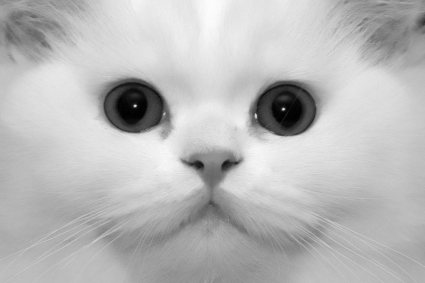
 no copyright | If you want to read and see more on how the Persian on the left turned into the Persian on the right Click here |  courtesy: Messybeast |
Please don’t misinterpret what I am saying. The vast majority of breeders of Persians are responsible. It would seem that some breeders are considering whether it is wise to continue to breed along the chosen path of developing the flat faced Persian.
I say “Traditional” style Persian as there is certainly a gray dividing line between the two appearances. It could be asked “what is a Traditional Persian cat?”. Does it mean the type of cat that was shown at shows in the late 1800s and early 1900s. Probably, yes. Pictures of Persian cats from that era, perhaps up until the 1940s (and you can read a lot more about the technical aspects of this plus photos if you click here) were very definitely what I would call “normal looking”, just like a non pure breed cat, except with the famous coat.
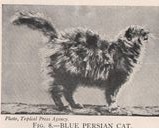
Above: Persian Cat as illustrated in the Encyclopædia Brittanica 1911 which is in the public domain.
Here is an interesting text from the 1911 Encylopedia Brittanica:“As to long-haired cats, there appear originally to have been two closely-allied strains, the Angora and the Persian, of which the former has been altogether replaced in western Europe by the latter. That these long-haired cats have an ancestry, to some extent at any rate distinct from the ordinary short-haired breeds, is practically certain, and it has been suggested that they are derived from the “manul” cat, or Pallas’s cat (Felis manul), of the deserts of central Asia, which is a long-haired and bushy-tailed species with comparatively slight striping. The fact that in tabby Persians the body-markings are never so strong as in the short-haired breeds is in some degree confirmatory of this, as suggesting descent from a nearly wholecoloured type. At the present day, however, Persians exhibit nearly all the colour and pattern types of the short-haired breeds, the “orange Persian” representing the erythristic phase.”
There is no doubt that the Persian Breed Council is very well intentioned. But they consider, it seems, the longer nose of a Traditional Persian a defect. By the criteria of the breed standard, it is a defect. Back in the 1970s the flat profile was well established, with large round eyes and round head structure. However, since then the nose has become shorter but the “break” (the point where the angle of the nose turns to join the forehead) has remained in the same place – between the eyes.
 Photo of Ultra Persian © StockxpertI would suggest too, that since the 1970s the head structure has been developed more towards the flat profile but has now stopped.
However, throughout this period of development and change, up until the 1980s the Persian Breed Standard had remained almost unchanged (since the acceptance of the breed in the late 1800s – i.e. over a 100 year period).
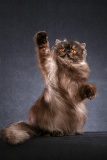 ©Helmi Flick | Want to see great pictures of Ultra Persians? |
Persian breeders in both England and in America were aiming to produce cats with a rounder head structure and a shorter nose that they believed were closer to the “ideal” expressed by the Persian standard.
Moving forward to the 1980s, breeders tended to “over develop” the face, in my opinion, and faces became too extreme and “piggy” looking. The piggy appearance is due to the fact that the nostrils are between the eyes.
The noses of these cats where not necessarily shorter but the break was higher (at the top of the eyes), with the noses between the eyes.
As a result, cats developed to this extent had lost some of the sweet open look that was the original objective to be achieved by reference to the breed standard.
It was decided at this point to change the breed standard to ensure that the nose was not between the eyes, while the break was between the eyes. A number of changes to the standard took place over this period (late 1980s).
Since then, there has been one more important change to the standard. Over many years judges had been using the same diagrams and examples of the Persian head and profile in judging workshops so it was decided to formalize that with a change to the profile (flat facial profile).
In conclusion, through selective breeding and a desire to satisfy judges interpreting a naturally open ended breed standard, breeders developed the Ultra Persian, the changed appearance of which has now become a new breed standard; the standard having been adjusted to meet the evolving appearance.
There are no absolute right and wrongs as to which is the better. The only immutable consideration is the health and well being of the cat. However, it would seem to me that Persian cat breeders have overlooked the CFA “overall standard”. This is an underlying standard that is not breed specific. A cat in competition must meet this standard as well as the breed standard. They work together, the former being more fundamental than the latter.
This overall breed standards makes it clear that the ideal cat must not suffer from an illness, condition or discomfort as a result of characteristics bred into the cat. Isn’t this the case with the flat faced Persian? Why is this underlying standard ignored? There is a parallel situation in the dog world in the UK. The Kennel Club, and old and revered dog club, who run Crufts, the biggest dog show have decided under pressure to review breed standards with the intention of promoting health over appearance. Read about this.
One last point. Perhaps a number of Persian cat breeders feel but do not express the view that the breed standard is not written as clearly and concisely as it should be. In addition it could and should be illustrated (for the sake of clarity). Further I sense that Persian cat breeders would like the standard changed to one which allows them to breed healthy cats. The current standard encourages the opposite.
As one breeder says, if a cat has too many toes the cat is disqualified. The number of toes have no bearing on anything least of all health. But if a cat has a nose that looks correct according to the breed standard but the cat has difficulty in breathing the judges are prepared to make the cat a champion.
Read about Persian cat health issues by clicking on the link below.
 ©Louise | Which is the healthier?Click and see | 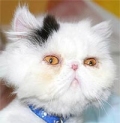 src: Wikipedia |
One thing we are all in agreement about is that the appearance of this breed is still very popular. They make great photographs if you’re a great photographer. But the popularity of Persian cats seems to have waned due to the extreme and unhealthy conformation, which is in addition to the other health issues. It is these, in my view, which have had a negative impact on the Persian cat.
Also, through selective breeding, the coat has got longer bringing both a fabulous appearance and greater demands on grooming. The development of this breed’s coat has a similar history to the face, it seems. I would argue that it has gone a fraction too far. When the coat becomes problematic to the point when it is recommended that the cat remain indoors for fear of getting the coat dirty, then humans, I think, have interfered with nature too much.
|
Persian Cat Rescue Centers
Click here for Californian rescue centers
Click here for UK rescue centers.
Breeders
These are selected as usual from the first 2 pages of a Google search and only from independent websites (i.e. not part of a directory). They are listed in the order in which they appear on a Google search.
Rocky Mountain Persians
A small family operated cageless Persian cattery located in the Rocky Mountains of Colorado.
Boutique Kittens
Located in Colorado, USA. Himalayans and Persians, all traditional.
Pelaqita Persians
Located in Pleasantville, OH, USA, this is both an educational site and a small cattery.
T-N-T Puff Cattery
Located Merrimack, NH, USA (believed – this is not clear from the website).
Kasiakatz
Located in Upstate New York, USA, breeding Himalayan and Persian.
The Cozy Kitten Cattery LLC
Located in Missouri, USA. Quality is their objective. Traditional Persians bred.
Hekla Cattery
Located in New Zealand. Small cattery.
Burton’s Persians
The CFA registered cattery of Monica Burton. You can contact her by email from the website. Monica also breeds Himalayans.
Sources:
- Wikipedia
- TCA
- CFA
- PetPlace.com
- Own Knowedge
- Chapel House rescue centre
- Tally’s cat behaviour links
- traditional persian picture courtesy Louise

Thanks. I completely agree that the flat-faced Persians look far less attractive than the traditional Persian and yet the breeders decided the smushed face looks better which is why they bred them. It is bizarre to me.
What a wonderful article! I just love the traditional faced persians, they are so beautiful. I find the very extreme cats to look very sad and almost deformed. They look to me like deformed white tigers I’ve seen, which were inbred. I would love to see doll face persians in cat shows again. Thank goodness some breeders still breed the traditional look.
Susan, thank you for that. Due to pressure of work I have not updated this short list for a long time and it shows. I may delete them all.
Rocky Mountain Persians is not longer on-line.
Kasiakatz is no longer breeding.
Cozy Kittens has opened under a new name due to law-suits filed against them by several of their kitten buyers (which you can find on-line, including Better Business Bureau complaints) and they are a kitten mill.