

Introduction
Note: this page is divided into several parts to make it more manageable. At the end of each section there is a link to the next page.
This is a cat whose name is based on the cat’s character not its location of origin or appearance. The name is part of the creation of this cat breed.
The beautiful Ragdoll cat (both physically and in temperament) is a testament to how a fine purebred pedigree cat can be created from random bred cats.
The history of the beginnings of this breed are a little confusing and what follows should not be taken as fact despite being reliably sourced. The breed was created and developed by Ann Baker in the early 1960s, in Riverside California, initially by mating the special kittens from a Persian “type” cat (Josephine see below) with a Birman “type” (see below Daddy Warbucks) and a Burmese cat (not sure if this is the case!). Josephine has also been described as “Angora type”.
In more detail but still in outline the founding cats for this breed were:
- Raggedy Ann Daddy Warbucks
- Buckwheat
- Raggedy Ann Fugianna
Raggedy Ann Daddy Warbucks was the offspring of Josephine, a random bred cat living with Ann Baker’s neighbour, Mrs Pennels and an unknown father. At the time of Daddy Warbuck’s birth Josephine had allegedly turned from a cat that gave birth to “difficult” offspring to ones that had tranquil natures and the change was put down to a car accident (in which she suffered head injuries) and the treatment that followed. This change sparked an interest in Ann Baker who, it seems, believed in the possibility of such a phenomenon occurring. It seems that Ann Baker created a myth (perhaps no longer believed and certainly disproved) that this cat was immune to pain or had a high pain threshold. This is clearly impossible. perhaps this was all part and parcel of creating a mystique around this breed to promote it. Raggedy Ann Daddy Warbucks looked a bit like a Birman – white socks, white chin and white tip on the tail.
Buckwheat was the offspring of Blackie and Josephine. Blackie was Josephine’s son. Blackie was black and looked like a Persian cat. Buckwheat was black too.
Raggedy Ann Fugianna was the offspring of Josephine and Daddy Warbucks.
Josephine, the mother of the above, was a white semi-long-haired cat that looked like an Angora cat. Angora cats are similar to traditional Persian cats. She was almost feral. It is not clear if this cat was rescued by Baker or Pennels.
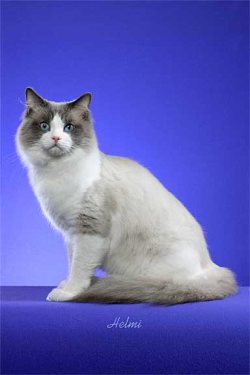
Through careful breeding thereafter the breed was developed. In fact the development of this breed to registration was carried out by the Daytons, see below.
The creation of a breed from non-purebred stock is slightly unusual. A similar start to a breed is the Nebelung. I discuss the terms “purebred” and “pedigree” on the Household Pet page of this site.
This is a highly popular cat because of an attractive combination of appearance, a fine/balanced character and little in the way of genetically associated health issues (see health issues below)
Perhaps their docile, trusting and accepting nature makes them more vulnerable to danger. There is more danger outside the home. No doubt this encourages people to keep them in, which they should find acceptable. Some say that this breed is “strictly” an indoor cat. I talk about indoor and outdoor cats and building cat enclosures

In 2016, a cat adopted us. He was a stray, but we soon learned he was domesticated and fixed. My daughter believes he is a ragdoll. He fits the characteristics: size, demeanor, eye color etc. Can you view the pics and tell me what you think. I have other pictures of him.
Hi Dale. Thanks for commenting. It seems the years with the breeder may have affected her character. She is definitely anxious as you say. Chronically anxious it seems. I guess you have checked her out for cystitis. A long shot. Anxiety can cause cystitis and cystitis causes inappropriate elimination.
I presume she is spayed by the way. If not please spay her.
Sometimes a cycle can be set up. A cat pees on the carpet. The owner becomes annoyed. The cat becomes anxious. The cat pees some more on the carpet through anxiety and so on. That cycle needs to be broken. Is he litter trained? Crazy question perhaps but worth asking.
Are you around the home a lot or not much? If you are away a lot that may cause anxiety and her reclusive nature. It can also lead to cystitis as mentioned. Personally I don’t like the idea of drugs because it just treats the symptoms. If you have totally covered all the possible causes then drugs might be the answer but they must be a last resort.
What does your vet say? I’d try and interact more with her. Play with her. Be around her more etc.. If you don’t have the time for this it would be a shame because I think it may be the cure but it will a slow process I feel. Although I may be incorrect about the cause.
I presume she is a full-time indoor cat. If not and she goes outside sometimes there may be a cat outside who terrorises her. Sometimes indoor cats can be upset by the presence of cats outside who they can see through the window. That is a long shot to but may be worth checking out. I am speculating because I don’t know the full facts.
There is one last possibility: rehoming with a retired person who has time. But this may seem crazy to you and I’d understand if it is. Good luck.
Hello, I picked up my Rockstar from a breeder here in Vancouver Canada. She is a retired breeder who apparently never gave her owner kittens. I’ve had her for a year now(she is 4). She has issues with peeing everywhere. Bathtub, bed, my rug, and most recently my couch. I have been using Feliway but it only seems to work for a while. She spends most of her time alone in the basement. I got a kitten this past summer. They seem to get along. When I pick her up to pet her she has a look of “why are you touching me”. Will she ever warm up to me or is she destined to be anxious forever. I’m tempted to try drugs to keep her happy.
Thanks Art. Nice to hear from a visitor who has some personal experiences of the very popular Ragdoll or RagaMuffin (a very similar cat).