logo for pictures-of-cats.org
Great Pictures of Cats. All the Breeds:-

Home

Beginning A-H
Beginning J-P
Beginning R-T
Fringe Breeds
Wild Cats
Feral Cats
Cat Facts
Cartoon Cats
Cat Videos
Cat Appearance
Pictures of Cats
Cat History

Cat Health
Cats & the Law
PoC Admin
PoC Site Map


[?] Subscribe To This Site

XML RSS
Add to Google
Add to My Yahoo!
Add to My MSN
Add to Newsgator
Subscribe with Bloglines

TwitThis

Breeds Discussed
Rare Cat Breeds
Domestic cat size
PoC Updates
Choose a Cat
Declawing Cats
Cat Sounds


Dwarf Cats
Helmi Flick Photog
Abyssinian
Siamese Trad
Siamese Modern
Maine Coon
Persian
British Shorthair
Bengal
Warrior Cats
Purebred rescue


LEFT for pictures-of-cats.org

Russian Blue Cat


Russian Blue cat
Russian Blue Cat
Photo © copyright Helmi Flick


Introduction
As is the case for many natural cat breeds the origin of this cat is hazy. On the basis that she is indeed a cat that has
russia map
Copyright free map see below
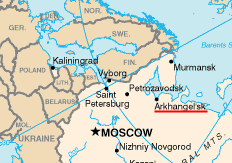
evolved naturally without mankind's involvement until becoming a pedigree cat, the Russian Blue, as the name suggests, comes from Russia. More particularly, the town of Archangel in North Russia (see map underlined in red). The city (or is it a town) is now called Arckhangelsk.

If you want to see a bigger and better map plus bigger high quality Helmi Flick pictures of the Russian Blue cat in a slide show accompanying a description of this breed with reference to a breed standard then click on the link: Russian Blue.

Far from me to suggest it, but it does seem a very happy coincidence that a cat that comes from cold and icy Russia should naturally be cold and icy in appearance. Perhaps this cat breed's appearance has been refined, by careful breeding. Amanda Bright who has been breeding Russian Blues for almost 39 years says, "the Russian Blue did originate in Arkhangelsk and was developed in England AND the USA beginning in the late 1800s and early 1890s. Early USA cats included Peterkin, Peterkin II and Fiametta -- and we have pictures of these American Russian Blues. There was also a cat called Olivette who was a Bayard daughter." Thank you Amanda.

Russian Blue Cat
Photo: © copyright Helmi Flick

Update 28-7-09: I have had a welcome message from a mysterious contributor who has the following to say about this breed - to add to what I have written. I judge it to be accurate and quote it verbatim for accuracy. Thanks for the input by the way!:

First RB (Russian Blue) shown in the crystal palace had domestic parents, see "Our Cats" by Harrison Weir, who organized the show, where he describes the parents of this first "russian blue" as being VERY non-blue..LOL

Blue cats of many kinds were imported into England from supposedly "Russia", ie blue and white, solid blue, blue tabby...it was the humans who decided to work only with the solid blue...there are no natural barriers in the area of Archangelisk to keep shorthaired blue only cats separate from any other hairlength or color.

So, what I am saying is they are not a "natural" breed, just a common blue color that the breeders decided to make into a breed. ACFA, TICA and GCCF DO recognize the whites/blacks/tabbies for showing in provisional classes, just not for championship yet.

The "colors" are accepted by, as you mentioned Australian and New Zealand registries, plus LOOF in France, South African cat registry and many smaller independant cat registries all over europe--ie Neocat etc (Europe has a different system and it is hard to find out exactly which independant registries accept what breed and colors).

You are correct that CFA only recognizes the russian in the color blue. Also, those first two Russian Blues registered in the 1940's in the CFA studbooks actually have a British Blue for a dam! There is also a question about some of the earlier "russian blues" pedigrees, ie coming from Brits or alley cats, imported into the USA in the early 1900's.


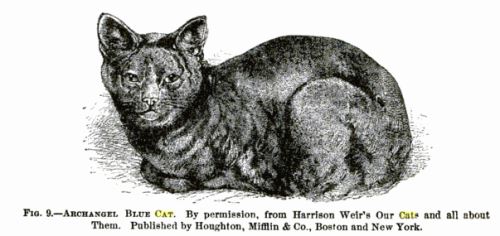
Archangel blue or Russian blue cat 1800s
An engraving from Popular Science 1890

History

Date Event - this should be read in the light of the above
1860 Informally imported in UK and Europe from Russia
1890 Formally imported into UK?
1875 Shown at Crystal Palace Cat Show. Crystal Palace was the premier arena at that time for exhibitions in London
1912 Classified as a Russian Blue as opposed to a blue cat by UK cat fancy
post
ww2
Development of the breed takes place in earnest
1947 Imported into USA
1949 CFA recognize the Russian Blue Cat
1970s Solid white Russian Blue (renamed Russian White) bred by Australian breeder
Current CFA only recognize Russian Blue. TICA and ACFA do NOT recognize the white, black and tabby colors that some breeders are attempting to develop. They are accepted for registration. However, they are not accepted for championship which would be full recognition. Australian (ACF) and New Zealand (NZCF) cat fanciers also recognize the Russian White and Black. GCCF recognize the White and Black as "preliminary" and give full status to the Blue (& see below)
18-10-08 A Russian Blue cat won the Best of the Best award at the CFA/Iams Championship at Madison Square Garden 19th October 2008. His name is Runner. Full name is Platina Luna Blade Runner. The proud owners/keepers are not cat breeders, just exhibitors. There names are Teresa Keiger and Rob Miller.


Russian Blue Cat
Russian Blue - Bali - photograph © copyright Helmi Flick

Associations and the Russian Blue

TICA and CFA have breed standards specific to the Russian Blue. GCCF (UK) uses the Russian Blue standard for the Nebelung as apparently the only difference is the length of the hair. The GCCF does not formally recognize the Nebelung, however (see above- history as well).


Russian Blue Cat Russian Blue
Russian Blue Cat photographs © copyright Helmi Flick - click for larger images

Appearance and Character

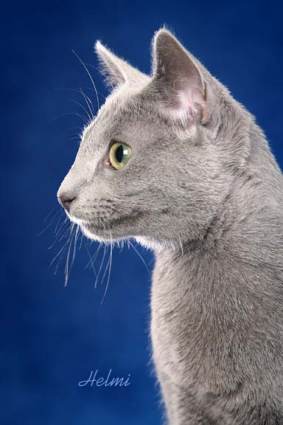
She is a nice medium sized cat (see cat size/weight comparison). The Russian Blue Cat always has blue-grey hair and green eyes, which simplifies a description of this cat. Anyway Helmi's photographs say it all. Looking at the eyes of the cats (Bali, Beauty and the cat below right) it is noticeable how wide open they are. This seems to be a characteristic. They should be "vivid green" color and I think that they are. The coat color is as a result of the dilution of black. You can see a bit more on dilution by clicking on this link.

Russian Blue Cat
Photo: © Sensual Shadows Photography
Other cats with similar color configuration are the British Shorthair (one of the colors is blue/grey),the Chartreux (exclusively grey), Nebelung (the Russian Blue has been used to add "type" to the Nebelung i.e. make the Nebelung look more like she is meant to look) and the Korat. Both the Nebelung and Korat are also exclusively grey - see Grey Cat Breeds.

The coat is the outstanding feature of this cat. It is a double coat with dense fur, fine in texture and "plush". The top coat (guard hairs) are blue with silver tipping giving the special chilly Russian appearance that you can see in Helmi's photographs.

Reports say that this is an intelligent breed of cats (although most admirers of a breed will say this) and that she possesses all the usual attributes of a sociable pet. They are perhaps a little shy, it seems, with strangers (this maybe anecdotal).

The European breed is apparently slightly heavier and larger than the American breed. However, the cat above right, by Sensual Shadows Photography, is an American cat and I think heavier than the show cats taken by Helmi in America. So, I'm not sure this is true.

Russian Blue Cat
Photo of Bali © copyright Helmi Flick

Breeders

Click on the link to read about buying Russian Blue Kittens illustrated by some really nice pictures.

Top ranked cattery websites breeding this cat in the order listed by Google:

Otis Russian Blues
Located in the UK, Chesterfield, Derbyshire. Breeding this cat since 1993.

Siblu Cattery
Run by Cheryl Steffe. The Cattery is located in the Lower Blue Mountains, one hour's drive west of Sydney. This is one of the best cattery sites that I have seen.

Enchanting Diety Cattery (new window)
This is based in Estonia and owned and managed by Eduard Maandi.

Would you like to be listed on this site? Please contact me.

Russian Blue Cat and Tonkinese cat
Photo: © copyright Helmi Flick of Tonkinese cat (left) and Russian Blue


Russian Blue cat - Sources:
  • http://www.nebelung.nl/nebelung_standard.html
  • CFA
  • Breedlist
  • Wikipedia
  • Messybeast
  • About
  • Amanda Bright who says, "I've been breeding cats under the prefixes of Kyina and Talisker since 1970 and am currently a Provisional Allbreed judge with TICA. I've had Russian Blues for most of those 39 years and am one of the people who does the most historical research on the breed." Thanks Amanda. I always welcome information.
Map: this is courtesy www.embassyworld.com and is copyright free as I understand it. The map has been modified to make it smaller and to highlight the town of Arckhangelsk. It is made smaller for practical reasons.

From Russian Blue Cat to Home Page


footer for pictures of cats page