
 |  | 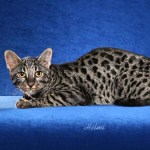 | |
| Safari Cat photos: copyright Helmi Flick. Click on the thumbnails | |||
|---|---|---|---|
Introduction
This is one of the rare cat breeds by my reckoning (8/10 where 10 is the most rare). This is supported by the fact that there are very few photographs of this cat breed. Fortunately, probably the best cat photographer, Helmi Flick, has photographed this cat and they are reproduced here with her kind permission. Also two Safari Cat breeders have kindly agreed to let me use their photographs and some are reproduced here. You’ve got the best cat pictures again.
Lets’ make not mistake about this special cat breed; it is a stupendous and exotic cat and very few people own one. There are apparently no more than about 70 registered with The International Cat Association – TICA – (src: Marechal Cattery as at late 2007). This cat is said to be the “Rolls Royce” of exotic cats (wild/domestic hybrid) and there are a number of such cat breeds. The best known are the Bengal, Chausie and Savannah cats. A lesser known wild/domestic cat hybrid is for example the Alpine Lynx.

Photo above: F1 Safari Cat – Copyright Marechal Cattery. Please click thumbnail for larger format.
The Safari cat is a hybrid cross between the wild Geoffroy’s cat and the Domestic Shorthair (of various types depending on the outcome desired). Sometimes it is Geoffroy’s cat x Bengal cat. They were originally bred back in the 1970’s for use in Leukemia research by Washington State University (but please see below).
Similar research into feline leukemia was carried out with the Asian Leopard Cat (ALC – the wild parent of the Bengal cat) as this wild cat has allegedly a partial immunity to feline leukemia. A physician was breeding them with domestic cats and agreed to let Mrs Mills the breed founder adopt the cat. You can read more about the beginning of the Bengal breed here (the conventional version) or here (the critical version). The beginnings of the Bengal and Safari cats are therefore similar in both what happened and when it happened (see below).
Geoffroy’s Cat
Geoffroy’s cat is a small South American wild cat related to the Ocelot. In the north of South America, Geoffroy’s cat commonly has a brown/yellow coat color. In the south the coat is grey. Geoffroy’s cat is named after the 19th century French zoologist and naturalist Etienne Geoffroy Saint-Hillaire, who discovered that this wild cat was a separate species.
Breeding
The author of the Wikipedia article says that there have been attempts to breed this cat with the domestic cat “with very little success”. Some success, though, has occurred.

Above: Marechal Xotica F1 Safari cat Dark spotted, powerful build, 17lbs
The difficulty in breeding the Safari cat arises because the Geoffroy’s cat has 36 chromosomes while a domestic cat has 38 chromosomes (see below – Chromosomes). The breeding program started before the Bengal breed began. Bengals were first bred in 1975.
The Safari Cat was first bred in the early 1970. However, due to difficulties encountered in the breeding program (see below) interest waned. The huge success of the Bengal cat indicated the public’s interest in exotic cats. This “kick started” the breeding program. An important point needs to be made.
Apparently, the first generation hybrids (F1s) have a “calm temperament” (src: Sarah Hartwell). The breeder at Select Exotic says that the F1s are “delightfully gentle creatures”.

This is clearly important for buyers. Select Exotics (see the link at base of page) sell F1s. They say that they are 50% Safari (i.e. 50% wild Geoffroy’s cat) but have as a goal 75% wild cat Safaris. This goal is in line with what breeders see as the customer’s requirements (my thoughts). These are to produce as near as possibly a wild cat with the temperament of a pet.
It would seem that the more wild blood in the F1 Safaris the bigger they are (reaching 36 lbs for the 75% wild blood Safaris). The larger size approaches the wild cat size. This is desirable but brings considerations for the cat’s human caretaker. Once a successful mating takes place the result is that the offspring weigh more than either of the parents. This cat weighs in at about 25lbs (male) and up to 18lbs (female). Your average domestic cat weighs about 7-14lbs. The Geoffroy’s cat weighs about 5-10 lbs and occasionally bigger. See largest domestic cat breed for a size comparison of the domestic breeds and between domestic and wild cats.
The Safari is then a big domestic cat. The large size of the F1 offspring is put down to the mating of a cat with 36 chromosomes with a cat having 38 chromosomes. This somewhat mirrors what Bengal breeders when they say that the F1 Bengals have an added level of vigor.

Above: Marechal Xtreme, F1 Safari cat, brown toned spotted. Full sister to Xotica above, weighs 16.4lbs
Chromosomes
The first generation hybrid offspring have 37 chromosomes. 19 of the chromosomes come from the Domestic Cat and the remainder from the Geoffroy’s Cat. The males are infertile (same as for the Bengal and Savannah, both wild/domestic hybrids). The female F1s however are fertile. The males are sold as pets as a consequence, while the females become breeding cats. The F1s tend to be large (desirable) while the F2s and beyond are more the size of the domestic cat. F2s have either 37 or 38 chromosomes.
Adoption
I am sure that breeders of this cat would agree that only a person or persons who fully understand what it means to adopt a cat of this type should do so. In that way the cat is protected. The prospective adopter should research and understand all the pros and cons.

Above: F1 Safari Cat Jungle Mountain Exotics click on thumbnail for larger image..
There are some moral/environmental issues surrounding the breeding of hybrids such as the Safari Cat. My thoughts on this are that as long as all those who partake (breeders and buyers) have a highly responsible approach and take into account the wider issues then it’s OK. The wider issues are for example (a) the welfare of the cats involved (b) the environmental issues – the impact on wild cats.
I’d watch out too for the legal stuff. You can read about the Savannah (near base of page) for a comment on some legal issues in the US and here for UK concerns. But please check yourself too.
Research
Cat lovers might like to know that this cat seems to have been used in medical research on more than one occasion. In 1994-5, Safari cats were used to study the behavior of blood forming stem cells in “large animals”. Six cats were used (the researchers state the number of cats like this: (n=6)). The research lead some Safari cats to become pancytopenic – A pronounced reduction of white blood cells, platelets and red cells in the blood. This is normally due to chemotherapy or disease. It seems that the cats were “irradiated”. These cats were “sacrificed”.
Breeders World List
Please click on the following link to go to a world list of breeders.
Sources:
- Special thanks to 2 catteries for some of the photographs on this page. The catteries are mentioned below the thumbnail photographs. Full credits are on the linked page. The catteries are Marechal Cattery and Jungle Mountain Exotics
- Wikipedia
- Messybeast Textual content is licensed under the GFDL
- Marechalcattery
- Junglemtnexotics
- Scholarly Journal Archive

Hi Joe, I remember your cat. I decided that he is large Bengal type cat. He looks more like a Bengal cat to me than any other wild cat hybrid and his character indicates a wild cat hybrid. I disagree with the people who say he does not look like a Bengal cat. He has definite Bengal cat physical and behavioural characteristics but as you say the breeder may have been messing around with an experimental breed that is yet to be registered etc.. There are quite a few breeders who like to do that sort of thing.
He has very large/long toes. But some individual cats are inherently very large not because the breed of cats is large but because he is large. This is one such case.
Hi! 🙂 I posted this here. So this will be mostly copy/paste
https://pictures-of-cats.org/bengal-mix.html
And as an update to his weight (born on September 25th of 2013) he weighs 23.6 pounds now. On June 27th he was 18.6 pounds.
I looked at Bengals, which he could be an earlier generation. Though he seems far larger than most Bengals. But most people told me he didn’t look like one (and said he was just a tabby…yeah …(tabbies don’t make exotic cat sounds)…but the forum I used was rather weird.
Anyway here is the copy/paste
Did we get a Bengal? Or a Mokave Jag cat (my wife and I think he is a type of one, but specicially bred by the breeder)? Or a bengal hybrid of some kind? Everyone says he looks nothing like a Bengal that we ask. And he acts far more like a wild kitty (very friendly and loving though).
First, the picture:
So the story…
Me and my wife have asked many forums what he could be, and no one knows what he is. But, everyone says he looks nothing like a Bengal. A good friend of my parents and Grandma, said he was way bigger than any Bengal she has ever seen (and has gone to cat shows). She said “looks as big as a Maine Coon”. My wife’s aunt said “Wow, he is huge. Looks more like the size of a Cougar.”
He was born september 25th, and we got him in January. Today, not even a year old, weighs 18.6 pounds and is 3.6 feet long. Still growing very fast!
So, we got him at an animal sanctuary. The man who ran it (this was in the rural area of Los Angelos California), had Zonkeys, Mongolian horses, weird hybrid horses, weird hybrid lions (he had a Liger he said, but we couldn’t go in without a supervised visit due to legal reasons)…he had tons of strange hybrid animals and other very rare animals. And he said he a lot more, but he couldn’t show us unless it was a planned trip (we only went for the kitty).
Oh, he had some kind of camel/donkey hybrid…a camel/zebra hybrid and some other weird things. Tons of weird hybrids.
So, breeding very exotic animals. Breed exotic cat…
So, now about the cat himself…
He has chirped, roared (like a lion or tiger, heard that only once, wife heard it twice), growls not like an ordinary kitty (it is hard to describe, but like a wild cat growl), never meows (it is more like a squeek) and other strange sounds.
One thing though…even though he makes strange sounds…he is a very quiet kitty. He shows you he wants food. Shows you his litter box needs to be done. He never meows at you, but shows you instead. He doesn’t make too much noise at all.
He is very fast and climbs all over the place! He teaches himself more than we can ever teach him. He does bite a lot, but has taught himself to not bite us as hard. He can jump on top of the shower door (the thin metal part) and climb on the shower head. The most agile cat I’ve seen.
Loves water (plays in sink and water bowl, but not too much in the shower sadly. He is scared of the noise, so we are working on that…he calms down after a few minutes though and enjoys it. He likes it way more than he used to). We had a fountain water dish that he knocked over and then sat and watched us clean up the mess. We did. Filled it up. He did it again and sat and watched. That was kind of funny.
Oh and his fur is plush/velvet like (never felt a kitty with fur like him, so a bit hard to describe)…very soft…NEVER sheds at all. However saying that, he has only had tiny shredding (very little) twice or three times since we’ve had him and it always stopped after a nice shower. But it pretty much stopped after a few months of having him and he hasn’t shed since at all. But his fur feels really unique.
He likes to play tag/catch/follow you around the house/greet at door…very dog-like. He likes to play hide and seek and all kinds of games.
And lets see…well as I said, very agile and fast. Unique sounds we never heard from a normal kitty. Acts nothing like a normal house kitty (like tabbies).
But, with the description+pictures…hopefully you guys have some ideas. 🙂 I mean, man breeds exotic animals, guess he’d breed an exotic cat.
Oh and even though he may be wild or something…he is so loving to us. 😀 he is definitely mommies boy (always goes for mommy and starts getting scared when she leaves), but likes to play more with me). The only problem is he bites walls and my arms/legs…but we’re working on it. If he is a type of mokave jag cat, I did hear they are biters.
Oh, and he knows when my wife is having a seizure (she is being tested for them)…when it happens and I’m asleep, he can sense it and goes crazy and tries everything to get her to wake up. I think that is pretty unique and smart, and really worries about her when that happens.
Thanks. 🙂