|
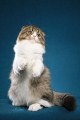
| Scottish
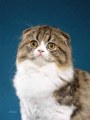
Fold photograph © copyright Helmi Flick |
Introduction
This
cat breed is another instance of a natural genetic mutation affecting a
part of
the cat's body that has been seen by people as different and
attractive. This has resulted in the mutation being commercialized
through selective breeding.
 |
 |
 |
 |
 |
 |
| Photos of Scottish
Fold copyright Helmi Flick - click on the thumbnails
to see some great
large format pictures |
Origin
|
published
under Wikimedia® creative
commons license
=
Attribution-ShareAlike License
The
origin of this breed is similar to that of the American Curl and indeed
follows the route of other individual cats that have become breeds due
to a mutated gene. In 1961, Susie, a cat with a "fold" in her ears (due
to the ear cartilage being affected by the mutated gene), was a barn
cat living near Coupar Angus, Scotland (UK). Apparently this
cat
breed is called the
Coupari
by some Canadian breeders; I see
why.
The American Wirehair breed commenced
under similar circumstances. The neighbor, a shepherd, of the owner of
the barn
became interested in Susie's litter, in which there were 2 kittens with
folded ears.
He bred from one of the kittens and so began the Scottish
Fold breed.
Genetics
- health - breeding
The breeding indicated that
the gene causing the folded ears was dominant (it's action can be
described as "dominant with incomplete penetrance", meaning I presume,
in layman's
terms, that the effect of the gene is not always present). The book
"Medical, Genetic & Behavioral Aspects of Purebred Cats"
(edited by Dr Clark) says that the gene is autosomal dominant. A
dominant
gene results in at least half
the litter having the mutated
gene's
characteristic. The gene is labeled as "
Fd".
As there are different degrees of ear fold there may be other genes
involved that modify the action of the
Fd
gene.

|
Scottish Fold
copyright Helmi Flick
|
This
Scottish gentleman (local shepherd William Ross) cat fancier and cat
breeder tried to register the breed with the Governing Council of the
Cat Fancy (GCCF - the UK cat fancy registry). They didn't agree it
seems and that is still the case (neither does Europe as a whole
register this breed). This is for health reasons. Ears that are folded
over offer the potential for ear infection and mites.
Also, some
gene mutations confine their influence on the formation of the cat's
body to a particular area (e.g the folded ear). However, this mutated
gene is not only associated with the folded ears but a thickening
tail and swollen (thickened)
feet. The thickened tail results
in less flexibility.
Note
this though (and don't be put off or think that I am being too negative
about this breed):- Good breeders will do all they can to minimize this
and breeding Fold to non-Fold rarely
produces a cat
with the accompanying tail and feet deficiencies (but see below). See
more on health
issues below.

|
Scottish Fold
copyright Stockxpert
|
If
the cat has both the mutated genes (homozygous
form - genes come in
pairs) then the kitten will die in the womb. There is a similarity here
with the dwarf cat as the dwarf gene also has a potential for causing
"secondary" defects (in the dwarf cat this can be, for example, a
"tight chest"). You can read more about dwarf
cats on this website. The dwarf
gene also affects cartilage
growth. However, Dr Clark says that fold to fold mating results in 1 in
3 Scottish Fold kittens that develop mild to severe skeletal lesions.
These are prognathia, vertebral deformities and severe joint disease.
The deformed vertebrae affects the coccygeal vertebrae causing a
shortened tail. The tail becomes very inflexible. The bones in the rear
legs may be shortened causing curved hocks.
Accordingly, this breed has to be developed by breeding
heterozygotes
to American and British Shorthair cats. The results in many purebred
Scottish Fold cats with normal ears.
Dr Clark's book also mentions that red blood cell destruction happens
more commonly in the Scottish Fold newborn kittens than in other
breeds. This condition is called Neonatal erythrolysis. The disease is
a major cause of fading kitten syndrome.
There may be a problem with treating ear mites due to the folded ears.
In
a talk given by Richard Malik, BVSc, DipVetAn, MVetClinStud, PhD,
FACVSc, MASM at the 28th Congress of the World Small Animal Veterinary
Association on genetic disorders of cats, he referred to the condition
Osteochondrodysplasia in this cat.
Even when cats of this
breed are mated with normal eared cats resulting in heterozygous cats a
progressive arthritic condition takes hold. He says that this is to be
expected as the folded ears are due to cartilage that is insufficiently
resilient to maintain the shape of the ear flap (pinna). As a result it
is not surprising that articular cartilage (cartilage where bone meets
bone) is not fit for purpose.
See a post below. It
is a real story about this condition and I have attempted to answer the
person's request for advice:
Osteochondrodysplasia
in Scottish Fold Cats
This
breed was exported to the USA (1971) and breeding continued by crossing
with British and American Shorthair cats. As might be expected the
defining feature of the Scottish Fold, the ears, has been "enhanced"
through selective breeding so that the ear now folds more smoothly
(i.e. the fold is in three places as opposed to a single place).
The
breeding program has resulted in this breed having long and short hair
of various colors and patterns except Siamese and Himalayan style
pointing (this may be for health reasons). However, the Cat Fanciers
Association allow the pointed pattern.
__________________________________
Update
6th Dec. 2008: Scottish
Fold Kittens is a post
reflecting on the dilemma of whether we
should adopt a cat of this breed.
Longhair
I have not distinguished thus far between long haired and short haired
Scottish Folds. The cat heading this page is a long haired cat, for
example.
The two types, long and short haired, differ only in respect of hair
length. In the UK, specifically England, the British Shorthair cat had
frequently been used as an outcross for the Fold. And the Persian had
been an outcross for the Brit SH, so it is no surprise some long hair
crept into the Scottish Fold.
The long haired Fold achieved TICA championship status in 1987. When
breeding long haired Folds two genes are involved. The dominant gene
causing the folded ears and the long haired gene, which is
recessive to the gene for short hair. To enhance the prospect of
achieving a long haired cat, two Scottish Folds need to be bred (e.g.
two long haired cats of this breed). That is bad practice
vis-à-vis the defective, mutated gene that causes the folded
ears, as there is a risk that the kittens could develop into crippled
cats due to cartilage defects in the leg joins.
Perhaps the Scottish Fold long haired cat is more easy going than the
short haired cat. They are undemanding and gentle.
Appearance - Character - show
requirements
They are quiet cats
with small voices and a nice
character. They like companionship and attention. The ears are small
and tightly folded. The Scottish Fold has a short nose and a round
head. The coat is dense, plush and medium short. The coat stands out
from the body. The eyes are large.
In the show hall cats with tails that lack flexibility, kinked or
short are disqualified.
Check
Important:
As a result of the potential for secondary problems caused by the
mutation, when adopting a Scottish Fold it is sensible to gently check
tail flexibility and thickness. The cat should have no lack of mobility
due to short coarse legs or splayed toes. The hardening of the
cartilage of the tail (and sometimes the ears) can develop later.
When
adopting it would be wise to discuss this. Helmi made a good point
about this. Once you have adopted a Scottish Fold you will bond with
him/her and you will not want to return your cat. Clarify this issue at
the beginning for you and your new companion.

Scottish
Fold Cat src: unknown
but in general circulation
this picture is digitally manipulated in my opinion.
Note
When a cat is being defensive she flattens her ears completely to
protect her ears from claws during a fight.
This cat breed
displays the defensive ear position
all the time giving
her a continuously defensive appearance. This may have an effect on how
she is perceived by other cats that may live with her.
1
Sources:
- As stated in the
text
- http://www.uic.edu/classes/bms/bms655/lesson4.htmlUniversity
of Illinois Chicago
- Wikipedia
- Messybeasts
- Moggies
- Breeder sites
- Legacy of the
Cat by Gloria Stephens and Tetsu
Wikipedia®
Click on this link to see the
Wikipedia®
License src:
Wikipedia® published under GNU
Free Documentation License, Version 1.2 or any later version, November
2002
Copyright (C) 2000,2001,2002 Free Software Foundation, Inc.
51 Franklin St, Fifth Floor, Boston, MA 02110-1301 USA
- - no
other
conditions to the license are added.
The map is a
modified (cropped) version Derived from
Wikimedia Commons image of original work forming part of the "Europe
location" map series created by David Liuzzo: derived from
Image:Europe_location_SCO.png.
Scottish
Fold to home page