logo for pictures-of-cats.org
LEFT for pictures-of-cats.org

Serval

Serval
Serval photo reproduced under creative commons see base of page


serval cat serval cat serval cat serval cat
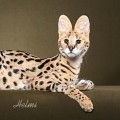
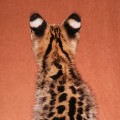
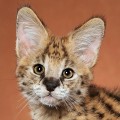
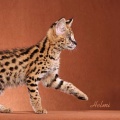
Photos ©Helmi Flick. Click on thumbnails


Introduction

The African Serval is a medium-smallish sized wild African cat and a domestic cat breed, albeit quite rare; but not as rare on my reckoning as some other domestic cat breeds (see rare cat breeds). This cat has been domesticated and bred, primarily in the USA. They are tame wild animals. The Times Newspaper (UK) reported on a case of a tame Serval that had accompanied the "owner" to a central London restaurant. The date was November 12th 1923. So, you can see that domesticated Servals are not a recent idea. Read more about this story.

Very strong bonds can be forged between a tame wild animal and humans. Note though that although this is a medium sized wild cat the Serval is a very large domestic cat (25-40 lbs compared with 7-11 lbs for a domestic cat - go to a comparison chart on domestic cat size). You can make a comparison between this cat and the Savannah in the photograph below.

The Savannah cat is a domestic cat/Serval hybrid and a big cat in her own right (the biggest registered purely domestic cat). Yet, in this photograph, you can see that the Savannah is very much smaller than her wild relative. As a person who adopts this cat you will be in part responsible for taming her. In taming her you take away from the cat her natural ability to provide for herself. She becomes dependent on the "owner". There is I think therefore an added responsibility to care for your Serval throughout her life.

In the Savanna habitat this cat's diet is mainly small animals such as rodents and includes insects, birds, fish, reptiles and occasionally larger animals such as small antelope. This needs to be kept in mind when considering the kind of diet that you will be providing (see below).


Behavior

This tamed wild cat likes to head butt a lot and yes they purr just like your standard Moggie (well not exactly like your Moggie - much louder actually - you'll love the purr).
serval cat
Serval jumping. Servals can jump 8 feet up.
credit: jurvetson

Their meow is unusual. It is a mixture of a birds "chirp" and a kitten's meow. The Maine Coon also chirps. The cat is dog-like in character playing fetch etc. Wild cat/domestic hybrids such as the Bengal and Pixie-bob are also dog-like.

It must be the wild genes, which when domesticated produces this characteristic. This may also be associated with cat intelligence as it seems the wild cats and wild cat hybrids are very intelligent, which makes the cat more trainable.

They also like to play in and with water (same as the Bengal). Some owners/breeders keep pools in the cat's enclosure for this reason. This love of water extends to liking rain. You're going to have a lot of cleaning up and drying down to do.....

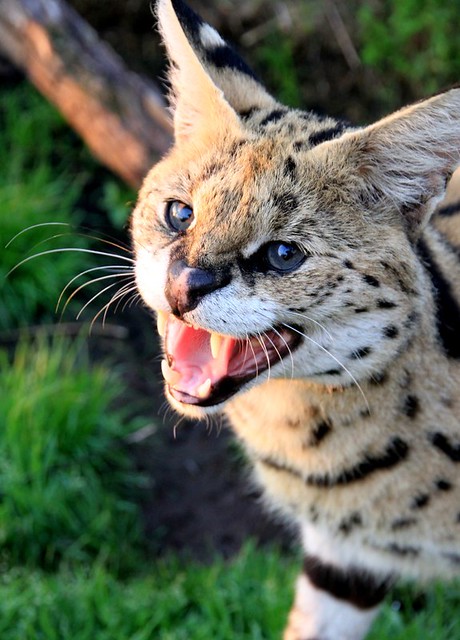
The photographs on this page show how big her ears are (click on the thumbnails above if you haven't already to get a good look). They also show you that her ears are tall and erect. They allow her to pick up sounds that we cannot hear and "home-in" on the source of the sound with unerring accuracy.

They kill their prey by jumping powerfully up in the air and landing their front paws onto the prey, killing it (see the video below). They apparently have a 50% kill rate, which is exceptionally high. Other similarities to the Bengal are their athleticism and the fact that they use their paws to grab things (and poke down holes).


Serval Cat
Serval cat (female) - photo copyright Kathrin Stucki A1 Savannahs 


There is obviously a lot of pleasure and fascination to be gained in living with a tame wild animal with the kind of skills that this cat has.

Here are some more comparisons between the Serval and standard domestic cat:

Serval Domestic Cat
more prone to litter box and spraying problems rarely have to deal with spraying problems unless they are unneutered
jump high and crash through things when they jump they do so with a certain precision and rarely knock things over
like to spend most of their time using teeth and claws in play like to play a normal amount
deadly pouncing action pounce sometimes but rarely in play
need huge litter box normal litter boxes
faster reflexes average reflexes
strong average strength
exceptional jumping skills average jumping skills, although some are exceptional - Chausie, NFC
very large claws! average claws
hissing can mean she is excited and pleased to see you hissing and back arched means threatened and defensive
tendencies to chew anything and swallow things no such tendencies or rarely happens, but sometimes present in wildcat hybrids such as the Bengal cat.


It is helpful if you train your Serval at an early age (for example, to accept being restrained) to help manage the extra demands that a cat of this type imposes on you.


here
Savannah resting on top of a Serval copyright Helmi Flick
Click on the image too see a larger image


The Law

The laws governing the keeping of a wild animal obviously varies from country to country and in the US from State to State. An absolute must is to study the situation carefully before embarking on adopting this magnificent cat.

It would seem impossible to contemplate "owning" a wild but tamed cat without having a lot of space and the financial means to build a large and well equipped enclosure. There will be laws governing everything to do with this cat as wild animals are potentially dangerous to humans. For example, there will probably be laws governing the materials used in an enclosure and the design of the enclosure. See this website for details (this is a USA website)


The Moral Issues

serval
Serval credit: Whitney GH creative commons
this is a large thumbnail - click for larger image

No judgment or comment provided, but here are some thoughts:

  • is it right to keep a wild animal in an enclosure all her life?
  • whose interest are you thinking of when you think about adopting this or any wild cat, yours or the cats?
  • can you guarantee to comply with the law?
  • how will neighbors react?
  • can you guarantee to protect your Serval (you owe this cat full protection for life once adopted)?
  • can you meet the demands? On 27th Jan. 2008 there was story on the news that there was a Serval running around West Seattle. Another Serval had been found 2 weeks earlier doing the same thing. Obviously some people are unable to meet the demands to the detriment of the cat.

Diet

You will need to replicate the wild diet. That requires study and care. Raw meat, poultry and fish must be the body of the diet. Breeders would probably suggest supplements such as vitamins and calcium. The best information on this subject can be seen here.

Veterinary requirements

It is likely that any vet can deal with a Serval but some vets will be better equipped than others. Do you know who they are? Check this out thoroughly beforehand.


serval cat
Photo: © bikini sleepshirt (Flickr) creative commons

The Ears

If you click on the thumbnail photograph second from the left at the top of this page you will see in large format the interesting ear pattern on the back of the Serval's ears. There must be a reason for such a pronounced white marking, but what is it? An aggressive and hostile cat will display a special ear posture; the ears are rotated and slightly flattened so that they become visible from the front. The position is half way between alert and defensive (flattened). This is a signal to another animal (and a signal that it is understood) that she is ready to attack. The half flattened position says that you don't frighten me such that my ears are totally flattened (defensive position to protect the ears). This special ear position also allows the Serval to fully flatten her ears if the opponent decides to attack and a fight ensues.

Declawing

There will be a huge desire to declaw as a this cat has big sharp claws. But declawing is in my opinion inherently wrong and can never be justified. It is a serious procedure that may well damage the cat emotionally. You will be adopting a wild cat and then taking away from the cat a very substantial part of his "being" and psyche. Some breeders will have the operation done automatically; shame on them. Do you want to adopt a wild cat or not? This website has some articles on the subject and there are many on the internet. I suspect all say, "don't do it" .

A Story about a Serval

This is an interesting story because it concerns a court case of November 12th 1923 in which a race hourse trainer sued a person who had taken a tamed Serval into a central London restaurant (the West-End), the Cafe Royal, which is very near Picadilly Circus. This is right in the middle of London.

The race horse trainer had been allegedly bitten by the Serval as he sat down in the restaurant. He sought damages and the legal action threw up some interesting "evidence" about the domestication of this wild cat. It is also interesting to note how long ago that Servals were considered to be suitable as a domestic cat, at least by some people.

The evidence given concerned whether such a cat could be truly tamed. It was suggested that the wildness in this cat could not be completely "eradicated". When they were young things were alright. The Serval concerned was given to the "owner" in South Africa when the cat was 8 months old (and subsequently imported into England). As the cat became an adult, it was argued, (for the person who was bitten) that their wildness was more likely to be revealed.

A book entitled, "Animal Life in Africa" by a Major J Stephenson-Hamilton had stated that this cat did not lend itself easily to domestication. The food of the Serval was large rats and guineafowl.

I had thought that the tamed Serval as a domestic cat was an American idea. I was wrong.

From Serval to Home page


Sources:
  • http://www.exoticcatz.com
  • Wikipedia
  • Messybeast
  • breeder sites
  • Re: header photo, this is a Flickr photographer I have lost the name of - please come forward as I want to credit and copyright you.
  • Desmond Morris
  • Times Archive