
Siamese cat history, in detail, is set out on this page using many sources and some patience. You’ll need patience to read it all too as it is quite long! But then it is meant to be as definitive as I can make it. But please note that these are my carefully considered views. I don’t pursue the well worn conventional path. I just look, read and form my own views.
 What did the original Siamese cat look like? Today in 2010 there is a range of Siamese cat body types, from the slender (“oriental”) Modern Siamese to the Applehead (Traditional) Siamese with a more cobby body. In the middle there is a new breed called the Thai, which I call the classic Siamese. Breeders of each say theirs is the true, the original Siamese cat. Who is correct? Lets just add that the “original Siamese” is the cat that was roaming around Siam (Thailand) as a household pet before the cat fancy was a twinkle in the eye of Harrison Weir!
Taking a purely commonsense view it was bound to have been something like modern day slightly rangy feral or semi-domestic cats found in warmer climes in terms of body shape and overall appearance but a pointed cat…much more on that to follow. Another quick point: was the coat of the original Siamese cat less contrasty. Was the body colour less white? See photo adjacent. I don’t know. This article is about body shape.
Although I go back to the very beginning further on in this article, here is an extract from the Penny Illustrated a newspaper dated 30th October 1897, which is relevant to Siamese cat history. This was the time of one of the first Crystal Palace Cat Shows. The Crystal Palace was an impressive exhibition hall in London, England – it was burnt down. The writer says this about the show – this is taken verbatim as you can immediately tell by the language used:
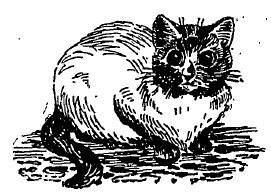
“I went to the Palace Cat Show to get a note for my readers, and saw the “whole silvers,” the “white smokes,” the Iceland cats, and the most popular of all the Siamese, with their mauve-blue eyes and kinky tails. Here is Grave, innocent, and dignified as the animal depicted appears to be, he is none of your tame garden wall sort, and he can show any amount of sprightly gambol and frisk when opportunity offers.”
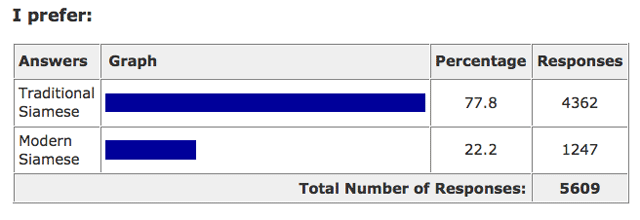
As is clear from the illustration accompanying the above text, the Siamese cat was the Traditional Siamese cat as we now know it or, in my view, under TICA registration approximating the “Thai” cat breed (although the Thai is more slender). It was an exotic cat in 1897. The Siamese was also considered rare at the time of the early years of the cat fancy, late 1800s. Of course, the interesting thing is that the Siamese is still popular and it is still the traditional Siamese cat that is the more popular. In other words, the same cat breed is still one of the most popular. I can say this with some authority (but not admittedly with complete certainty) because the polls carried out on this website tell me that the Siamese is in the top three most popular cat breeds (scroll down) and the Traditional Siamese is by far the most popular out of the Traditional and Modern Siamese. (on these linked pages you will see a voting form and results, below).

In another extract from this newspaper dated 10th March 1894, the author states that ….”Siamese cats, the latter variety being the rarest variety of all…..”
The Siamese is no longer rare but almost ubiquitous. This doesn’t make this breed any the poorer. You can see which cat breeds are rare, in my opinion and on my reckoning, at the time of the writing of this article (2008) by clicking on this link.
At the beginning of the cat fancy the National Cat Club was the premier cat fancy organization. It had the role that the GCCF in the UK has at present. In fact, the National Cat Club was the Governing Body of the Cat Fancy but the Governing body seems to have split away in 1910. The first show the club organized at the Crystal Palace was in 1887, when 323 cat were entered. This was only three years after the importation of the first Siamese cat into the UK in 1884; the beginning of Siamese cat history in the West it is said. But there is evidence to suggest that a fine specimen of a Siamese cat called “Siam” was shipped in a Wells Fargo crate to the United States by David B. Sickels, a United States diplomat at the consulate in Bangkok to the First Lady Lucy Hayes in 1878! The cat died about a year later. Not an auspicious start.
There appears to have been a cat show at the Crystal Palace in fact in 1885 only one year after the importation of the Siamese from Siam, when the offspring of the sister to the cat referred to below (the gift from the King) were shown.
The importation from Siam to England happened when the King of Siam gave the departing British Consular General (returning to England) a Siamese cat as a present. I presume that he returned by ship and it must have been quite a difficult journey for that cat. Note: I have a slightly different story about this which I refer to when writing about the Siamese cat’s kinked tail.
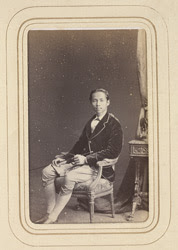
The King of Siam who gave this gift is illustrated left. He was by all accounts a good King. The Monarchy in Thailand (formerly Siam) is still going strong. To this day, it is a criminal offence in Thailand to criticize or fail to respect the Monarchy of Thailand. Punishment can be severe.
Mr. Harrison Weir founded the National Cat Club 1887 and set up the first formal cat show in 1871. He described the Siamese cat as the “Royal Cat of Siam” in his book Our Cats and all about them. He said that the Siamese was “widely different from other short-haired varieties”.
In 2008, that cannot be said to be the case. But it does reinforce the view that at the time this was a rare and unusual cat breed, which of course it was as it had only recently been seen three years earlier for the first time in the West.
He observed the Siamese cat (for the first time himself, perhaps) when he visited Lady Dorothy Nevill, at Dangstien, near Petersfield. For those not living in the UK or who are uncertain, the term “Lady” signifies the wife of a man who has been knighted by the Queen. A man who has been knighted can use the prefix “Sir” before his name in the same way a medical doctor uses the prefix “Dr” before his/her name. Usually, they are fairly well off financially.
He commented on the “extreme shortness of their fur” and the fact that it was “not so glossy as our ordinary common domestic cat”. Both these comments would not, it seems, be in line with current thinking and are a part of Siamese cat history although it hints at the smooth single coat. Although it implies that the Siamese cat had a coat that was noticeable shorter and closer than he was used to. There are currently quite a few cats with coats that are probably shorter and closer, such as the Havana Brown and Oriental Shorthair, both of which were not a twinkle in the eye of any cat breeder at that time.
He referred to the tail as “thin”. Mr Harrison Wier also wrote that Lady Nevill had said that the Siamese cats that belonged to her were imported from Siam and “presented by Sir R Herbert of the Colonial Office”. He is not the British Consular General referred to above, but there maybe a connection.
Lady Neville told him that all her Siamese cats died fairly quickly, some within one year, of worms. She said that, “they permeated every part of their body”. Veterinary surgery was obviously more primitive over 100 years ago as that kind of condition is curable today. There is a wealth of information on the Messybeast website but little in the way of conclusion on the early years of the importation of this breed of cat. What clearly comes across is this:
There were other Siamese cats imported from Siam at or about this time, for example a cat called “Wankee” was imported from Hong Kong in 1895-96. The Siamese was said by English cat fanciers to be the cat that occupied the palace at Bangkok and was not known as a domestic cat for “ordinary” people. The Siamese was considered delicate and intelligent.
There was talk of two types of Siamese and this may be the origin of the split between the Traditional and the Modern Siamese. This talk seems to have been about both the Seal point and the Chocolate point, two original colors of pointing and secondly differences in the body shape (conformation).
A person called Mrs Robinson (possibly a cat breeder of the time – early 1900s – or at least someone in the cat fancy) said that, “Of the royals there seem to be two types in England: the one – rather a small, long-headed cat, with glossy, close lying coat and deep blue eyes, and with a decided tendency to darken with age – is generally the imported cat or having imported parents; the other is a larger cat, with a rounder head, a much thicker, longer and less close-lying coat, and the eyes a paler blue (these cats do not darken as much or as soon as the other type, and have generally been bred for several generations in England.” She is saying that the imported cat is on the face of it more like the Modern Siamese of today and the one that is breed in England is more like the traditional cat of today. That is confusing and probably incorrect it seems to me because all the pictures of the time show the Siamese cat at that time as having, what I would call, a balanced conformation. In any event, when a person is describing a cat as “long-headed” they are making that description relative to what he or she considers to be the norm and the norm was probably a fairly round faced cat such as the British Short hair, which at the time was largely a random bred or mixed breed cat.
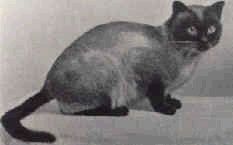
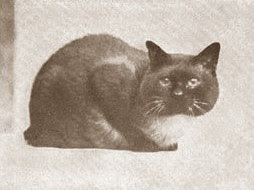
Of other sources of the time the 1911 Encyclopedia Britannica is helpful in researching Siamese cat history. Although it is a little hard to be precise because the presentation of the photographs of the 1911 Encyclopedia Britannica website (Love to Know) is vague; by deduction the picture above right must, by my estimation, be the Royal Siamese referred to in the Encyclopedia.
The 1911 Encyclopedia Britannica also refers to a characteristic of the Siamese cat, the kinked tail. This has been bred out but can sometimes be felt, the merest vestige remaining. The Encyclopedia says this, “……….showing in greater or less degree a decided kink or bend near the tip”……….”These kink-tailed or tailless cats are moreover smaller in size than the ordinary short-tailed breeds….” The Encyclopedia then goes on to describe the cat as follows. It describes the “Royal” Siamese as one of the “Old World domestic breeds”. It says that the Siamese has an origin distinct from “ordinary” European breeds. The evidence for this could be found in the pointed coloring (this must have been unique of very rare at the time) and the unmistakable “cry” (we know the Siamese has a “demanding” voice and is vocal). Once again reference is made to a kinked tail. The book says this is related to the kinked-tail Malay cats, which have a voice similar to the Siamese. A kinked tail under the CFA Breed Standard is grounds for disqualification in competition, today (2010). Yet it was treasured as special in Siam! This shows the arbitrariness of some of the decisions in respect of the breed standard. Siam incidently is now called Thailand.
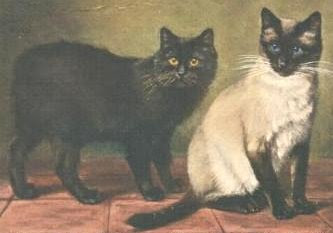
Then, most interestingly, this Encyclopedia makes reference to, “..the head is rather long and pointed, the body also elongated with relatively slender limbs, the coat glossy and close, the eyes blue, and the general color some shade of cream or pink with the face, ears, feet, under-parts, and tail chocolate or seal-brown.” I had thought that the reference to a long a pointed head was an indication that the Modern Siamese conformation of today, extremely foreign and really quite skinny, was a reflection of the original Royal Siamese cat. In other words the modern look was near the original look. But I am convinced this is not the case. The head of the Royal Siamese was simply longer than the average English cat of that time, which was a little round like the British Shorthair cat as mentioned above. The pictures on this page are the cat being described. I think that the difference between the Manx face and the Siamese face above left illustrates what I am saying. Important note: this is not the conventional view, which is that the Modern Siamese reflects the ancient Siamese. Nothing that I see or read supports this. It seems to fly in the face of common sense too as mentioned earlier. Up until now I have been mentioning England almost exclusively. In 1890 apparently Siamese cats were imported into the USA from Siam. Siamese Cat history began in earnest in the USA in the early part of the 20th Century (early 1900s). I have also focused on the early years. Once the cat fancy in the USA got involved with the Siamese cat the appearance of this cat gradually changed. This developmental change also happened to the Persian.
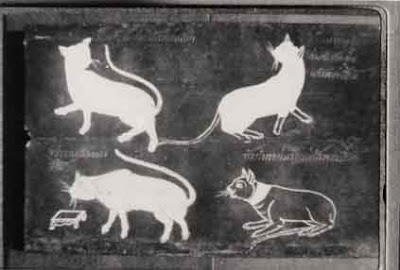
Cat Book Poems 1350-1765 – photo copyright Daphne Negus (believed). The cat top right in this illustration is a Siamese Cat I presume.
In and around the 1950s the appearance of the Siamese cat was as seen in these photographs. The well-known film, Bell Book and Candle starring Kim Novak and James Stewart also starred Pyewacket a traditional seal point Siamese. The film was released in 1958. This was the only type of Siamese cat at that time.
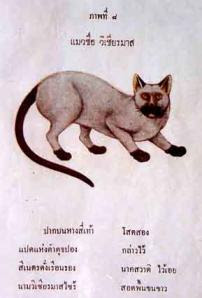
From about the 1960s onwards, Siamese cat history took a turn and breeders developed this cat in the direction of what they call a “foreign” type cat (see cat body types). Maybe this was for the simple reason that it is a foreign cat in terms of origin. Maybe it was a gradual thing that crept up on cat breeders due to breed standards that allow wide discretion and breeders preferred what they considered a more exotic appearance (i.e. less normal and more refined). Or perhaps they had decided (as I have not) that the thin Modern Siamese cat is the original and correct appearance based on the Cat-Book Poems of 1350-1765 (see right). The author of the Moggies website (one of my favorites) says that Siamese cats depicted in this book looked thin, like the Modern Siamese. Of course, thinness and cobbyness are subjective and relative concepts, as already mentioned.
The illustration on the right shows what I believe to be a Siamese cat (top right). This cat has a normal body and appearance similar to the other Siamese cats illustrated on this page. In the Cat-Book Poems (writes Daphne Negus) the Siamese cat depicted is a seal point, the original color. Another old book that originates from Thailand, as it is now called, is the Smud Khoi of Cats dated 1868-1910). This book also has a picture believed to be of a Siamese cat of normal body appearance (see above left).
Siamese cat history – The Change to Modern Siamese
As mentioned, Siamese cat history took a turn when the appearance changed over the last 50 years to the extent that the original “normal” conformation was so far removed from the new look that it was outlawed by the cat associations and cats of that type could not be shown. What prompted the cat breeders and associations to decide to develop a cat different to the one that they had inherited? The answer, I believe, is in an article written by Betty White from the 1987-88 CFA Yearbook. She says that the National Siamese Cat Club was formed in 1946 as there was a need for a Siamese Group within the CFA “body politic”. She says that the Siamese cats of the mid 1900s found in Thailand (that were imported into America) were not the same type (“not the same animal”) that were protected by order of the King of Siam in the late 19th and early 20th century. These imported cats were also only selected for their pattern. I wonder how it was decided that the Siamese cat had changed in Siam? There is no written or illustrative data from that period to support this argument. And the research presented on this page concludes differently. In addition, she says that the “specimens” from abroad were “inferior” and had coarser bone, “short heads” and paler eyes. The reasons for a change are made starkly apparent.

She goes on to say that a movement started in the 1940s, the purpose of which was to “stress type”. I presume that this means to make the appearance more outstanding as the word “type” means appearance.
Betty White also says that in the 1960s breeders paid attention to “refining bone”. I presume that this means breeding for the long boney face (equating to a refinement for cat fanciers) and the rangy body. In 1966, the breed standard was updated and revised (to cement the new look, I guess). There were those within the CFA who no doubt disagreed with the direction in which the breeding was going but were overridden.
Betty refers to Jeanne Singer who herself had referred to “great improvement in head type” during the ten previous years (i.e. 1956-1966). The authors of Robinson’s Genetics for Cat Breeders and Veterinarians, say that the Modern Siamese is a fine example of cat breeding and a prime example of the foreign or oriental “type”. The authors are 3 cat breeders and one veterinarian. That then is the story of the change in appearance. To summarise: the people at the CFA decided a more elegant (to their eyes) appearance was required than the “normal” one.
This naturally leads on to the question of the business of cat breeding. There is an uneasy relationship between breeding cats and business, but it is a business, bottom line. Bearing in mind the results of the survey on this site in relation to preferences on the Traditional or Modern Siamese (see current result below), it would seem that the cat fancy or the relevant breed council did little in the way of market research before changing the appearance of the Siamese cat. If they had they wouldn’t have done it – if they really were concerned about the business aspect of breeding.
The truth is that the cat fancy is a bit of a club, they do it for themselves. When you go to a cat show you feel that you are an invited guest to a private club, not a public exhibition. The Siamese Cat History bears out this suggestion. Synchronize this history with Balinese Cat history. One final point. Common sense dictates that the two cat breeds, the Modern and the Traditional are not so well defined as to exclude every cat type in between. There are a range of cat shapes and appearances in between the Modern and Traditional. These cats are sometimes referred to as the Classic Siamese cat (particularly if they are at the Traditional end of the spectrum). These will usually be seen as non-purebred Siamese cats; fine cats nonetheless. And in my opinion the Classic Siamese cat is the Thai cat. Some Thai cat breeders will strongly disagree but to all intents and purposes it is one and the same cat.
Siamese cat history – The Backlash
That created a backlash and TICA have seen sense and registered the Traditional Siamese as a new breed called the “Thai”. Thai cats, recognized by TICA and which can be seen on the Siamese cat breeders page and the Thai cats (new window) page are in fact Classic Siamese cats, perhaps in between the Modern and Traditional Siamese cats but very much at the Traditional end of the scale. Their breed standard is enlightening and welcome to supporters of the Traditional Siamese. It refers to the indigenous Siamese cats, well balanced and not extreme. It is nice to see a person within a major cat association who has written a breed standard supporting the view that the Traditional Siamese cat is the way the Siamese cat should look or originally looked. See a fanastic Flame Point Siamese Cat. Siamese cat history would not be complete without showing the before and after appearances of this cat breed:-
 Traditional Siamese photo ©Barb Henry (under Creative Commons) | 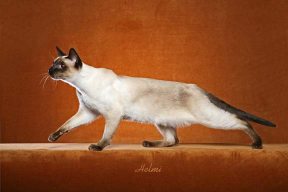 Thai cat photograph ©Helmi Flick |
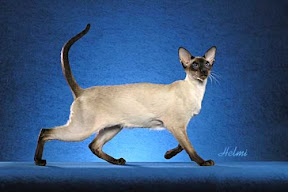 Modern Siamese Cat photo ©Helmi Flick Siamese Cat History. This shows the full spectrum. | |
Siamese cat history – The Public’s Opinion
Siamese Cat History as I have mentioned on another page is bound up with the development of this cat breed. My view, as you have guessed, is that the Traditional or more accurately, the original, Siamese should have been left alone. What is your view? Opinion is still divided and polarised. Now you have voted your preference.
Siamese Cat History – Copyright:
My understanding of copyright in respect of images comes from Wikipedia. In relation to images used by them they say that copyright for images is for the life of the author plus 70 years for USA, Europe and Canada. Louis Wain died in 1939 so on the face of it at 2008 he or his heirs retain copyright (just). But it seems that he did not retain it at the time the artwork was produced. I don’t know who did or under what terms. Another point, this is not a commercial site; it is for educational and non-profit making purposes.
It is my carefully considered opinion that if in reproducing images on this page I have potentially infringed copyright (highly unlikely), I have a defense of “fair use”. The 1911 Encyclopedia Britannica is copyright free. If someone disagrees please contact me. You can see my details on this page. Where the copyright issues are clear a notice is provided under the photograph. There are 2 photographs of old books by Daphne Negus. I have tried to contact her without success but provided a notice under the photo nonetheless.
As to the text quoted this is out of copyright due to lapse of time.
Siamese Cat History – Sources:
- http://www.nationalcatclub.co.uk/History_frame.htm
- http://www.collectbritain.co.uk/
- http://web.archive.org/web/20131028014317/http://www.messybeast.com:80/retro-photo.htm
- http://www.1911encyclopedia.org/Cat
- http://www.cfa.org/Breeds/BreedsSthruT/Siamese.aspx
- http://www.moggies.co.uk/
- http://www.koratworld.com/smudkoi.html
- http://www.siamesebc.org/yearbookArticles/yearbook87.html
- http://www.rbhayes.org/hayes/manunews/paper_trail_display.asp?nid=65&subj=manunews
Siamese Cat History to Home Page
The text about Siamese cat history on this page is copyright © Michael @ Pictures of Cats

Andrew, thanks for the feedback. Always appreciated. Return one day!
This is an excellent article on the history of Siamese Cats. I own 19 books on Siamese Cats and read other books & Websites on Siamese Cats. So when I say this is Excellent I really mean that tern!
I prefer the modern show Siamese, as that is the type we raised when I was a kid. The so-called traditional Siamese seen today was created during WWII when breeders would breed their cats to anything just to save bloodlines. The faults could be bred out later. The so-called traditional Siamese is wrong; it looks like a moggie with a Siamese paint job.
Hi Roberta. Yes, the cat is the Balinese.
https://pictures-of-cats.org/balinese-cat.html