Sphynx cat
|
Photo: © skithund
Introduction
The Sphynx Cat looks unnatural and
rather peculiar, I thought. I also thought this cat breed was ugly and
I couldn't see the point of the breed. But when you meet and touch and
interact you tend to change your mind mainly because of the intelligent
character of this cheeky and curious cat. And in any event the Sphynx
cat is actually as natural as any of the cat breeds.
Having
had a very close look at this cat at The National Cat Club Show 2007 at
Olympia, I was impressed by the Sphynx Cat's character and behavior.
This cat can look a bit neurotic I think this is because of the fragile
appearance and of course having no hair (the cat is not fragile). Yet
the Sphynx Cats that I
met, touched and photographed were great characters and quite laid back
despite the noise, distractions and strangers at the hall. And the
little guys I met were new to the showing business.
Although this is considered a rare
cat breed, my research on common sense principles indicates
that the breed is less rare than thought. On a scale of 1-10 where 10
is the most rare I have ranked this breed around 3-4. That said you'll
probably find that there is a waiting list if you go to a breeder. In
terms of popularity she is probably mid way up the scale. You can find
out for yourself if you vote on the home page poll. Once you've voted
your taken to the results.
Casper a 16 weeks old kitten at
The National Cat Club Show
London 2007. Photographs
copyright Michael Broad
Origin - History
This cat breed is one of a group
of cats that came about because of a natural and spontaneous
genetic mutation of a recessive gene. On this occasion the event took
place in Toronto Canada in 1966 (although it seems that this line of
Sphynx cats died out due to a failed breeding program, but see below).
 |
 |
 |
 |
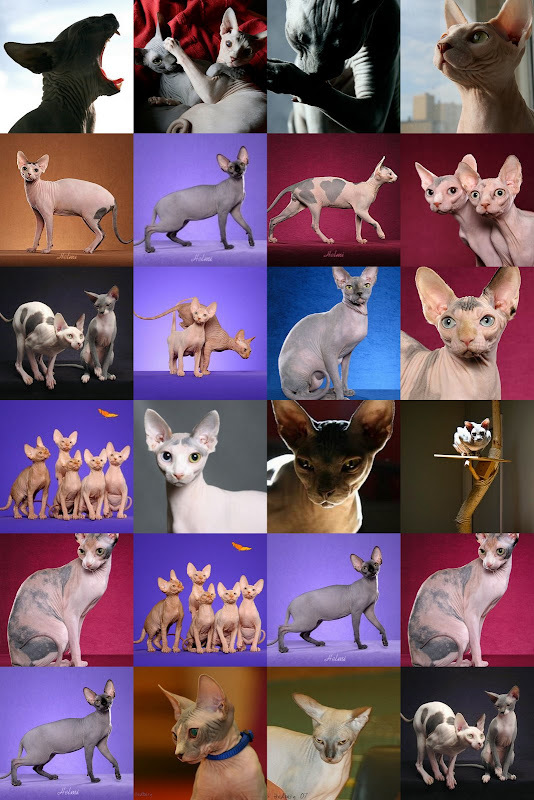
| Photos - Copyright Helmi
Flick. These are thumbnails linked to great large format images |
The breed is therefore otherwise known as the "Canadian Hairless",
"Moon
Cat" and "Moonstone Cat". There are, though, well documented instances
of the hairless cat mutation occurring many times before 1966 without
attracting sufficient attention for a new breed to be formed from the
mutation. For example, in 1830 in Latin America and in many other
countries including England, Australia, USA and Russia to name a few.

Sphynx cats - photo ©Helmi Flick
A notable example of another occurrence of this genetic mutation would
be the birth of brother and sister "Dick" and "Nellie",
Mexican hairless cats of 1902 (there are, though, recorded instances of
hairless cats going back as far as the 1830s). It seems that
Dick and Nellie were quite famous. They were given to E J Shinick,
Albuquerque, New Mexico by the Pueblo Indians. Mr Shinick did not mate
Nellie. While Dick, although a strong healthy cat, was killed by dogs.
Dick liked to sneak out of the house despite Mr Shinick's best efforts
and was attacked. Mr Shinick said he would have survived one dog but
not a group of dogs. Mr Shinick was aware of the rarity of his cats and
their value.

Sphynx cat - photo ©Helmi Flick
They were valued at $1000 (about $20,000 today) each and
he valued Nellie at $300 (about $6,000 today).

|
more Sphynxs
|
Another example is the story of a cat named "Nonesuch". So named as the
owner wasn't sure if the animal was a cat or a dog. The time: mid 1936.
The place: USA - Wilmington. The parents were ordinary cats and the
occurrence was put down to a recessive genetic mutation. This event
sparked a certain Professor Etienne Letard, in France, to write about
"Hairless Siamese Kittens And Their Parents" (the "French Bald Cat").
There is also the dominant gene mutation that results in a hairless cat
named the Don
Sphynx (Russia 1987) and the Hawaiian Hairless (or Kohana
Kat). This mutation was noticed in 2002 in Hawaii. The hairlessness is
different as there are no hair follicles as opposed to very
little downy hair.
| History
time
line |
| 1966 |
White domestic shorthair in
Ontario Canada gives birth to a hairless cat amongst "normal" kittens.
He is called Prune, bred back to his mother to produce more hairless
cats and the breed started. |
| 1988 |
The first Sphynx cat enters the UK from
Holland |
| 1990 |
Application to the GCCF for the breed to be
recognized |
| 1998 |
CFA accept breed for Miscellaneous class |
| 2002 |
CFA accept breed for Championship class |
| 2006 |
GCCF granted the Sphynx breed preliminary
recognition |
| Now |
CFA,TICA and FIFe fully recognize this cat. |
Up a cat tree looking like a bird
photo by Fleur-Design
Appearance and character
Most of us know that the Sphynx cat is not actually hairless - just
looks that way, at a distance. This cat has very fine
downy hair and
the whiskers and eyebrows are not there at all or small and perhaps
broken.
They can seem quite slight in appearance but can be largish with a pot
belly. In fact the CFA would penalize a cat that looked delicate so
this cat needs to look pretty robust.
The other, perhaps, obvious characteristics (supported by the GCCF
breed
standard, called the Standard of Points), are the large (very large
sometimes) ears, long bony head with high and prominent check
bones, large eyes and long wiry looking tail (exagerated by the fact
that it is hairless). Perhaps a number features are exaggerated as they
are not covered by fur. The color of the cat is irrelevant to the GCCF.
Sphynx cats take on the color of their fur through their skin so you
will see patterns on the skin that would have been on the fur.
The Sphynx seems to have longer limbs or is this just the lack of hair
giving and impression? The answer is, yes, as the GCCF breed standard
states that the legs and feet are of medium length. They
also seem
to have longer "fingers" and "toes", which they use to good effect in
holding on to things. In this case what seems to be the case is the
case as the GCCF breed standard says the toes should be long and
slender (the CFA does not say this). Look at the picture below by dracorubio
(Flickr name) and see how the paws are so much like hands and fingers.
They are probably the most intelligent
cat breed and therefore require input and interaction from
human keeper or another cat perhaps. They are also agile and strong so
something to play with and climb on will probably be welcome.

Sphynx cats playing - photo
©dracorubio
reproduced under a
creative commons license
Breeding
The
only allowable outcross breeds from the
Sphynx Cat in the CFA (Cat
Fanciers Assoc.) are now the American
Shorthair and Domestic
Shorthair (src:Wikipedia).
Although the Sphynx Cat Club in the UK says that permitted outcrosses
are the Domestic Shorthair (moggie) and Russian
Blue. Is this a difference in policy between USA and UK?
Please tell
us here.
It is clearly feasible to breed more varieties of hairless cats but it
seems that this is resisted for 3 reasons. First, the gene that makes
this cat almost hairless is not a mutation
that is naturally beneficial to the cat. Secondly, the breed in terms
of appearance is not obviously attractive to humans and there are
probably health issues if
crossing with certain other breeds. Since
writing this I have changed my mind a bit about the Sphynx Cat, however
(see introduction).
Sphynx cat - photo ©dracorubio
The breed has been crossed with a dwarf cat (the founding dwarf cat)
the Munchkin,
to produce the Bambino
(named after the Italian word for a baby). The Bambino is essentially a
short legged Sphynx. There is also the Dwelf,
which is a cross between a Munchkin,
Sphynx and an American
Curl -
short, hairless with ears that curl at the tips.
More recently a couple of breeders have developed a cat breed they call
the "Elf"". Click on the link to read about the Elf
Cat, an extremely rare
cat. Generally, due to careful breeding the Sphynx is robust
with few health or genetic
problems.
My research indicates that there are no (not absolutely sure though)
health problems associated with this genetic mutation (that produces
hairlessness) and that the breeding program has not has health
consequences due to close breeding. However it can be hard to find
details about health for obvious reasons.
The Shynx is a strong cat. It
would seem to me that the breeding program has had as an objective the
enhancement of the Sphynx like face, which on occasions may (and this
is
just my personal opinion) have gone too far (compare with the Ultra
Persian and Modern
Siamese).
The author of the Wikipedia entry says that the current Sphynx breed in
Europe and America is descended from 2 lines of mutations (a) Dermis
and Epidermis (great names) - Pearsons of Wadena MN USA and (b) Bambi,
Punkie and Paloma - 1975 Toronto.
Other hairless cats are the Don
Sphynx and Peterbald.
Sphynx cat -
photo ©Helmi Flick
Care
In addition to weekly or at least regular bathing as mentioned above,
excellent cat care would also include cleaning ears just after the
bath. Do this with great care and only clean what you see (i.e.
obviously don't prod a Q tip down the ear canal).
Although this breed is robust and healthy it is wise to keep your cat
indoors for 3 reasons a) they will feel the cold more and like about 70
degrees Fahrenheit (typical indoor temperature) b) as they can get
sunburned it is wise to keep them indoors and c) they are rare and may
attract undesirable attention.
The Sphynx needs to be washed periodically as the skin (which
feels like heated chamois) becomes oily due to the lack of a coat. Also
for people who are allergic to cats but who love cats they may find
this
breed acceptable (the Siberian cat has some of this quality as well it
seems but this would appear to be anecdotal). But allergy to cats is
caused by "dander",
a mixture of saliva and skin flakes that are an allergen to some
people. As a consequence being hairless does not remove the possibility
of the cat producing the allergen. I am sure Sphynx cats groom
themselves like any other which means saliva on their skin and fine
hair.
Points of interest:
- the cat feels the cold more than usually but
some breeders say this is not true. I would have thought this must be
the case.
- Conversely, she is warm to the touch due to a
release of energy by heat loss through the exposed skin.
- To some (me included) at first they look a bit
ugly. You'll find you warm to them and they feel warm and smooth too. You
might like to read what I had to say after I got up close to
a Sphynx Cat
- Here's a page about Sphynx
cat rescue
|
Photo: © skithund
Sources:
- Messybeast
- Wikipedia
- CFA
- Sphynx Cat Club - UK {link}
- Breeder sites - various
|