
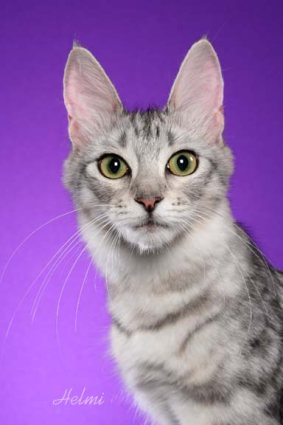
Turkish Angora Cat – photo of Safira © copyright Helmi Flick
The page is in sections for tech reasons. Links to next section at base.
- Click Turkish Angora Quick Guide for an overview.
- Read a page about the TRUE Turkish Angora that looks like a traditional Persian (click here)! The US breed Turkish Angora is not true to the original
Introduction
This breed of cat is related, it seems, to the Turkish Van and it certainly has an equally distinguished and long history that marks this cat, and the Turkish Van, out from most other purebred cats (the Chartreux being an exception). Were the Turkish Van and Turkish Angora one and the same breed once upon a time?
This is a natural breed, therefore. Of course, the breed’s naturalness would only extend to the time, in the early and mid-20th century, the early years of the cat fancy, when people got involved and started breeding the cat. This cat breed has been described as a “living legend”. By ‘natural’ the cat fancy means that that it developed naturally without human intervention. This is an interesting topic because the TA is still in Turkey as a street cat not a purebred cat. It is not and never was a purebred, pedigree cat in Turkey. The West made this cat a ‘cat breed’ and in doing so changed its appearance and genotype. The exact same thing can be said about all the natural breeds. Another example is the Norwegian Forest Cat.
The history is outlined in tabular form below. The Turkish Angora can be traced back to the 14th century and had evolved in an area called Anatolia. Anatolia is centered by Turkey (see map below – Anatolia is marked in red). It was imported into France in the 16th century. The breed was originally called the Ankara Cat.
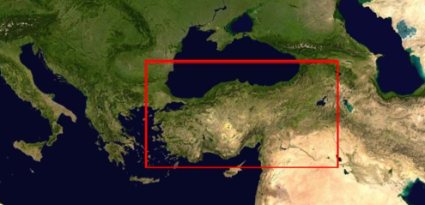
{This file is in the public domain because it was created by NASA. It has been modified by en:User:Denizz (drawn a rectangle around Anatolia) and by me (cropped the image to fit this page)
There is a possibility that the Turkish Angora evolved from the Manul cat (Felis manul) or Pallas’s Cat, which was a pet of the Tartars. Also, the breed possibly evolved in mountainous regions, hence the semi-longhaired coat. It may in fact have evolved in Russia initially.
There was a certain amount of confusion, in that the word “Angora” was originally used during the early years of the cat fancy to mean a long-haired cat (see Angora cat). The terms “Angora and Persian were used interchangeably”.
 | 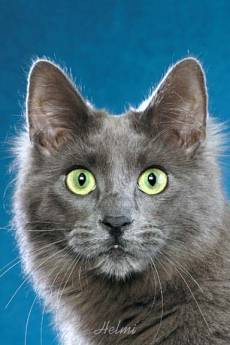 |
| Photos of Nightingale on left and Paolo on right © copyright Helmi Flick. Helmi says that Paolo is a good example of a “Turk”. Click on these photos to see larger versions. | |

Thanks Liz. I’ll check that out asap. I have another on the TA – the real Turkish Angora!
hi, there are a few inaccuracies here about Turkey.
First of all, Anatolia is the name for the whole of the Asian part of Turkey (most of it) not an old name, it’s still in common use. Also, you say Angoras ‘used to be called Ankara cats’ which would make absolutely no sense seen as the city was called Angora until the 1930s – you’re the wrong way around!
Thank you
What picture would you like to use? Remember that a lot of the pictures are by Helmi Flick. These are copyright protected. Most of the others are published her under a creative commons license.
Do you take requests for the cat pictures? I’ve looked all over google and can’t find the picture I need.
Hi Michael Pity that Antioch Turkish Angoras does not have genuine Turkish Angoras.
I am very pleased to have you around to explain the finer points of this tricky subject. Thanks a lot Harvey. It was nice of you to take the time to respond to this lady.