In answer to the question, “what do lions eat“, the answer comes with an appreciation of this wild cat’s hunting prowess. Over centuries people have considered the lion at the very top in respect of hunting skills. The lionesses are the hunters of the pride. They hunt in groups as most of us have seen on television.
Their exceptional hunting skills allow them to hunt and kill other predators and large animals (mammals) usually within the range of 190–550 kg (420–1210 lb) but occasionally outside this range. The choice of prey is based on availability. The region can dictate the type of prey. For instance, in India it might be livestock or the Savuti river, where they prey on elephants. The risk of injury is the limiting factor in choosing prey. This translates to avoiding animals such as adult rhinoceroses, adult male buffalo or adult male giraffes. Competitors such as leopards cheetahs, hyenas, and wild dogs may be killed but not usually eaten. Smaller gazelles, impala, and other agile antelopes are generally excluded. Perhaps on a basis of effort versus reward, these smaller antelope are fast, very fast animals more suited to the prey of the cheetah (see what do cheetahs eat).
The lioness will eat 11lbs of meat a day, the male 15.5 lbs (but up to 30 kg or 66 lb). As is the case for the domestic cats, they are obligate carnivores – they only eat flesh.
Note: until about 10,000 years ago the lion was the most widespread land mammal apart from people. The lion is now considered threatened (vulnerable). See IUCN in relation to cats.
What follows is an illustrated list of the mammals that fall into the group of animals eaten by lions and provides the answer to the question, “what do lions eat?”. The listed animals’ habitat is in Africa unless otherwise stated.
Wildebeest
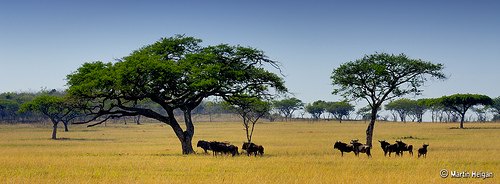
Blue Wildebeest, Africa – photo by Martin_Heigan
 |
The wildebeest is a large animal, weighing 330–550 pounds (150–250 kilograms). It is a hooved mammal (ugulate) and an antelope.
There are two species of wildebeest: the Black Wildebeest, or white-tailed gnu (C. gnou), and the Blue Wildebeest, or brindled gnu (C. taurinus). They migrate annually.
They inhabit plains and open woodlands in places such as the Serengeti Park, Africa.
Impalas
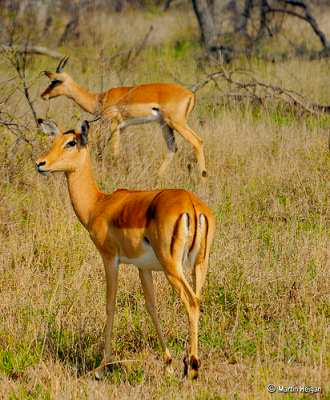
Impala – photo photo by Martin_Heigan
The impala is also the prey of the cheetah (see what do cheetahs eat). The impala is an antelope of medium size. The average weight is 75 kilograms. When frightened (
for example by a lion!), as a group, they jump around to confuse the predator. They are extremely athletic being able to jump 9 meters (30 ft) in length and 2.5 meters (8 ft) high.
Zebras
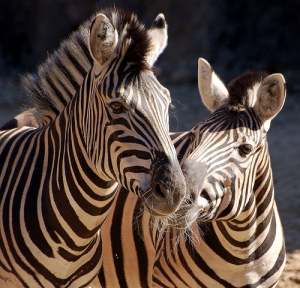
The zebra is very well known to people. They are, unsurprisingly, part of the horse family. There are 3 types: the Plains Zebra (most common), Grevy’s Zebra and the Mountain Zebra. As is the case for horses they walk, trot, canter and gallop. Attempts at domestication have generally failed. They are slower than horses but have more stamina. They are about 2.3 m (8ft) long, 1.25-1.5 m (4-5ft) at the shoulder. Their weight is around 300 kg (660 lbs)
Buffalo
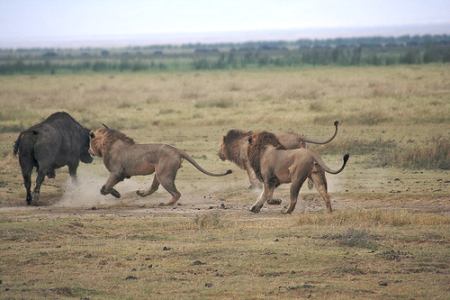
The buffalo is well known to be a dangerous animal, one of the most dangerous in Africa. This is a large animal, 1.7 meters high, 3.4 meters long and weighing 500-900 kg (and essentially too dangerous, as an adult, for the lion to hunt – but see group hunt in video below). This animal is a large African bovid (cloven-hoofed mammals of the Bovidae family).
Warthog
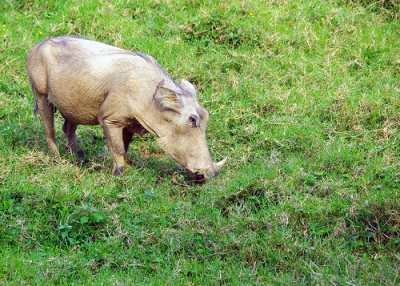
What do lions eat? = Warthog – photo by tattoodjj
The warthog is a wild member of the pig family, in Africa. It has wart-like protrusions on the head, hence the name. They are solid creatures: 0.91 to 1.5 meters (3–5 feet) in length and 50 to 150 kg (110–330 pounds) in weight. They are fast, good jumpers and have a keen sense of smell. They evade predators by running.
Nilgai (India)
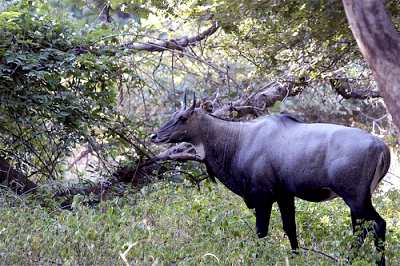
The Nilgai is a very large member of the antelope family. It’s habitat is in India and Pakistan. It is the largest antelope of Asia. It is probably the second or third largest antelope in the world. It is, perhaps, worth remarking that the lion in India is very scarce; see the map:
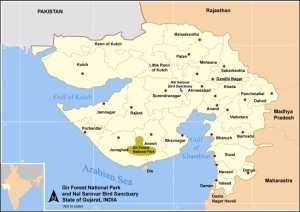
The Asiatic Lion range in India marked green – a very small area. Published under Wikimedia commons license. User: Miljoshi.
Wild boar (India)
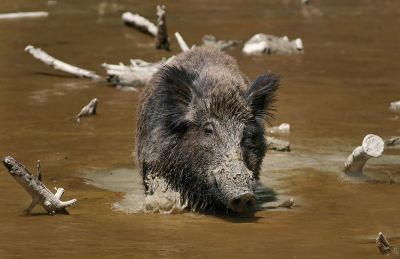
What do lions eat? = Wild boar – published under a Wikimedia license – author: Richard Bartz, Munich Makro Freak.
The wild boar is the wild ancestor of the domestic pig. Their weight averages between 70–90 kg kilograms (144–200 pounds) but is dependent on where the animal is found and can be much heavier. In addition to India this animal is native to:
- Central Europe
- Mediterranean Region inc. Atlas Mountains in North Africa
- Asia including Indonesia
Giraffes
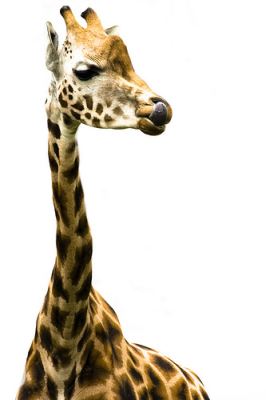
Giraffe – photo by Adam Foster | Codefor
The Giraffe is an ungulate (hooved mammal). It is the tallest mammal and the largest ruminant. They are 4.8 to 5.5 meters (16-18 ft) tall and can weigh up to 1,700 kgs (3,800 lbs).
Kudu
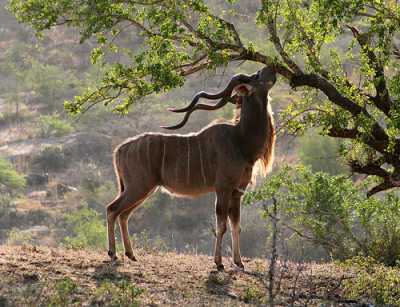
There are two species of antelope:
- Lesser Kudu, Tragelaphus imberbis
- Greater kudu, Tragelaphus strepsiceros
Kudu numbers are also threatened by people hunting them for their meat. People also hunt them for hides and horns and they use their habitats for charcoal burning and farming.
Hartebeest
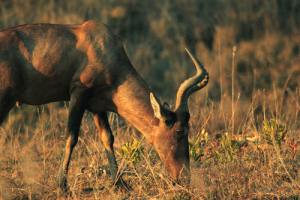
Hartebeest – photo by teague_o
The Hartebeest is an antelope that weighs between 120-200 kg (265-440 lb). The animals’s habitat is found in West Africa, East Africa and Southern Africa.
Gemsbok
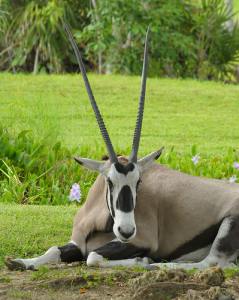
Gemsbok – photo by ucumari – ucumari is a noted photographer on Flickr.
The gemsbok is a large African antelope; the males weighing between 230-250kg and females weighing between 200-210kg.
Eland
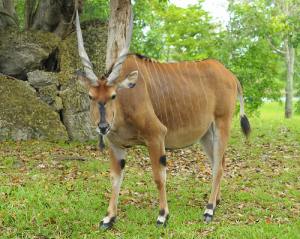
Eland – photo by ucumari
The eland is also an antelope whose habitat is the African savannah. There are two species, the common eland and the giant eland. They are the largest African antelopes weighing in at 600kg – 800kg (1300 – 1760 lb) for the males.
From What Do Lions Eat to Wild cat species
Photographs are published under a creative commons license: unless otherwise stated.