
Accurate assessment of wild cat population sizes is notoriously vague and sometimes misleading or nonexistent despite the best efforts of all concerned. On that basis assessing the threat of extinction of a species of wild cat is going to be just that, an assessment. It could, in fact, be argued that on occasion there is political motivation to hype up numbers. This arguably happened in respect of the tiger. Update May 13, 2022. This page was written in 2011. As that is around 11 years ago there may be changes in the assessment of the species by the Red List as to their survivability. However, my experience tells me that most of the recent assessments by the Red List are dated 2014. The Red List is not very current in my view. For that reason, the information provided on this page is still probably current in many respects despite being dated 2011.

The best techniques for counting numbers, scats and camera traps, are not always accurate. In addition, taxonomy (classification of species) is still an evolving subject that can cause a bit of confusion. The chart below has been carefully compiled from two excellent sources (a) Wild Cats Of The World by Mel and Fiona Sunquist pages 411 and 412 ISBN-13: 978-0-226-77999-7 and (b) the online IUCN Red List of Threatened Species. Below the main chart you will find further information in relation to the IUCN Red List for cats. This is earlier work from 2008 that adds and sometimes overlaps but is presented here nonetheless. Is the IUCN independent?
IUCN Red List for Cats – Contents
Introduction – IUCN Red List for cats
The situation regarding the IUCN Red List for cats (the source below is the IUCN Red List of Threatened Species™) is set out in the table below and is the situation as at the date(s) in the heading to the table. Things change (usually for the worse). I will try and keep up.
The IUCN Red List of Threatened Species™ is an organization that assesses the situation of wild species, worldwide, in respect of their survivability in the wild and the threat of their extinction. This should promote their conservation, but I reluctantly question whether it does.
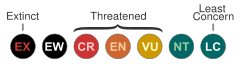
The World Conservation Union (IUCN) Red List categories are set out in their well-known scale or chart:
| Symbol | Meaning |
| EX | Extinct |
| EW | Extinct in the Wild |
| CR | Critically Endangered |
| EN | Endangered |
| VU | Vulnerable |
| NT | Near Threatened |
| LC | Least Concern |
The wild cats – as at Oct 2008 – things change – IUCN Red List for cats
These are the world’s wildcat species (some sub-species are shown) and the IUCN category assigned to them. There is also a column CITES showing whether the cat is listed under Appendix I – most endangered. See CITES in relation to cats.  = New Window.
| Cat | Latin (scientific) Name | IUCN RL cat | CITES Appen.I |
| African Golden Cat | Caracal aurata, formerly Profelis aurata | NT | yes |
| Amur Leopard | Panthera pardus orientalis | CR | |
| Andean Cat | Oreailurus jacobita | EN | yes |
| Asian golden Cat | Catopuma temminckii | NT | |
| Black-footed Cat | Felis nigripes | VU | yes |
| Bobcat | Lynx rufus | LC | |
| Bornean Bay Cat | Pardofelis badia Synonym: Catopuma badia (Gray, 1874) | EN | |
| Canadian lynx | Lynx canadensis | LC | |
| Caracal | Caracal caracal | LC | yes – Asia only |
| Cheetah | Acinonyx jubatus | VU | yes |
| Chinese Mountain Cat | Felis bieti | no record | |
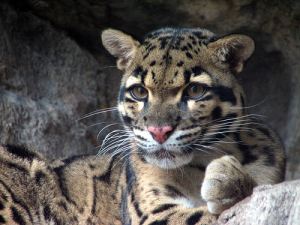
| Clouded leopard | Neofelis nebulosa | VU | yes |
| Eurasian Lynx | Lynx lynx | LC | |
| Fishing Cat | Prionailurus viverrinus | EN | |
| Flat-headed Cat | Prionailurus planiceps | EN | yes |
| Geoffroy’s Cat | Oncifelis geoffroyi | NT | yes |
| Iberian lynx | Lynx pardinus | CR | yes |
| Jaguar | Panthera onca | NT | yes |
| Jaguarundi | Puma yagouaroundi | LC | |
| Jungle Cat | Felis chaus | LC | |
| Kodkod | Oncifelis guigna | VU | |
| Leopard | Panthera pardus | NT | yes |
| Leopard Cat | Prionailurus bengalensis | LC | yes (see below) |
| Lion | Panthera leo | VU | |
| Marbled Cat | Pardofelis marmorata | VU | yes |
| Margay | Leopardus wiedii | NT | yes |
| Ocelot | Leopardus pardalis | LC | yes |
| Oncilla | Leopardus tigrinus | VU | yes |
| Pampas Cat | Oncifelis colocolo | NT | |
| Pallas Cat | Otocolobus manul | NT | |
| Puma | Puma concolor | LC | yes (see below) |
| Rusty-spotted Cat | Prionailurus rubiginosus | VU | yes |
| Sand Cat | Felis margarita | NT | |
| Serval – domestic | Leptailurus serval | LC | |
| Snow leopard | Uncia uncia | EN | |
| Tiger | Panthera tigris | EN | yes |
| Sumatran Tiger | Panthera tigris sumatrae | CR | |
| European Wildcat Description Wildcat – Scottish Wildcat – African | Felis silvestris | LC | |
| Total=38 – see Wild Cat Species for lots more on the wild cats | |||
note 2 – Cougar – listed in CITES Appendix I in relation to the Cougar, the Florida Cougar or Panther and the Costa Rican Cougar.
Comment – IUCN Red List for Cats
What is the overall position regarding the wild cats? If the category EX=1 and the category LC=7, the average position for all cats is: 5.5, which equates to being in between vulnerable and near threatened.
I think the categorization is a little generous. Appendix I of CITES lists species that are “most endangered”. There seems to be a conflict between CITES and IUCN unless I am missing something. For example, the Ocelot is listed as LC (least threatened) under IUCN and as most endangered under CITES. There are other, what appears to be, differences of opinion.
Of course, the criteria between the two is different. One, CITES is concerned with the trade in species and body parts and the other, IUCN, is concerned with the extent of the treat to the existence of the species. One however, is linked to the other.
Assessments – IUCN Red List for Cats
Update: Controversial note: I am sure some, perhaps most, of the Red List assessments are correct. But I am also sure that some are not. Take just one reason. There is a distinct lack of accurate data on wildcat population numbers. A lot of wildcats inhabit countries where there is corruption at governmental levels and where there is an economic reason to misrepresent wildcat population figures. I would not be surprised if the providers of data are sometimes working under a conflict of interest. Do we know the population on a regional basis of the Lynx for example? I don’t think that we do. Without this fundamental data it could be argued that the Red List could achieve the opposite of its intended goal. It could assist the destruction of wildcats rather than preserve them by lulling people into an apathetic stance in respect of wildcats that might in fact require urgent action. I made a post about this: IUCN Red List Assessment .
.
Spectator
It seems that the IUCN Red List of Threatened Species™ is recording the demise of species rather than acting as a motivator to others to do something about it. I must presume that one of the underlying objectives of the Red List is to alert people to conservation issues that require attention. Yet often these problems are not addressed. This must be because of commercial pressure on the ground that blunts efforts and dictates outcomes. If information is not acted upon there is little use in it. This undermines the IUCN Red List of Threatened Species™. It might be time for a change in the relationships between the various conservation organizations and to bring in some sort of international enforcement. The wild species of this world, including the wild cats, belong to the world and not individual countries. International treaties should be enforced at an international level. I don’t see this. Some countries fall down badly in respect of enforcement and where this happens in respect of endangered species (I am thinking of the tiger) there is an argument that international teams should be allowed in to enforce legislation (including local legislation) and treaties. It is time for real change and effectiveness. Many people want to see good news and population growth not perpetual decline in wild species, particularly the wildcats.
Regional variations
I also feel that where there are regional differences in the survivability of a wildcat as is the case for the Eurasian Lynx, a choice is presented. The Eurasian Lynx is endangered in Europe (critically in Portugal) yet it is classified overall as Least Concern because of the cats “wide range”. I don’t understand that as illegal hunting is “considered” to be the major threat. A wide range does not mean high and stable population. I presume that the population of the Eurasian Lynx is considered relatively stable and high because of its presence in Russia, a large area. I think that where there are regional variations the choice is:
- to list the regions separately on a formal basis
- to assess on the more cautious side
- to average the regional assessments
I favor number 2 above as there is a general downwards trend and people need to be alerted to this. Least Concern sends the signal that illegal hunting can continue without proper enforcement. In other words, assessing more cautiously is the best route in the long term. And the whole thing is about long-term strategies.
IUCN Red List for Cats — Source: IUCN 2008. 2008 IUCN Red List of Threatened Species. www.iucnredlist.org. Downloaded on 27 October 2008.
Photograph:published under a Attribution-Non Commercial-No Derivs creative commons License

You should only get a comment when it replies to yours and as you have not made a comment before it would not have happened. Am I wrong? Is so please tell me. You may have used a different email address in a previous comment.
Wheen I initially commented I clicked the “Notify me when new comments are added” checdkbox and now each time
a comment is added I get three e-mails with tthe same comment.
Is there any way you can remove me from that
service? Thanks a lot!