

Asiatic lion – Photo by DrGaz
Introduction
See lion facts for information on both subspecies of lion.
There are 359 Asiatic lions left in the wild (Gir National Park) at April 2010 (this figure is quoted as being the same in 2006 as well4 – is it still accurate?). It is said that in 1936 a survey resulted in an estimate of 234 animals in the Gir National Park. In April 2010, the authorities say that a five yearly consensus at April 2010 will show that there is a population of 400 in the park3. The IUCN Red List of Threatened Species™ says that there are approximately 175 mature individuals. 34 animals were reported killed in 2007 (Jackson 2008). 72 have died in the past 2 years3.
There are serious concerns about the hybridization of captive Asiatic lions (African x Asiatic). India now only breed purebred4. I think it fair to say that the situation at this time (2010) is not good for this very rare subspecies of lion.
Yet the people living in the Gir National Park, where it is nly found, mourned the loss of a five year old male lion that fell (or was pushed) off a bridge over a 60 foot drop. It may have been traffic that forced the lion off. He was killed in the fall3. There is genuine concern from local people, but it seems that a coordinated or truly effective response to preserve this species is lacking.
This subspecies of lion is very similar in many ways to the African lion. I limit this page to information that is specific to this species. Please see Lion Facts for lots of easily accessible information about the lion in general.
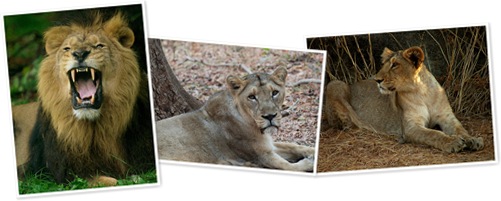
- Lioness (right) by vaidyarupal
- Lion roaring by Brimac The 2nd
- Lioness (left) by Paul Mannix
Above: All are Flickr photographs published under Attribution 2.0 Generic license.
The low genetic variability of the Asiatic lion is not thought to be caused by inbreeding but to be a “characteristic feature of this species”8. It is said that from a genetic standpoint all these lions are like twins.
Description and Difference from African Lion
The differences between the Asiatic lions and African lions, both subspecies of the lion are listed below:
- the genetic difference between these subspecies is “smaller than the genetic distance between human racial groups”11
- the Asiatic lion prides are smaller than those of African lions, with an average of only two females. An African pride has an average of four to six.4
- males are less social than African lions and only associate with the pride when mating or on a large kill.4
- they have less swollen tympanic bullae (a thin-walled bony capsule which houses an extension of the cavity of the middle ear, the tympanic cavity5)
- they have shorter postorbital constriction4 (this is wrong on the face of is as this term applies to primates6 – a lion is not a primate)
- they usually have divided infraorbital foramen4 (an opening in the maxillary bone just below the lower rim of the orbit that gives passage to the infraorbital artery, nerve, and vein7) – this might be doubted.
- the lion of Asia is generally smaller, it is said
- the Asiatic lion nearly always has a flap of skin (a belly fold) running the length of the belly from the fore to the hind legs, while this flap is rare in the African lion.
- they have a thicker coat
- they have a longer tail tassel
- they have less of a mane1 although one text2 says that they have fuller manes, which are more complete:

| Lion | Weight or length | Sample size |
| Female | 110-120 kg in weight10 | 2 |
| Male | 160-190 kg in weight10 | 4 |
| Male | Average (head and body length) 1,947 mm9 | 3 |
Name & Classification
Asiatic lion Panthera leo persica (Meyer, 1826). Persian lion or the Indian Lion.
| Scientific classification | |
|---|---|
| Kingdom: | Animalia |
| Phylum: | Chordata |
| Class: | Mammalia |
| Order: | Carnivora |
| Family: | Felidae |
| Genus: | Panthera |
| Species: | P. leo |
| Subspecies: | P. l. persica |
News April 2010
Politics has entered the world of wild cat conservation again. It had been thought that the Gir Forest sanctuary was too small. There were fears of a disease killing a large part of the population. Central government decided, in 1995, to move a handful of lions to the 133 square mile Kuno sanctuary in Madhya Pradesh by 2001, 9 yeas ago.
The Gujarat government refuse the move. They probably foresee loss of tourism business as 100,000 visit yearly. Yet the central government has decided to ban tourism to the reserves as it is killing the tiger it is claimed. That is disputed. The move to Kuno is also disputed and goes to court fro a decision. Gujarat says that Kuno has a poor record of protecting the tiger and in any case the preparations are not complete (some 15 years after the decision was made to move the lions).
It sounds bad. And I think that this politicizing of the conservation process and a lack of will to do something damages the lion’s and tiger’s chances of survival.
Range – Distribution
This has been much reduced over the years. Here is an extract from a 1832 book:
This less well known subspecies of lion once occupied habitat from the Danube to the Ganges. Its historic distribution extended across southwest Asia.
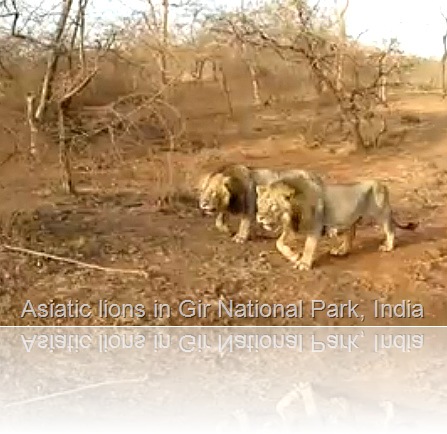
It now only occupies the Gir Forest sanctuary in north east India, in the state of Gujarat. The Red List says that this isolated population extends beyond the boundaries of the sanctuary.
This sanctuary is 617 square miles in area (1,598 km²). The habitat is a dry teak forest. Teak is replanted by the authorities as logging takes place.
Please see lion habitat for more on the distribution of the Asiatic lion and the lion generally as at late 2009.
History Notes
In 1832 there were a couple of Asiatic lions inhabiting the Tower of London the well known landmark in the east side of central London, England. These lions, brother and sister, were the offspring of two lions, father and mother shot by General Watson. It was 1823 and the general was on horseback with his double barrelled rifle. He was approached by a male Asiatic lion and he shot it dead. The female approached and he wounded her. He followed her back to her den and shot her dead. There were two young cubs, which he took and raised them with the aid of a donkey. He shipped them back to England as a gift for the King, Henry I, who had them confined to the Tower of London.
The brother and sister mated and produced three cubs on 20th October 1827. They were the first to be born at the Tower since 17942.
In the Middle Ages lions were kept in menageries in Europe. In England the King’s menagerie was in the Tower of London. Apparently he discontinued this practice in 18402.
Threats and Conservation
The population is considered stable although this lion is critically endangered per IUCN Red List of Threatened Species™:

Threats11:
- falling down wells (there has been a campaign to cover 13,5003).
- as the entire population of Asiatic lion is in one place there is a risk of a catastrophic loss of numbers through fire or epidemic.
- poaching. Poaching is a problem for the Bengal tiger in India. Poachers who would take the tiger are now going for lion. This maybe because it is easier to find. The Bengal tiger is extirpated in some tiger reserves. They are hard to see and find even for poachers.
- is inbreeding a problem? I am not sure. The population of lions is low. Is it a sustainable population? Inbreeding causes low fertility.
Conservation11 consists of protecting the lions in the Gir Forest and establishing a second population as described above. Update: this initiative has progressed. Please read this page for more.
There was a previous failed attempt at establishing a second population in Chandraprabha Wildlife Sanctuary in eastern Uttar Pradesh. The lions were lost – shot or poisoned.
The Asiatic lion is listed under CITES Appendix I. CITES in relation to Cats. See IUCN Red list in relation to cats.
References:
1. Pocock RJ 1939 The fauna of British India, including Ceylon and Burma in Wild Cats Of The World (WOW) by the Sunquists 2002.
2. Historical and descriptive account of British India, from the most remote …By Hugh Murray, James Wilson, Robert Kaye Greville, Robert Jameson, Sir Whitelaw Ainslie, William Rhin – 1832.
3. The Times newspaper, page 35, 29th April 2010.
4. http://en.wikipedia.org/wiki/Asiatic_Lion
5. http://medical-dictionary.thefreedictionary.com/tympanic+bulla
6. http://en.wikipedia.org/wiki/Post-orbital_constriction
7. http://www.merriam-webster.com/medical/infraorbital%20foramen
8. Genetic variation in Asiatic lions and Indian tigers – Pattabhiraman Shankaranarayanan, Moinak Banerjee, Raj Kumar Kacker, Ramesh Kumar Aggarwal, Dr. Lalji Singh.
9. Wildcats Of The World by the Sunquists.
10.Nowell K, Jackson P (1996). “Panthera Leo” (PDF). Wild Cats: Status Survey and Conservation Action Plan. Gland, Switzerland: IUCN/SSC Cat hi ialist Group. pp. 17–21. ISBN 2-8317-0045-0. http://carnivoractionplans1.free.fr/wildcats.pdf
11. IUCN Red List of Threatened Species™
From Asiatic lion to wild cat species


Hi Wadan Khan, thank you very much for telling us about these lions. This is an amazing story. The best book on wild cats ‘The Wild Cats Of The World’ says that the lion was widely distributed in the Middle East until 200 years ago! So on that basis the lion was in Afghanistan over 200 years ago. But not since.
There is nothing on the internet except a false claim that some US soldiers shot a lion with a Photoshopped picture.
I have never heard of lions in Afghanistan. But you are in Pakistan and closer to the what is going on.
What I will do is write a short article about it and hope that it gets noticed.
Thanks once again for commenting.
Update: here is a post on this lion.
To whome It may concern
I am Wadan Khan from Quetta Pakistan I always loved animals from my child hood and I still love them now and I am these days so much concerned about the wild life of Pakistan especially in our home villige. I also love Afghanistan so much as we have the same culture language and history.Like 5 years ago I heard about a man in Quetta (city I live in) has pair a of lions male and female lions and people say that they were gifted to him by Ahmed shah mahsood in Afghanistan and were caught when they were cubs in Afghanistan as wild lions but I have searched a lot about that is there any wild lions in Afghanistan as we all know the Afghanistan is also one of the historic distribution of lions but I have found nothing but I have seen those lions with my eyes and the male died last year but the female is still alive I am so much concern that they may belong to the land of afghanistan so they should be restored It is some thing precious and I think If it is true that these lions were caught in Afghnistan so they should be different in DNA and other characteristics then those of african and asian lions. please do some thing I am 17 but I will do every thing to help you for that lion I am wating for your reply. Every body so far beliefs they were caught in Afghanistan.Please I hope you will take a step atleast If you cannot do any thing or believe in it just share it with some one.