
- Introduction
- History
- Description
- DistributionBehavior
- Social Organisation
- Reproduction and Development
- Socialisation
Introduction
On this page I look at domestic cats from a different perspective, not as a breed of purebred cat or as a random bred cat but as a domesticated wild cat. It is a look at this species of animal from a more scientific point of view, as if I was looking at one of the wild cats. It is interesting and useful to see perhaps the most popular companion animal in this light. It allows us to stand back and see the bigger picture and to put things into context.
We can almost forget that domestic cats are tamed wild cats. Yes, they have evolved since being domesticated about 9,000 years ago in the Mediterranean basin but it doesn’t take much (a climb through the cat flap) for our cute domestic cat companion to return to its wild roots.
Many animals were tamed and domesticated before the wildcat (Felis silvestris), which is a small cat (Felinae) that is native to Europe, the western part of Asia, and Africa. I am thinking of horses, goats, sheep, cattle, chickens etc. and of course the dog. It is thought that the dog was domesticated about 12,000 years ago. This is 3,000 years before the cat.
In the top 10 cat and dog owning countries cat populations outnumber dog populations (204m to 173m)1. At 2002, there were more domestic cat than dogs in the USA2. In 1997 there were about 70.2 million cat companions and 55.9 dog companions in the USA.
This page does not overlap with other pages on this site. You can read about other aspects of the domestic cat on many hundreds of pages of this site for instance. Please just check the navigation bar to the left of this page.
History
I must mention cat history as it has been a long and sometimes unpleasant journey. I am thinking of the middle ages. I cover all of this on the cat history page.
Description
On this website we can see a large number of cat breeds (well over 100). The range of coat types, textures and patterns are enormous and sometimes startling. Some 200 years ago the situation was very different with no formal cat breeds. This was well before the cat fancy started in the late 1800s. The cat fancy has expanded the number of cat breeds and ‘refined’ the cat’s appearance greatly. That said, most of the cats of the world have some sort of tabby coat as it is closest to the wild agouti pattern3.
We see the word ‘agouti’ a lot in the cat fancy. The individual hair strands are banded with different colours that include brown, black, white and grey.
The striped tabby of the African wildcat is thought to be the coat from which today’s domestic cats have evolved either naturally or through selective breeding4. Selective breeding means the creation of a cat appearance by selecting which cat to breed with which cat. It requires a good knowledge of cat genetics including the health implications.
The beginning of the cat fancy and the concept of breeding and creating cats that we liked followed on from Darwin’s Origin of Species published in 1859. One of the objectives was to improve the breeds but I wonder if that objective has been attained?
The modern cat breeds are essentially founded upon two types of cat with body conformations that are very different. One is what is called ‘cobby’ meaning stokcy and the other type is what the cat fancy call, ‘foreign’ type meaning slender, more light weight (cat body types). The former is a body built for colder, Nothern European climates. These stocky cats also have thick double or triple coats. The European wildcat, a good example of which is the Scottish wildcat, has a similar underlying appearance to these breeds.
The latter, foreign type with single close to the body coats are from the warmer, southern European climates. These cats also have long limbs and larger ears inline with the appearance of the African wildcat.
A comparison of the African and wildcats shows us the fundamental difference:

All the cat breeds are, of course, one species of cat namely the domesticated wild cat.
Although each cat breed is very distinct from another in terms of pedigree (parentage), they can be similar or very similar in terms of appearance and their separation from each other. It has got quite crowded if you like because of the large number of breeds. The more crowded it is, the more difficult it is to separate the breeds. Sometimes the degree of separation is the length of the hair and nothing else (e.g. the Siamese and Balinese cats) or the number of coat colours and patterns allowed under the breed standard (Siamese and Oriental Shorthair). In the case of the Thai cat this is different from the Modern (extreme foreign type) Siamese only by its body conformation. The Thai is less slender than the modern Siamese but more slender than the traditional Siamese. The Siamese is a good example of how the cat fancy has carved out several breeds from one. The page on different cat breeds covers this ground in a bit more detail.
The dog, however, has been developed for longer and the range of sizes for dogs is much larger than for the cat. There is always, though, the danger of over breeding for appearance to the detriment of health, while not emphasizing enough character.
Distribution
The eastern Mediterranean is the probable site where domestication of the wildcat first took place which includes Egypt, where the African wild cat was domesticated.

Mediterranean basin the origin of domestic cats – Wikimedia commons file.
From this area domestic cats accompanied people on their travels. And we know about ships cats. A good number of domestic cats travelled far afield on ships. I recall the long hairs from Europe that are the founders of the famous Maine Coon cat and the shorthaired cats of England that were the founders of the American Shorthair. There is also the importation of cats from Britain to Australia, New Zealand and Tasmania. Australia now feel that they have a feral cat problem that threatens native wildlife. In parts of Australia the feral cat can be legally shot. See: Vet says keep cats in and Ground shooting of feral cats in Australia.
Another example of unwelcome exportation is that of the extermination of native species on small islands such as the Galapagos and other islands off New Zealand and Australia.
However, for me, there are conflicting reports of how domestic and feral cats kill bird life on continents and in countries. The bird conservationists produce reports that support massive damage to bird life while other reports reach different conclusions. See for example: How Feral Cats Affect Wildlife and Domestic Cats Do Not Decimate Bird Populations. Cats prefer rodents and small mammals (and sometimes adult rabbits). Birds do not figure prominently in domestic cats’ diets except on [small] islands3.
There is a nice section on the distribution of the domestic cat from eastern Mediterranean that went on to create cat breeds on this page: Cat genetics the cat breeds.
Genetic analysis shows that the distribution of the classic blotched tabby in Europe started from Britain and is mainly found in central Europe and Germany. The canal systems were used to distribute the domestic cat it is thought5.
Behavior
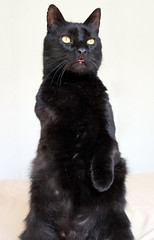 Domestic cats are adaptable, generalist (in terms of prey), specialist (in terms of hunting) and opportunistic predators. They have fitted nicely into domesticity but it is said they can easily revert to the wild and a feral life3. Once upon a time that may have been true when cats were less domesticated. However, the domestic cat is becoming more domestic. I read many stories of abandoned domestic cats starving and simply failing to survive in the wild; hardly an instant reversion to wildcat status.
The spread to all parts of the world with their human companions together with the cat’s adaptability and survivability has caused what some consider to be a feral cat problem. We must remind ourselves that if there is a ‘problem’ it is of our making.
Domestic cats like their wild cat counterparts adopt a very stealthy approach to hunting. When hunting ground animals such as rodents it will patiently sit and stare at the mouse’s burrow and continue to wait when the mouse appears until the mouse has moved sufficiently from the hole to be caught with a rush.
Update: A special page on Cat Behavior has been built if you would like to read lots more on the subject.
Birds require a different technique. Along the lines of wild cats (I am thinking of the caracal, a great bird hunter!) domestic cats approaches as near as possible. The belly is close to the ground. There are pauses and a fierce concentration. The eyes are focused sharply on the prey at all times. The ears are pricked and point forward. The tail swishes side to side sometimes. This last piece of behavior may be because the cat is hunting in an unnatural environment that is too open and which does not provide enough cover. This creates a uncertainty about success. The tail wagging is a form of displacement behavior. Sometimes a cat will move its head from side to side. This is using its binocular vision to best effect, to judge the distance between it and the bird. Then comes the final act, the attack, pushing off with its powerful hind legs, it is quick. The cat will grab the bird with it forelegs and swiftly bites into the nape of the neck (the back of the neck). The sensitive whiskers might assist in the dark to feel the exact spot on the spine where the canine teeth are inserted to severe the spine and kill the bird. It is all highly efficient. Cats catch birds on the ground (unlike the caracal that can catch them in the air), which means that, as mentioned, cats generally prefer rodents as they are easier to catch. On small equatorial islands feral cats prey on reptiles as well3.
But lets not get carried away. My cat has never attacked a bird! Maybe I feed her too well. But domestic cats vary enormously in their desire and ability to hunt. Some cats never hunt while others bring in a succession of prey for us to admire. Cats learn to hunt through a variety of experiences and not just through play. Early experiences prove to be useful. Kittens learn by watching parents or another cat. If the cat observed is familiar the kittens learns more efficiently26. Kittens tend to imitate mother’s preferences in prey and taste in food.

In a survey6 the top prey animals of domestic cats in a village in England were as follows:
- Wood mice – 17%
- Sparrows – 16%
- Field Voles – 14%
- Common shrews – 12%
Cats have a well known self righting mechanism when they fall. It is very impressive and results in a high survival rate even when falling from great heights. In fact there is an optimum height at which survival and lack of injury is maximised. I discuss this further here: Cat Falling.
Social Organisation
Wild, feral and domestic cats have home ranges. These are the areas that we would call their territory. Altough it is said that a cat’s territory is smaller than its home range – see cat marking territory. These areas vary hugely. The snow leopard has the largest ranges sometimes extending to hundreds of square kilometres. At the other end of the spectrum is the domestic cat confined to an apartment. The range for this cat might be several hundred square feet.
For domestic cats, stray cats and feral cats their home range or land tenure system varies with the availability and supply of food. The same can largely be said about the wild cats too. Except that we are the ultimate source of food for the various forms of domestic cat.
Domestic cats by definition are dependent on us and when feral they are often feral in urban environments. Food, therefore normally originates from us in one form or another. For feral cats the social system is dictated by the amount of food available and the reliability of it supply as this is the root of survival.
As food supplies vary enormously the social organisation of feral cat colonies also varies as they adapt to the food supply. There are have been some interesting studies that support this.
In reality home ranges are often artificially restricted by unsurpassable boundaries such as is the case for indoor cats or cat enclosures. When the boundaries are dictated by food supply male cats have larger home ranges than females. Female home ranges are from 0.1 of a hectare7 (one hectare = 2.47 acres) to 270 hectares8. The former was at a Japanese fish offal dump and the latter was in Australia. In these same locations male home ranges were 0.31 hectares7 to 900 hectares which is 9 square kilometres8. This is an area that is similar to that of some medium sized wild cats.
The home range of male domestic cats is also dictated by availability of females in the mating season. In the mating season the male range is greater to ensure access to more females. Breeding male home ranges are 3 – 4 times larger than those of females9.
As mentioned domestic cats are adaptable and they reflect the lion’s pride sometimes when living in groups under the right conditions, which translates to food availability. Such availability might be near garbage dumps for instance. Living in groups leads to a hierarchy and that in turn leads to dominance through aggressive actions. Lower ranking cats use a tail up signal to communicate that an affiliation is requested rather than conflict. Tail up is also a sign of lower status when greeting. This behavior is reflected in lion prides.
In another mirror of lion behavior, several male domestic cats take turns in sharing a female in heat to mate with11. The boss cat is probably an older male. Fights are apparently not as frequent as we might think. Female domestic cats also mimic lion behavior where there is a group of related cats. These groups are stable and they are hostile to outsiders. The females also tend to be in heat at the same time which promotes group caring and support. Group living however facilitates the spread of infectious diseases but it helps females protect young from infanticide committed by males10. When this has been seen it most often involves solitary mothers and their kittens.
Sometimes females raise young alone and sometimes there is group cooperation when the mothers are closely related12.
Males leave the group when sexually mature3. The ranges of several males might overlap and include the range of the group of females3.
Scent marking is part of cat communication. Other than olfactory communication there are the visual and vocal forms. Studies suggest that stray and feral cats use scent marking. Scent marking is spraying urine horizontally against objects that are likely to be bumped into by other cats that are within their home range. It is a way of time sharing a range if the home range of males overlap. Scent marking can indicate when the cat was there by its change in odor13.
Males scent mark more frequently than females. And dominant males scent mark more frequently than subdominant males. Females spray more frequently when in heat to attract males14.
Photo: by fofurasfelinas
More reading: Domestic cat territory.
Reproduction and Development
Female domestic cats have several estrous cycles during a single breeding season. Sexual activity seems to be governed by the amount of time that she is exposed to light on a daily basis15.
In the northern latitudes (presumed latitudes above the equator) the breeding season is early spring. Other examples are:
See also: Kitten development.
The timings are best presented in a table as follows:
| Event | Timing |
| Female cats become sexually mature | 7 – 12 months of age21. |
| Estrous cycles | 15 day intervals during the breeding season. |
| Duration of estrus | 4 days |
| Number of males attracted during estrus | Up to 20 males12. Some litters have more than one father17. |
| Number of males who can inseminate female | Up to 1018. |
| Number of litters per year | Normally 23. |
| Gestation (pregnancy) | 63 days. See cat pregnancy. Cats have individual tastes on the suitability of a birth den. Feral cats use a safe, out-of-the-way place. |
| Delivery times | 1 – 15 minutes – highly variable. Mother removes transparent membrane surrounding new born. She licks kitten dry3. |
| Litter size | 1 – 1019 (average = 4 or 520, max = 13) |
| Weight of kittens | 90 – 11023 grams at birth (3% of mother’s weight). Or 110 – 125 grams22. Kittens normally double birth weight in a week, 3x birth weight in 2 weeks, 4X in 3 weeks. See kitten weight. |
| At birth | Kittens have closed eyes, the ears are flattened and hearing is poor. Temperature is very important24 and their sense of smell and touch. |
| Kitten finds a nipple | Within one hour of birth. Kittens take ownership of a particular nipple. This creates harmony. Kneading encourages milk flow. Kittens spend up to 8 hrs per day suckling. Mother doesn’t leave nest for first 48 hrs. Mother licks bottom to encourage defecation. Colostrum: 8 times more protein than human milk & 3 times more fat3. |
| Who initiates sucking? | First 3 weeks: mother. Thereafter the kittens3. |
| Kittens open eyes | Between 2nd and 16th day after birth25. |
| Kitten’s teeth emerge | Just before 2 weeks of age. Adult teeth appear at 3.5 months of age. See Cat Teeth. |
| Kitten walks | During 3rd week. |
| Kitten plays | About 4 weeks of age. |
| Kittens regulate their own temperature | At 7 weeks of age. |
| Feral cat feeds kittens prey | At 4th week. Most kittens are weaned by 7 weeks of age. Kitten may still nurse though. |
| Feral kittens kill mice | At 5 weeks old. Kittens can run |
| Cat becomes sexually mature | 7 – 12 months of age27. |
| Cat age | How Long Do Cats Live? |
Socialisation
Socialisation of domestic cats is vital if they are to be successful domestic cats. Breeders, particularly of the wildcat hybrids, make a point of maximising socialisation.
There is a sensitive period between two to seven weeks of age during which kittens that are handled properly become better socialised and more willing to be handled by us25.
The acceptance of being handled by one person (say the breeder) is transferable to a new or different human caretaker. This has to be the case as kittens are not adopted until the 8th week of life when the kitten has been naturally weaned.
Feral cats can be tamed but it is time consuming.
References:
1. https://pictures-of-cats.org/Cats-vs-Dogs.html
2. Pet Food Institute in Washington DC
3. Wild Cat Of The World by the Sunquists
4. Bradshaw JS 1992 The behaviour of the domestic cat
5. Todd NB 1977 Cats and Commerce
6. Predation by domestic cats in an English village P. B. Churcher 1 , * and J. H. Lawton 1 , ** 1 Department of Biology, University of York, Heslington, York YO1 5DD *Bedford School, Burnaby Road, Bedford MK40 2TU
7. Izawa M 1984 Ecology and social systems if the feral cat – dissertation.
8. Jones E and Cosman BJ 1981 Ecology of the feral cat…in south-eastern Australia.
9. Liberg O 1981 Predation and social behavior in a population of domestic cat: An evolutionary perspective.
10. MacDonald DWP et al – Social dynamics, nursing coalitions and infanticide among farm cats.
11. Packer CDA et al – A molecular genetic analysis of kinship and cooperation in African lions.
12. Natoli E and de Vito E 1988 – The mating system of feral cats living in a group.
13. Cat Watching – Desmond Morris
14. Mellen JD A comparative analysis of scent marking, social and reproductive behavior in 20 species of small cats.
15. Kitchener A 1991 – The natural history of the wild cats.
16. Liberg O 1983 – Courtship behavior and sexual selection in the domestic cat.
17. https://pictures-of-cats.org/tomcats-and-genetics.html
18. Passanisi WCD et al – 1991 – Wild cats and feral cats. In Great Cats…
19. Robinson R abd Cox HW 1970 Reproductive performance in a cat colony over a ten month period.
20. Deag JM et al – Factors influencing the mother-kitten relationship….
21. Hemmer H 1979 – Gestation period and postnatal development in felids.
22. https://pictures-of-cats.org/kitten-weight.html
23. Leitch J et al – 1959 – The maternal and neonatal weights of some mamalia.
24. Cat Owner’s Home Veterinary Handbook by Drs Carslon and Giffin
25. Martin P and Bateson P 1988 Behavioral development in the cat – The Domestic cat: The biology of its behavior.
26. Caro TM 1980 The effects of experience on the predartory patterns of cats.
27. Hemmer H 1979 Gestation period and postnatal development in felids.


Good thinking Kylee. There are plenty of beautiful moggies around who come to us for a home. We can’t deny them. There is no place for a pedigree cat while there are hundreds of thousands of unwanted non-pedigree cats.
i just love the domestic cats. All my animals are all domestic cats or moggys i refuse to buy a pedigree cat as i believe moggys and domestic cat gets such a hard time at life