

Neutering cats – Romanino, Scene of a cat castration,
1531-32, Castello del Buonconsiglio, Trento
Photograph by Wikipedia® user:Laurom – license

Contents:
Introduction – neutering cats
The Neutering of cats refers to desexing either gender of cat. However, breeders use the term to refer to the castration of male cats. Females are desexed by spaying and a desexed female, called a spay, is one that has had the operation.
The operation in females is called an ovariohysterectomy (see below). The operation for the males is called castration.
The term “Alter” is used by the cat associations/registries to refer to spayed and neutered cats as a class of cat to be judged at a show. This term is also used to refer to a spayed or neutered cat in a more general sense.
Cats that are “intact” are, as expected, individuals that have not been spayed or neutered.
A “queen” is an intact female and a “tom” is an intact male.
When cats are spayed or neutered some people will say that they are “fixed“.
The Argument for Neutering cats
There is a sense that neutering cats is cruel and interfering with what is natural. This seems a reasonable thought. Some people (erroneously) equate it with declawing. Perhaps in a different world it wouldn’t be necessary but with feral cat populations high and the euthanasia of feral cats huge (estimated 2.2 million annually in the US) it is the only practical and responsible step to take. At 1986 it was estimated that there were 500,000 feral cats in London.
The cat population can increase very quickly without some checks in place. Although there is a lot of exaggeration that demonizes the feral cat – how fast do cats breed? Female cats are fine mothers. Domestication of the cat has resulted in an increase in both the number of litters and the size of litters. Whereas annually the European Wildcat (the ancestor of the domestic cat – see early history) have one litter and 2-4 kittens, the domestic cat has three litters and 4-5 kittens.
On a simplistic calculation (but one that helps comprehend the scale of the “problem”), and calculating for the maximum figure a breeding pair of cats and their offspring could produce 65,536 cats in 5 years – update Nov. 2010: this is incorrect. See How fast do cats breed?
Without the more humane process of neutering cats nature will take its course and restrict population through starvation and disease (and human intervention – euthanasia). Which is better?
Not only is spaying an obligation that is a part of keeping a female cat, in order to control the population of the domestic cat, the operation is also beneficial to the cat as it lowers the risk of a mammary tumors (7 times more likely in intact cats), infections of the uterus, cancers of the uterus and ovaries. There is less risk of skin conditions that are caused by hormonal imbalance.
Male cats spray urine (marking) less than intact cats. And of course there is the obligation in respect of population control referred to above.
There is some downside to neutering, apparently. The Wikipedia author says that neutered males are at an increased risk of FLUTD and kidney stones.
It would seem that neutering cats put them at an increased risk of obesity. This could be because of decreased activity, reduced metabolism and eating more. These effects can be countered.
On the issue of the cost of the procedure some people think it expensive and that this puts them off having it done. My rather blunt answer to this is that if we cannot afford the cost of neutering cats we shouldn’t keep cats. Sometimes the people who can’t afford it are those who have several or more cats. That speaks for itself. Vets are highly qualified people with substantial overheads. I am sure that the cost of the operation is reasonable. Although it is argued that vets could do more to facilitate the neutering of cats.
Ovariohysterectomy – spaying – pictures
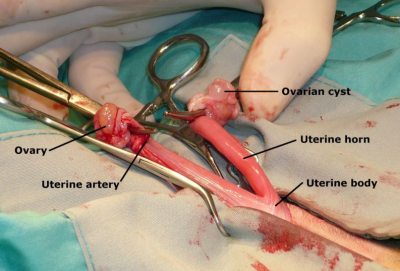
published under Wikimedia Commons license
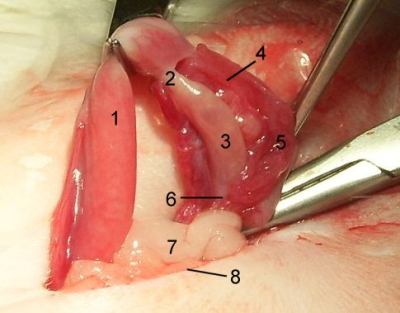
Spaying of a female cat. 1 uterus, 2 Ligamentum ovarii proprium, 3 ovary, 4 uterine tube, 5 mesosalpinx, 6 Ligamentum suspensorium ovarii, 7 abdominal fat, 8 incision wound (reproduced verbatim for accuracy from Wikipedia® – see licensing)
Neutering cats – Ovariohysterectomy – spaying – procedure in outline {thanks to www.cathospitalofchicago.com and www.thepetcenter.com.}
The Cat Hospital of Chicago says that spaying is best carried out on kittens and young cats.There are no noticeable side effects. Apparently there are fewer risks when the operation is performed on young cats and the procedure is simpler and the post operation recovery quicker. The hospital recommends that the operation is carried out on a cat that is between 3-6 months of age. They say that most shelters operate at a younger age than this which is acceptable. Sometimes the operation can take place when the kitten is only 6 weeks old. However, not all vets agree with this early operation, neither do some cat breeders. Some cat breeders sell kittens that are not neutered but withold pedigree paperwork until neutering takes place later. 4-6 months or 12 weeks minimum may be the agreed time frame for some breeders. Some breeders suggest altering at about 7 months of age.
The procedure involves the removal of the uterus and ovaries. I have summarized.
- A pre-anesthesia injection is administered to tranquilize and control pain.
- General anesthetic administered. Gas is more expensive than injections but preferable, it seems.
- Anesthetic monitoring devices attached and patient kept warm.
- Fluid is administered via a catheter to combat drop in blood pressure and dehydration.
- Patient is shaved and prepared for surgery.
- Surgery begins. Note: the Cat Hospital of Chicago take exceptional care of the patient before and during surgery through a meticulous approach to surgery.
- The surgeon makes an incision in the mid-abdominal region through the skin and then the muscle.
- The peritoneum is incised. The peritoneum is the membrane that lines the abdominal cavity.
- Surgery takes place, which is the excising of the body of the uterus and ovaries after a ligature (tied off to prevent bleeding) is placed on the relevant arteries.
- Post surgical procedure includes checking for bleeding and closing the incision made.
- Healing of the incision takes 8-12 days.
- Most cats are eating within 30-45 minutes of being taken from the operating table.
Neutering cats – Castration – oophorectomies
This sounds awful but male cats go home afterwards as if nothing has happened.
The procedure involves the removal of the testicles. This is it in outline:
- The cat is shaved, scrubbed and make antiseptic around the area to operated on.
- The scrotal skin is excised (cut). There is no bleeding.
- The testicle is pulled from the scrotum
- A suture is tied around the spermatic cord.
- The testicle is removed.
- The cord is returned to the scrotum and the antibiotic applied to the area.
- The scrotum does not need to stitched up
I don’t have a picture of a castration. You don’t want to see it anyway.
Orthodox Judaism seems to forbid castration in animals (what about spaying?) unless the situation is life threatening. But the Chief Rabbi has ruled that it is alright as it prevents cruelty to animals (I presume through overpopulation and feral cat problems, which is a real problem in Israel).
Islam has conflicting views it seems but neutering cats would seem to be permissible as it promotes the greater good.
I am told by a friend whose wife is Thai that in Thailand the citizens of the country tend not to spay or neuter their domestic cats because they believe it is bad karma. They believe that they will come back in another life perhaps as a cat and be persecuted. The cats in that country are not, if we are honest, treated that well. And clearly there are too many unwanted cats because they failed to spay and neuter them. Where there are unwanted cats, cat cruelty inevitably follows.
Neutering cats – experimental – ideas – future prospects – moral issues
At 18-10-08 there is some talk on the internet (not much though) of chemical castration for cats and dogs as a more effective means of controlling the feral cat population. All you’d have to do is put the chemical in food. Which means simply putting it in the food when feeding feral cats. Sounds almost perfect and very simple.
Apparently someone has put up a prize for a workable treatment. There lies the problem it seems. Chemical castration as it has been called has been practised on humans by Nazis on concentration camp victims during WWII. It has also been used in some USA States as a punishment of sex offenders and to protect the public. So some work has been done on this. But what kind of work.
I have not seen a medical treatment for cats. The problem is that although it seems to work there are side effects. This would make the process unacceptable. There are also moral issues. The control over the process that is built in during the conventional surgical process would be lost. The chemical could get into the wrong hands. There a lot of reasons why extreme caution would have to be exercised. Some people foresee Armageddon.
The bottom line is that the responsibility for neutering cats falls on us, the humans. Apparently about 14% of cats in the USA are unneutered (I don’t know if this figure is correct – I can’t verify it). That, though, is a good enough figure to cause a feral cat problem bearing in mind the breeding skills of cats. We need to tackle the people. This is the root of the problem. We need, I am afraid to say, to be tougher on “cat ownership”, make it more rigorous and less casual. There is a real responsibility involved towards the cat, primarily, and in regards to other people. Some people don’t sense this responsibility.
One last point: humans should also consider the level of procreation that they get up to. Human population is causing world problems. The ultimate reason for cat neutering is really as a result of human population growth, which is unmanaged except in China, where it doesn’t work. If we need to neuter cats we also need to think about what we do.
Cat Shows – appearance and behavior changes
When a cat has been neutered, male or female, and is being shown at cat shows they are categorized as “Alters”. Sounds a bit odd really. A bit unfair. There is more competition in this class than previously and it would seem that top quality breeding cats (the ones that make the future champions) are competing once their breeding days are over.
A buyer of a show quality purebred cat from a breeder that has or will be neutered or spayed will have to ensure the contract allows for the showing of the cat if that is the intention.
Why are spayed and neutered cats in a different class? Neutering cats affects both appearance and behavior. In fact a part of the reason for spaying and neutering is to change the behavior of cats so that it better fits in with our lifestyle (a questionable reason it could be argued). The behavior of cats is a factor in judging cats at shows.
It is difficult to find good clean data on appearance and character changes. Here is what I found out:
- there is a reduction in fighting, roaming and spraying in almost 9 out of 10 cats
- neutering cats significantly reduces male dominant and territorial aggression
- neutering/spaying does not affect fear or predatory aggression
- it would seem that neutering stops the development of the male secondary characteristics such as a thick neck and bulked up muscle. These should be allowed to develop before neutering if people want that in their males
- males change more than females after neutering/spaying
- neutered males are:
- more hygienic
- friendlier to other household cats
- tolerate handling better
- more affectionate
- more playful
- demand more attention
- less vocal
- less active
- spayed females are
- slightly more playful
- friendlier to other household cats
- tolerate handling better
- less vocal
- less active
There is no change for either sex on excitability and destructiveness. Between the sexes males, after neutering, are:
- very slightly friendlier to other household cats than females
- slightly easier to handle than females
- give a little more affection than females
{source: for this date immediately above: http://maxshouse.com}
Neutering cats — Associated pages:
- Cheap neutering is needed to contain the stray cat problem
- Neutering your cat causes the cat to put on weight
- Neutering Your Cat – an earlier post
- Early cat neutering – against
- Fixing Cats is Morally Wrong (opens new page)
From neutering cats to cat health problems
Published under Wikimedia® creative commons license license = Attribution ShareAlike license versions 2.5, 2.0, and 1.0. Wikipedia documents are published under GNU Free Documentation License, Version 1.2 or any later version – see Wikipedia license).
Click on this link to see the Wikipedia® License src: Wikipedia® published under GNU Free Documentation License, Version 1.2 or any later version, November 2002 Copyright (C) 2000,2001,2002 Free Software Foundation, Inc. 51 Franklin St, Fifth Floor, Boston, MA 02110-1301 USA – – no other conditions to the license are added.
- As stated in the text
- Cat Watching by Desmond Morris
- Wikipedia (figure on mammary tumors) and the photographs
- Cat Hospital of Chicago
- The Pet Center website
- http://maxshouse.com/effects_of_neutering.htm (good)
